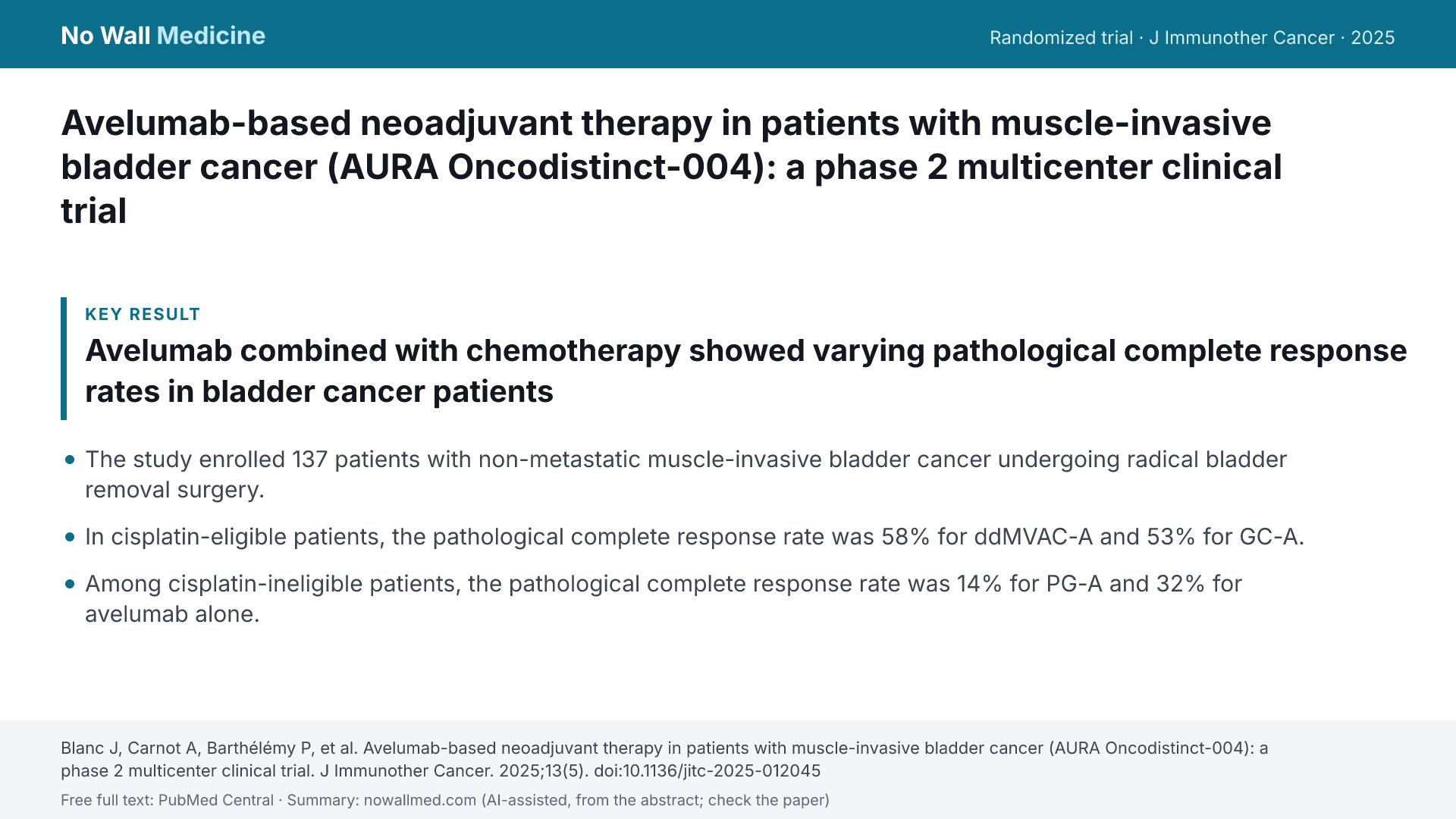
Avelumab combined with chemotherapy showed varying pathological complete response rates in bladder cancer patients
Avelumab-based neoadjuvant therapy in patients with muscle-invasive bladder cancer (AURA Oncodistinct-004): a phase 2 multicenter clinical trial
Phase 2 multicenter randomized trialMixed results
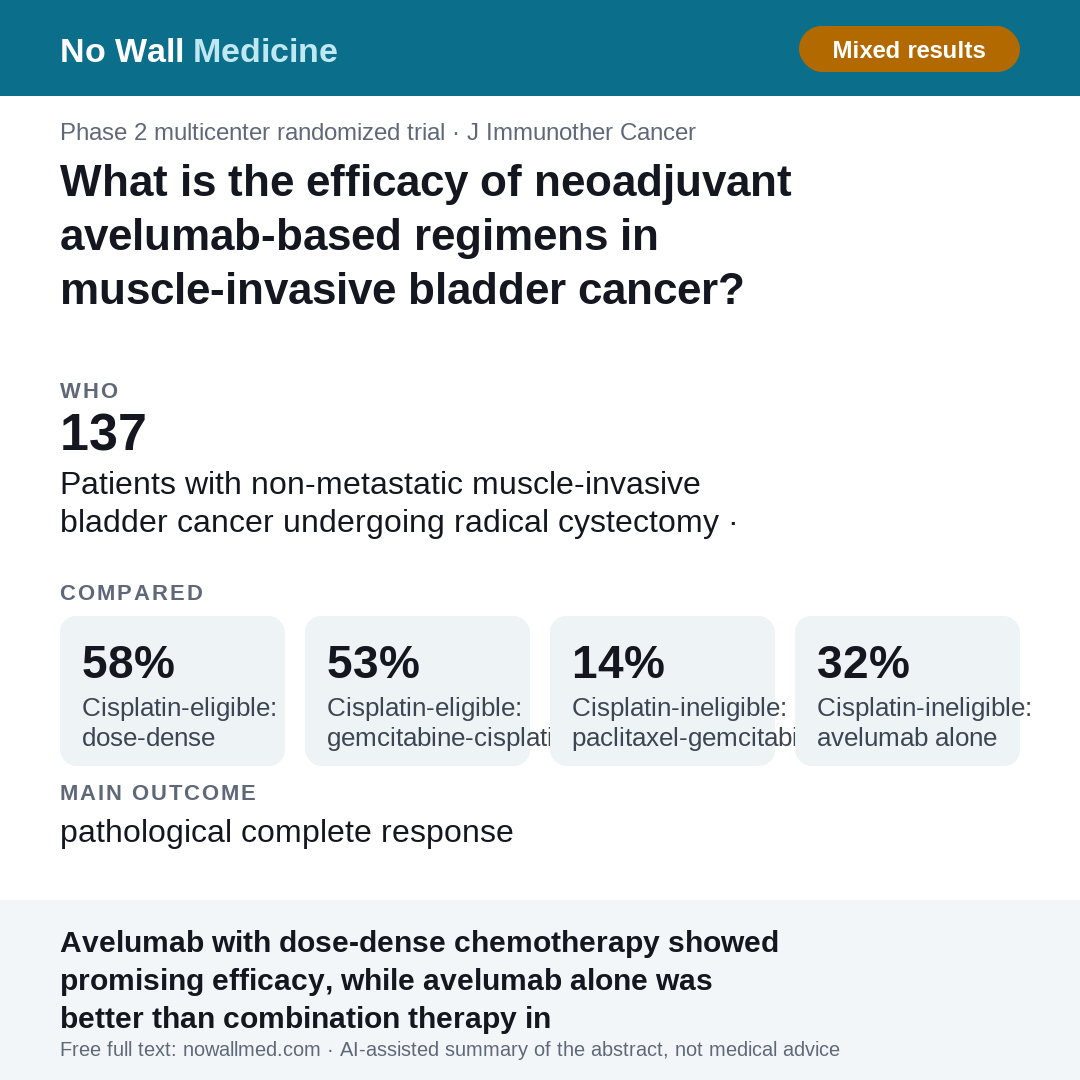
What is the efficacy of neoadjuvant avelumab-based regimens in muscle-invasive bladder cancer?
Who
137
Patients with non-metastatic muscle-invasive bladder cancer undergoing radical cystectomy · Multicenter
Compared
58%Cisplatin-eligible: dose-dense methotrexate-vinblastine-doxorubicin-cisplatin plus avelumab (95% CI: 42% to 72%)
53%Cisplatin-eligible: gemcitabine-cisplatin plus avelumab (95% CI: 37% to 68%)
14%Cisplatin-ineligible: paclitaxel-gemcitabine plus avelumab (95% CI: 6% to 31%)
32%Cisplatin-ineligible: avelumab alone (95% CI: 18% to 51%)
Main outcome
pathological complete response
Bottom line: Avelumab with dose-dense chemotherapy showed promising efficacy, while avelumab alone was better than combination therapy in cisplatin-ineligible patients.
J Immunother Cancer · 2025-05-24Download image
Clinical question: What is the efficacy of neoadjuvant avelumab-based regimens in muscle-invasive bladder cancer?
Why it matters: The optimal chemotherapy partner for combining immunotherapy with chemotherapy in patients with muscle-invasive bladder cancer remains unknown.
Key points
- The study enrolled 137 patients with non-metastatic muscle-invasive bladder cancer undergoing radical bladder removal surgery.
- In cisplatin-eligible patients, the pathological complete response rate was 58% for ddMVAC-A and 53% for GC-A.
- Among cisplatin-ineligible patients, the pathological complete response rate was 14% for PG-A and 32% for avelumab alone.
Headline and key points written with AI from the paper’s abstract, with every number checked against it. Read the paper before relying on them.
Was this summary helpful?
Abstract
Background
Immunotherapy is becoming a standard of care for non-metastatic muscle-invasive bladder cancer (MIBC). The optimal chemotherapy partner for chemo-immunotherapy combinations remains unknown. We evaluated the efficacy and safety of neoadjuvant avelumab-based regimens in patients with MIBC. Methods
The multicenter phase 2 AURA trial (NCT03674424) enrolled patients with non-metastatic MIBC undergoing radical cystectomy. Cisplatin-eligible patients were randomized to receive avelumab with either dose-dense methotrexate-vinblastine-doxorubicin-cisplatin (ddMVAC-A) or gemcitabine-cisplatin (GC-A). Cisplatin-ineligible patients received either avelumab alone (A) or combined with paclitaxel-gemcitabine (PG-A). The primary endpoint was pathological complete response (pCR). Secondary endpoints included safety, event-free survival, and overall survival (OS). Results
Between July 2018 and September 2021, 137 eligible patients were enrolled in the trial. In the cisplatin-eligible cohort (n=79), pCR rates were 58% (95% CI: 42% to 72%) in the ddMVAC-A arm and 53% (95% CI: 37% to 68%) in the GC-A arm. The 36-month OS rates were 87% (95% CI: 76% to 98%) for ddMVAC-A and 67% (95% CI: 53% to 84%) for GC-A. In the cisplatin-ineligible cohort (n=58), pCR rates were 14% (95% CI: 6% to 31%) in the PG-A arm and 32% (95% CI: 18% to 51%) in the A arm. The 36-month OS rates were 48% (95% CI: 33% to 71%) for PG-A and 42% (95% CI: 27% to 65%) for A. Overall, 51 (38%) patients experienced grade 3-4 treatment-related adverse events. Conclusions
Avelumab combined with cisplatin-based neoadjuvant chemotherapy showed promising efficacy in MIBC with a favorable safety profile, also with the ddMVAC regimen. Among cisplatin-ineligible patients, avelumab monotherapy showed encouraging activity, with no additional benefit observed from the PG-A regimen. These results support the use of the ddMVAC regimen as a potential chemotherapy partner for neoadjuvant chemo-immunotherapy combinations in future phase 3 trials, providing an alternative to the GC regimen currently under investigation. Trial registration number
NCT03674424.
Abstract reproduced under the article’s CC BY NC licence.
Subject terms
Cite this article
Blanc J, Carnot A, Barthélémy P, et al. Avelumab-based neoadjuvant therapy in patients with muscle-invasive bladder cancer (AURA Oncodistinct-004): a phase 2 multicenter clinical trial. J Immunother Cancer. 2025. doi:10.1136/jitc-2025-012045
Spotted a mistake? Suggest a correction