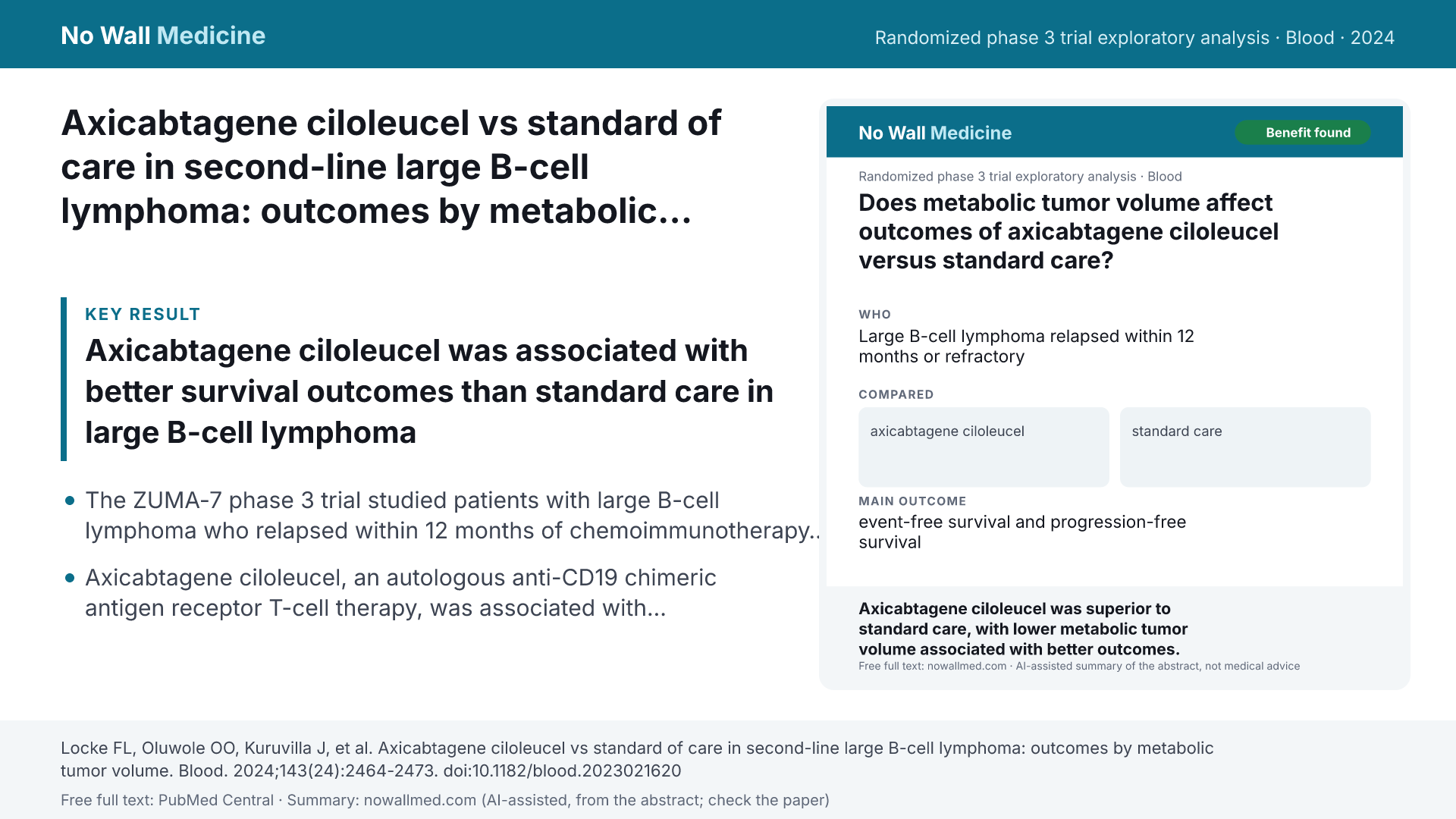
Axicabtagene ciloleucel was associated with better survival outcomes than standard care in large B-cell lymphoma
Axicabtagene ciloleucel vs standard of care in second-line large B-cell lymphoma: outcomes by metabolic tumor volume
Randomized phase 3 trial exploratory analysisBenefit found
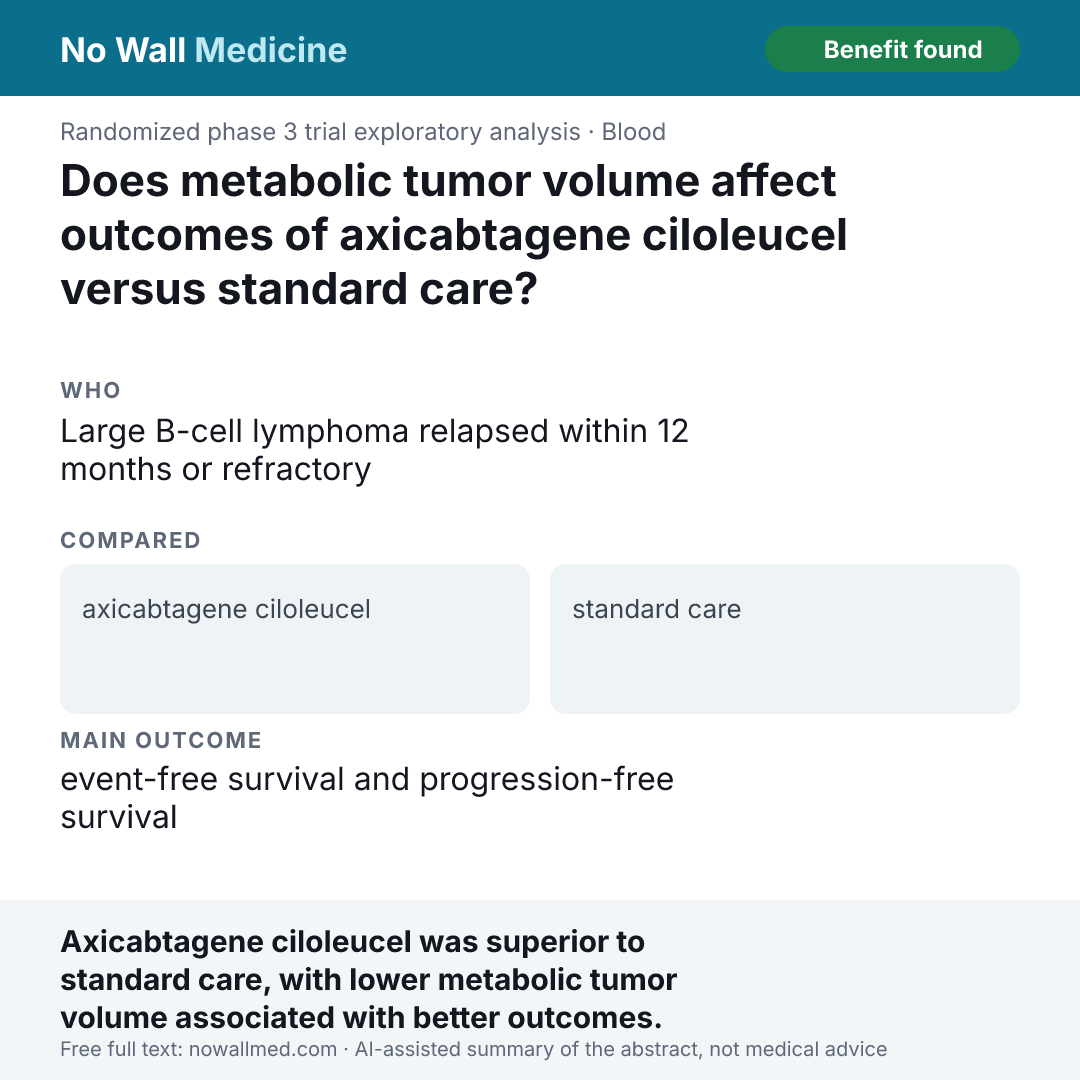
Does metabolic tumor volume affect outcomes of axicabtagene ciloleucel versus standard care?
Who
Large B-cell lymphoma relapsed within 12 months or refractory
Compared
axicabtagene ciloleucel
standard care
Main outcome
event-free survival and progression-free survival
Bottom line: Axicabtagene ciloleucel was superior to standard care, with lower metabolic tumor volume associated with better outcomes.
Blood · 2024-04-01 · NCT03391466
Same trial (NCT03391466)
Papers we list that report this registered trial, oldest first. Read a secondary analysis alongside the main results.
- Related report
Impact of tumor microenvironment on efficacy of anti-CD19 CAR T cell therapy or chemotherapy and transplant in large B cell lymphoma Nat Med 2024-01 - Main results Mixed results
Subsequent treatment outcomes for patients with large B-cell lymphoma after second-line therapy Blood Adv 2024-02 - Secondary analysis Benefit found
This paper Blood 2024-04
Headline and visual abstract written with AI from the paper’s abstract, with every number checked against it. Read the paper before relying on them.
Was this summary helpful?
Abstract
Metabolic tumor volume (MTV) assessed using 2-deoxy-2-[18F]fluoro-d-glucose positron emission tomography, a measure of tumor burden, is a promising prognostic indicator in large B-cell lymphoma (LBCL). This exploratory analysis evaluated relationships between baseline MTV (categorized as low [median or less] vs high [greater than median]) and clinical outcomes in the phase 3 ZUMA-7 study (NCT03391466). Patients with LBCL relapsed within 12 months of or refractory to first-line chemoimmunotherapy were randomized 1:1 to axicabtagene ciloleucel (axi-cel; autologous anti-CD19 chimeric antigen receptor T-cell therapy) or standard care (2-3 cycles of chemoimmunotherapy followed by high-dose chemotherapy with autologous stem cell transplantation in patients who had a response). All P values are descriptive. Within high- and low-MTV subgroups, event-free survival (EFS) and progression-free survival (PFS) were superior with axi-cel vs standard care. EFS in patients with high MTV (vs low MTV) was numerically shorter with axi-cel and was significantly shorter with standard care. PFS was shorter in patients with high MTV vs low MTV in both the axi-cel and standard-care arms, and median MTV was lower in patients in ongoing response at data cutoff vs others. Median MTV was higher in patients treated with axi-cel who experienced grade ≥3 neurologic events or cytokine release syndrome (CRS) than in patients with grade 1/2 or no neurologic events or CRS, respectively. Baseline MTV less than or equal to median was associated with better clinical outcomes in patients receiving axi-cel or standard care for second-line LBCL. The trial was registered at www.clinicaltrials.gov as #NCT03391466.
Abstract reproduced under the article’s CC BY NC ND licence.
Subject terms
Cite this article
Locke FL, Oluwole OO, Kuruvilla J, et al. Axicabtagene ciloleucel vs standard of care in second-line large B-cell lymphoma: outcomes by metabolic tumor volume. Blood. 2024;143(24):2464-2473. doi:10.1182/blood.2023021620
Spotted a mistake? Suggest a correction