Axitinib combined with octreotide increased progression-free survival in patients with advanced extrapancreatic neuroendocrine tumors
Axitinib and Long-Acting Octreotide in Advanced Extrapancreatic Neuroendocrine Tumors: A Randomized, Double-Blind, Placebo-Controlled, Phase III Clinical Trial (AXINET, GETNE 1107)
Randomized, double-blind, placebo-controlled, phase II/III trialBenefit found
Does axitinib plus octreotide improve progression-free survival in advanced extrapancreatic neuroendocrine tumors?
Who
256
Adults with unresectable or metastatic grade 1-2 extrapancreatic neuroendocrine tumors · international
Compared
16.6 monthsaxitinib and octreotide (95% CI, 13.5 to 24.2)
9.9 monthsplacebo and octreotide (95% CI, 8.2 to 13.9)
Main outcome
progression-free survival by blinded independent central review
Result: hazard ratio 0.71 (95% CI 0.54 to 0.94)
Bottom line: Axitinib plus octreotide significantly improved progression-free survival and objective response rate compared to placebo and octreotide.
J Clin Oncol · 2026-02-20Download image
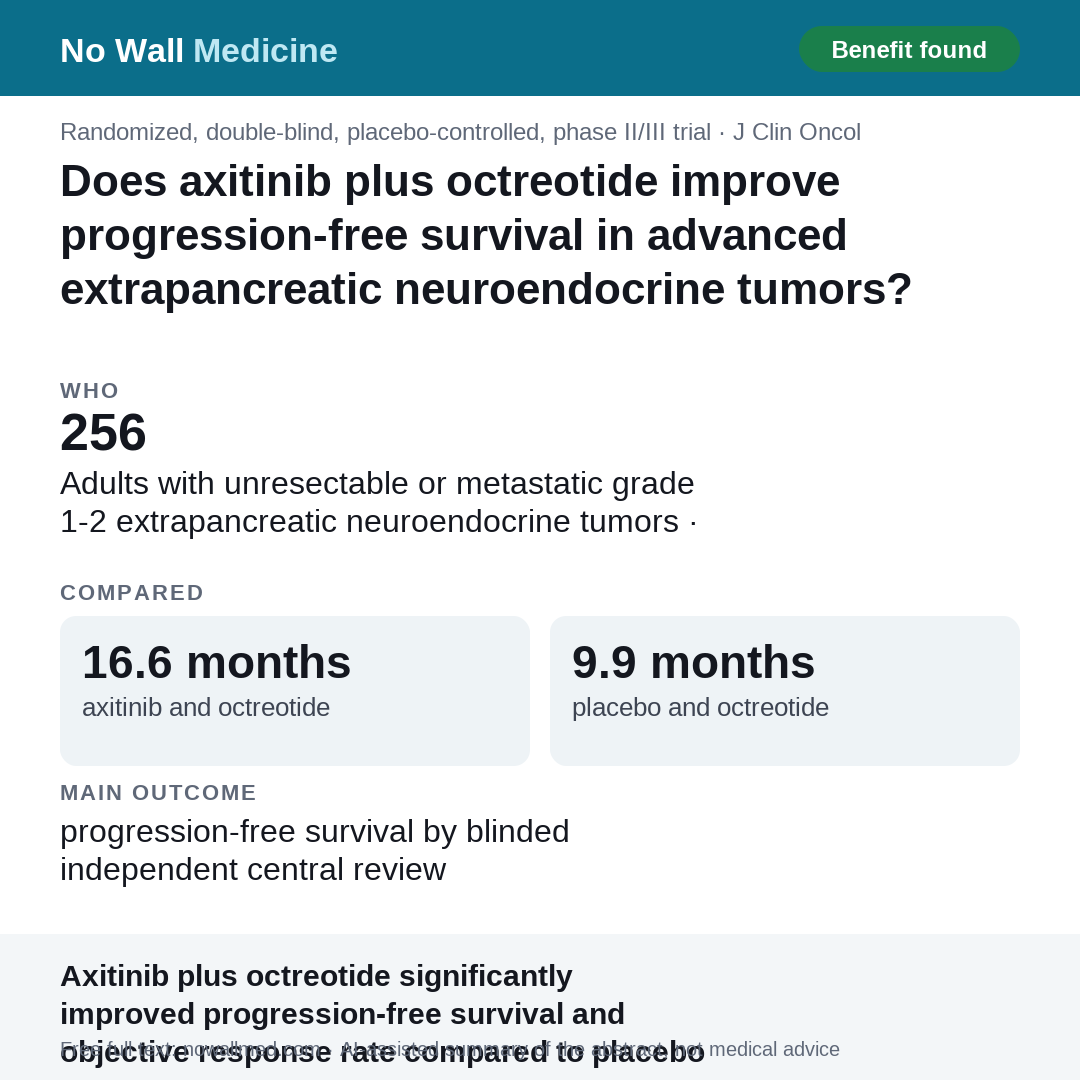
Clinical question: Does axitinib plus octreotide improve progression-free survival in advanced extrapancreatic neuroendocrine tumors?
Why it matters: Researchers sought to evaluate the efficacy and safety of axitinib in patients with unresectable or metastatic grade 1 or 2 extrapancreatic neuroendocrine tumors.
Key points
- The study compared 126 patients receiving axitinib and octreotide to 130 patients receiving placebo and octreotide for advanced extrapancreatic neuroendocrine tumors.
- Blinded independent central review showed median progression-free survival was 16.6 months for axitinib versus 9.9 months for placebo.
- The objective response rate was 12.8% for axitinib compared to 3.2% for placebo according to blinded independent central review.
Headline and key points written with AI from the paper’s abstract, with every number checked against it. Read the paper before relying on them.
Topics
Cite this article
Garcia-Carbonero R, Benavent M, Jimenez-Fonseca P, Alonso-Gordoa T, Teulé A, Custodio A. Axitinib and Long-Acting Octreotide in Advanced Extrapancreatic Neuroendocrine Tumors: A Randomized, Double-Blind, Placebo-Controlled, Phase III Clinical Trial (AXINET, GETNE 1107). J Clin Oncol. 2026. doi:10.1200/JCO-25-01808
Spotted a mistake? Suggest a correction