Azithromycin resistance in Salmonella Typhi and Paratyphi was estimated at 5% in South Asia
Azithromycin Resistance in Salmonella Typhi and Paratyphi Across South Asia: A Systematic Review and Meta-Analysis
Systematic review and meta-analysisNo clear difference
What is the prevalence of azithromycin resistance in Salmonella Typhi and Paratyphi in South Asia?
Who
30085
Salmonella enterica serovars Typhi and Paratyphi isolates · South Asia
Compared
5%Salmonella Typhi (95% CI: 4%-5%)
5%Salmonella Paratyphi (95% CI: 0%-9%)
Main outcome
Prevalence of azithromycin resistance
Result: 9% (95% CI: 3%-14%)
Bottom line: Overall azithromycin resistance is relatively low at 9%, but specific regions show higher prevalence.
Limitation: Interpretive criteria used by individual study authors were acknowledged.
Open Forum Infect Dis · 2026-09-12Download image
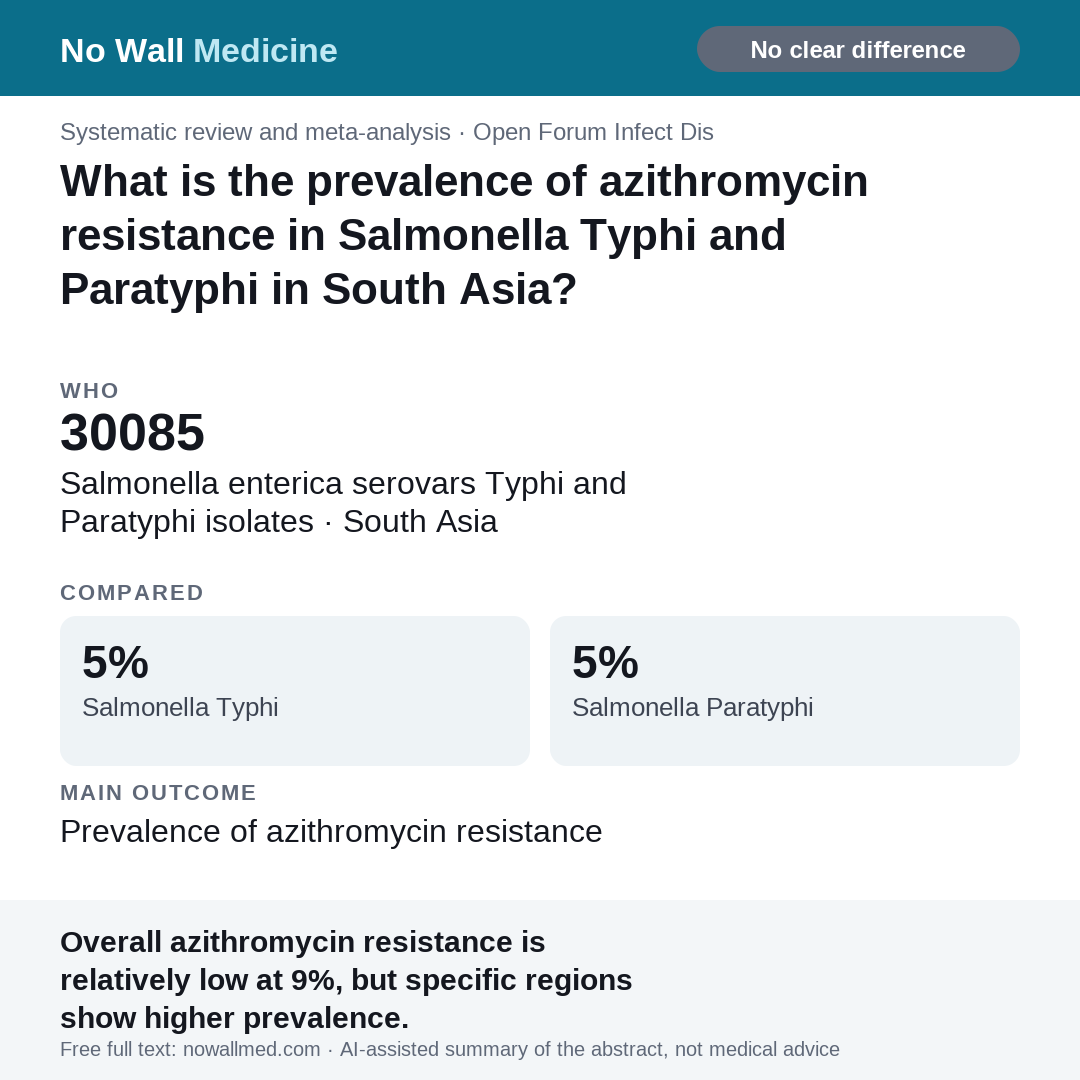
Clinical question: What is the prevalence of azithromycin resistance in Salmonella Typhi and Paratyphi in South Asia?
Why it matters: Emerging resistance in Salmonella Typhi and Paratyphi challenges the long-term efficacy of azithromycin as a frontline treatment for uncomplicated enteric fever in South Asia.
Key points
- Researchers analyzed 74 studies containing 30 085 isolates to estimate resistance to azithromycin, an oral antibiotic, in Salmonella Typhi and Paratyphi.
- The pooled resistance was 5% (95% CI: 4%-5%) for Salmonella Typhi and 5% (95% CI: 0%-9%) for Salmonella Paratyphi.
- When combining both serotypes, the overall prevalence was 9% (95% CI: 3%-14%), with Pakistan and India reporting the highest rates.
Headline and key points written with AI from the paper’s abstract, with every number checked against it. Read the paper before relying on them.
Cite this article
Ullah A, Jan A, Shabil M, Sayyed H, Khan MM, Akhlaq M. Azithromycin Resistance in Salmonella Typhi and Paratyphi Across South Asia: A Systematic Review and Meta-Analysis. Open Forum Infect Dis. 2026. doi:10.1093/ofid/ofag581
Spotted a mistake? Suggest a correction