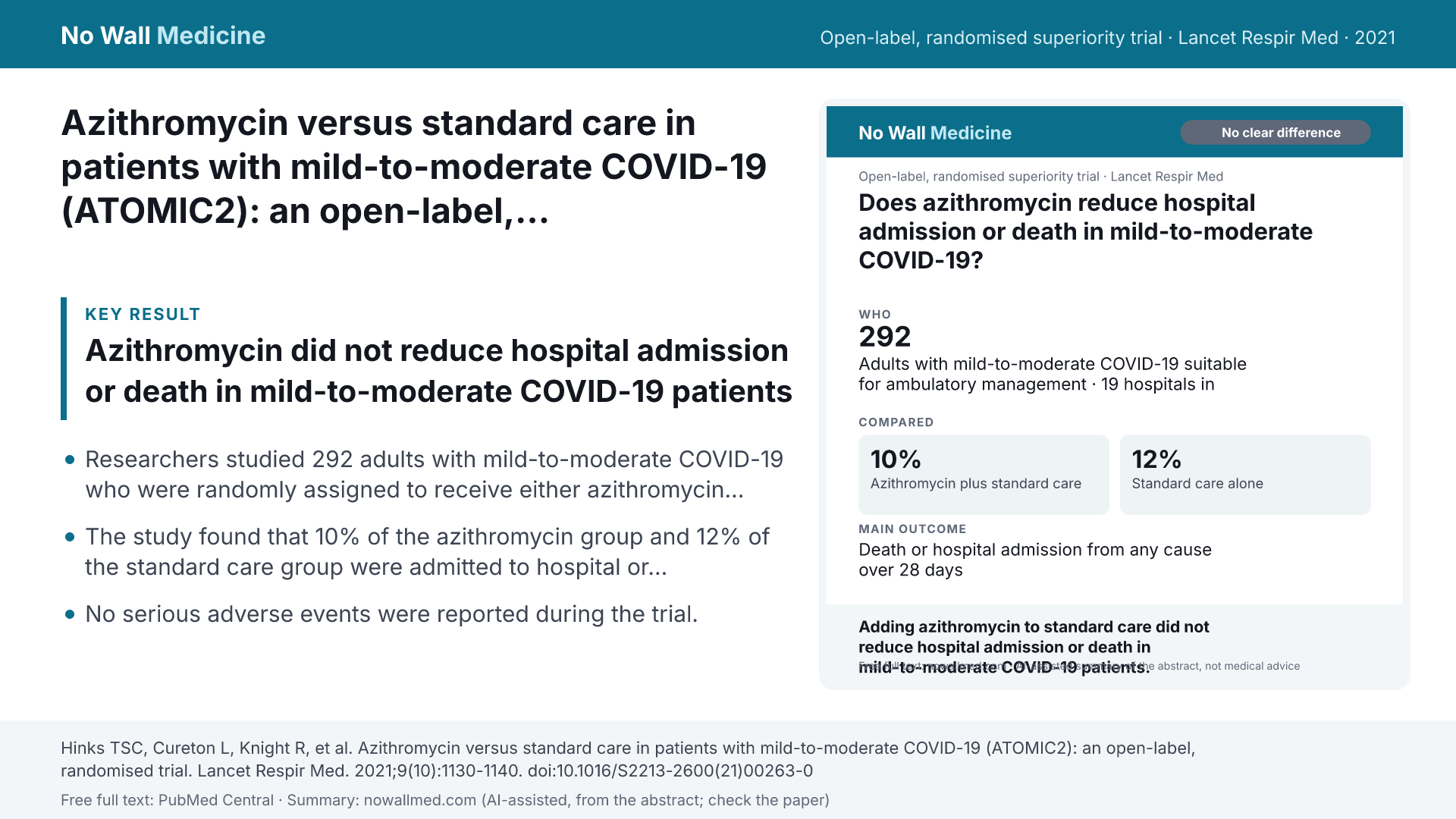
Azithromycin did not reduce hospital admission or death in mild-to-moderate COVID-19 patients
Azithromycin versus standard care in patients with mild-to-moderate COVID-19 (ATOMIC2): an open-label, randomised trial
Open-label, randomised superiority trialNo clear difference
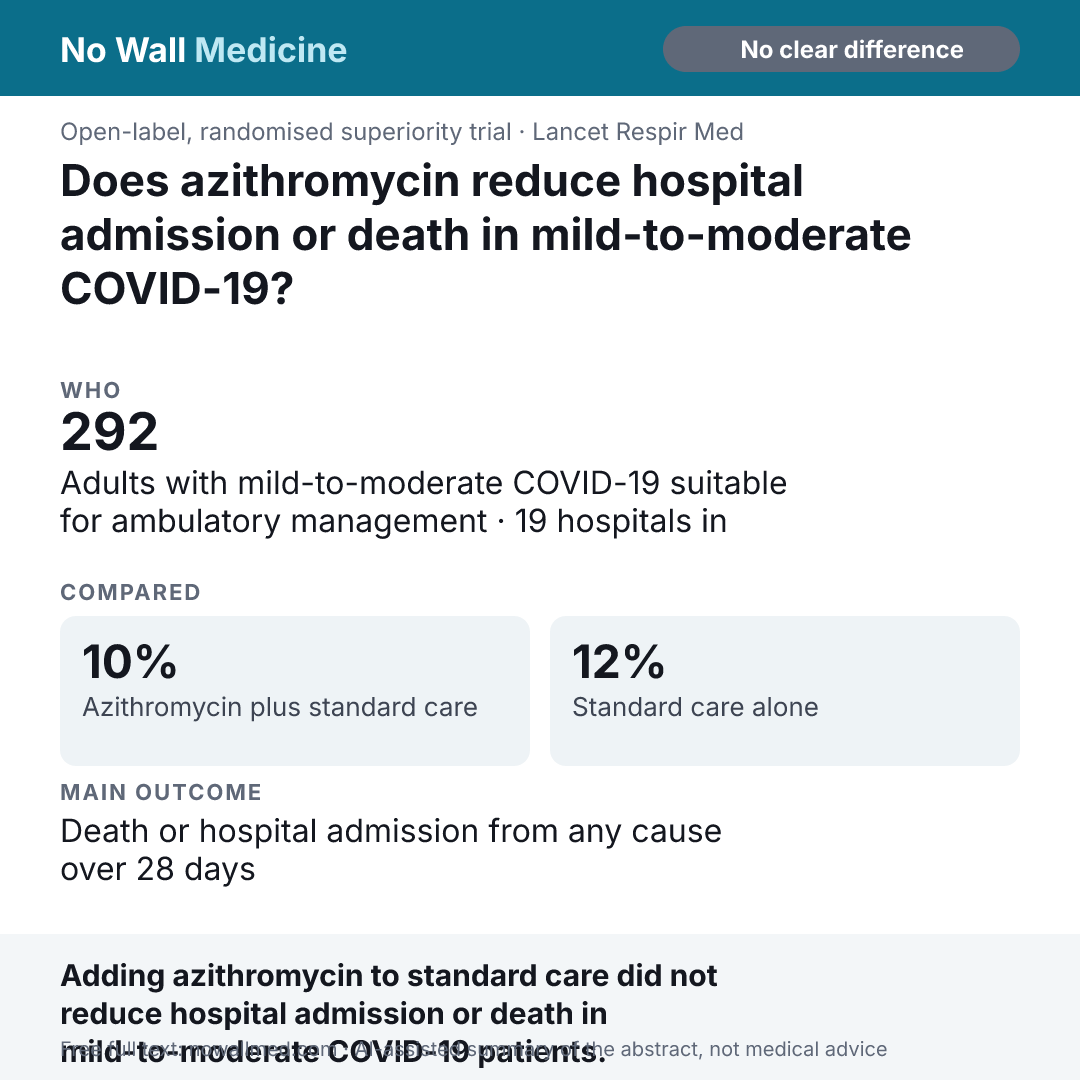
Does azithromycin reduce hospital admission or death in mild-to-moderate COVID-19?
Who
292
Adults with mild-to-moderate COVID-19 suitable for ambulatory management · 19 hospitals in the United Kingdom
Compared
10%Azithromycin plus standard care
12%Standard care alone
Main outcome
Death or hospital admission from any cause over 28 days
Result: adjusted odds ratio 0.91 (95% CI 0.43 to 1.92)
Bottom line: Adding azithromycin to standard care did not reduce hospital admission or death in mild-to-moderate COVID-19 patients.
Funded by: National Institute for Health Research, University of Oxford and Pfizer
Lancet Respir Med · 2021-07-09 · Save PNG
Clinical question: Does azithromycin reduce hospital admission or death in mild-to-moderate COVID-19?
Key points
- Researchers studied 292 adults with mild-to-moderate COVID-19 who were randomly assigned to receive either azithromycin plus standard care or standard care alone.
- The study found that 10% of the azithromycin group and 12% of the standard care group were admitted to hospital or died during the study.
- No serious adverse events were reported during the trial.
Headline and key points written with AI from the paper’s abstract, with every number checked against it. Read the paper before relying on them.
Was this summary helpful?
Abstract
Background
The antibacterial, anti-inflammatory, and antiviral properties of azithromycin suggest therapeutic potential against COVID-19. Randomised data in mild-to-moderate disease are not available. We assessed whether azithromycin is effective in reducing hospital admission in patients with mild-to-moderate COVID-19. Methods
This prospective, open-label, randomised superiority trial was done at 19 hospitals in the UK. We enrolled adults aged at least 18 years presenting to hospitals with clinically diagnosed, highly probable or confirmed COVID-19 infection, with fewer than 14 days of symptoms, who were considered suitable for initial ambulatory management. Patients were randomly assigned (1:1) to azithromycin (500 mg once daily orally for 14 days) plus standard care or to standard care alone. The primary outcome was death or hospital admission from any cause over the 28 days from randomisation. The primary and safety outcomes were assessed according to the intention-to-treat principle. This trial is registered at ClinicalTrials.gov (NCT04381962) and recruitment is closed. Findings
298 participants were enrolled from June 3, 2020, to Jan 29, 2021. Three participants withdrew consent and requested removal of all data, and three further participants withdrew consent after randomisation, thus, the primary outcome was assessed in 292 participants (145 in the azithromycin group and 147 in the standard care group). The mean age of the participants was 45·9 years (SD 14·9). 15 (10%) participants in the azithromycin group and 17 (12%) in the standard care group were admitted to hospital or died during the study (adjusted OR 0·91 [95% CI 0·43-1·92], p=0·80). No serious adverse events were reported. Interpretation
In patients with mild-to-moderate COVID-19 managed without hospital admission, adding azithromycin to standard care treatment did not reduce the risk of subsequent hospital admission or death. Our findings do not support the use of azithromycin in patients with mild-to-moderate COVID-19. Funding
National Institute for Health Research Oxford Biomedical Research Centre, University of Oxford and Pfizer.
Abstract reproduced under the article’s CC BY licence.
Subject terms
Headline, design, result, key points, caveat and citation as plain text.
Cite this article
Hinks TSC, Cureton L, Knight R, et al. Azithromycin versus standard care in patients with mild-to-moderate COVID-19 (ATOMIC2): an open-label, randomised trial. Lancet Respir Med. 2021;9(10):1130-1140. doi:10.1016/S2213-2600(21)00263-0
Spotted a mistake? Suggest a correction