Adding cefixime to azithromycin did not reduce treatment failure for uncomplicated typhoid fever
Azithromycin with or without cefixime for suspected or culture-confirmed uncomplicated typhoid fever in Nepal, Bangladesh, and Pakistan (ACT-South Asia): a double-blind, parallel-group, randomised, placebo-controlled, phase 4 trial
Infectious DiseaseAdult and pediatric
Double-blind, parallel-group, randomised, placebo-controlled, phase 4 trialNo clear difference
Does adding cefixime to azithromycin reduce treatment failure in uncomplicated typhoid fever?
Who
1831
Adults and children with suspected or confirmed uncomplicated typhoid fever · Nepal, Bangladesh, and Pakistan
Compared
5.1%Azithromycin and cefixime
5.1%Azithromycin and placebo
Main outcome
Composite treatment failure within 28 days
Result: absolute risk difference -0.00 percentage points, 95% CI -2.08 to 2.08
Bottom line: Adding cefixime to azithromycin provided no evidence of benefit for treating uncomplicated typhoid fever.
Funded by: Department of Health and Social Care, FCDO, Medical Research Council, Wellcome Trust
Lancet Infect Dis · 2026-08-20Download image
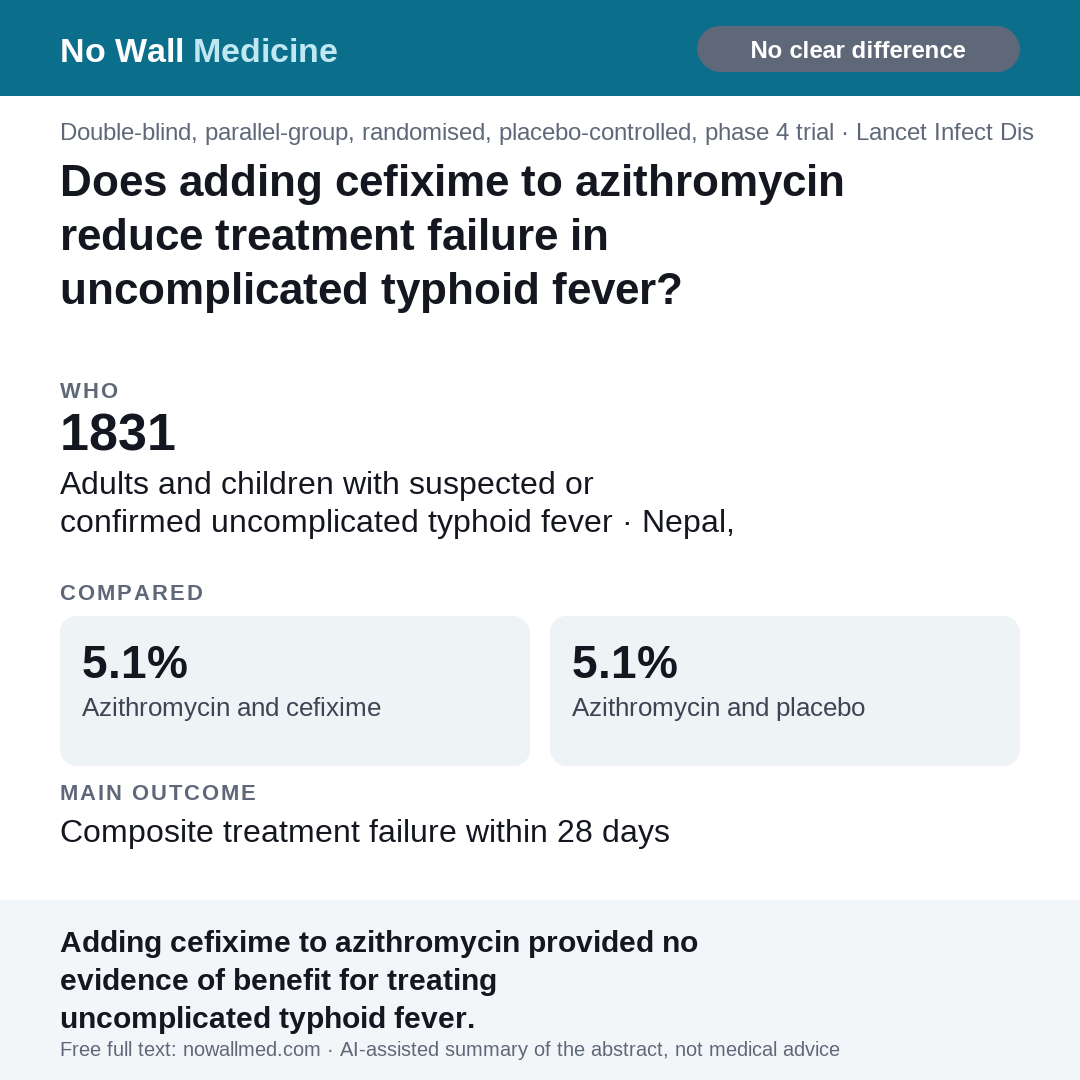
Clinical question: Does adding cefixime to azithromycin reduce treatment failure in uncomplicated typhoid fever?
Why it matters: Both azithromycin and cefixime have reported failure rates of 10% or more when treating uncomplicated typhoid fever.
Key points
- Researchers studied 1831 adults and children in Nepal, Bangladesh, and Pakistan with suspected or confirmed typhoid fever.
- The combination of azithromycin and cefixime resulted in a 5.1% treatment failure rate compared to 5.1% for azithromycin alone.
- Among participants with blood culture-confirmed typhoid, failure rates were 11.2% for the combination group and 16.0% for the azithromycin-only group.
Headline and key points written with AI from the paper’s abstract, with every number checked against it. Read the paper before relying on them.
Abstract
Background
WHO recommends azithromycin for uncomplicated typhoid fever treatment. Cefixime is also commonly used, but both drugs have reported failure rates of 10% or more. We hypothesised that combining azithromycin's intracellular activity with the extracellular activity of cefixime could overcome each drugs' pharmacokinetic gaps and enhance tissue sterilisation. The study objective was to determine if a combination of azithromycin and cefixime would reduce treatment failure rates compared with azithromycin alone. Methods
We did a double-blind, parallel-group, randomised, placebo-controlled, phase 4 trial in adults and children in Nepal, Bangladesh, and Pakistan with blood culture-confirmed or clinically suspected uncomplicated typhoid fever. Participants aged 2-65 years attending emergency and outpatient clinics with acute undifferentiated febrile illness lasting 3-14 days, C-reactive protein at least 10 mg/L, and negative tests for dengue, scrub typhus, malaria, and COVID-19, were randomly assigned 1:1 to receive oral azithromycin (20 mg/kg [maximum 1 g] once daily) and cefixime (10 mg/kg [maximum 400mg] twice daily) or oral azithromycin and placebo for 7 days. We used computer-generated block randomisation with blocks of 4 and 6, stratified by site and age; treatment allocation was concealed from all study personnel and participants throughout the study period. The primary outcome was a composite measure of treatment failure (fever clearance time ≥7 days, microbiological failure at day 7, need for rescue treatment, or typhoid fever complication or relapse within 28 days), which was analysed in the modified intention-to-treat population, defined as all randomly assigned participants who received at least one dose of study drug and did not test positive for COVID-19 by PCR at baseline. This trial is registered with ClinicalTrials.gov, NCT04349826, and has completed enrolment. Findings
Between May 9, 2021, and Sept 30, 2025, we screened 46 947 individuals for eligibility, and 1847 were randomly assigned (926 to azithromycin-cefixime and 921 to azithromycin-placebo). 1831 eligible participants (350 with blood culture-confirmed typhoid) were included in the modified intention-to-treat population; 915 were assigned to azithromycin-cefixime and 916 to azithromycin-placebo. 44 (5·1%) participants had treatment failure in each group (absolute risk difference -0·00 percentage points, 95% CI -2·08 to 2·08; p=1·00). 19 (11·2%) of 179 culture-confirmed participants had treatment failure in the azithromycin-cefixime group versus 26 (16·0%) of 171 in the azithromycin-placebo group (absolute risk difference 4·48 percentage points, 95% CI -2·52 to 12·21; p=0·20). Adverse events occurred in 142 (16%) of 918 participants in the azithromycin-cefixime group and 144 (16%) of 917 in the azithromycin-placebo group. Serious adverse events requiring hospitalisation occurred in 21 participants (2%) and 17 participants (2%), respectively. Interpretation
This study supports the WHO recommendation of oral azithromycin alone for treatment of clinically suspected or culture-confirmed uncomplicated typhoid fever,providing no evidence to support addition of cefixime, which has important implications for antimicrobial stewardship. Funding
The Department of Health and Social Care, the Foreign, Commonwealth & Development Office, the Medical Research Council, and Wellcome Trust.
Abstract reproduced under the article’s CC BY licence.
Spotted a mistake? Suggest a correction