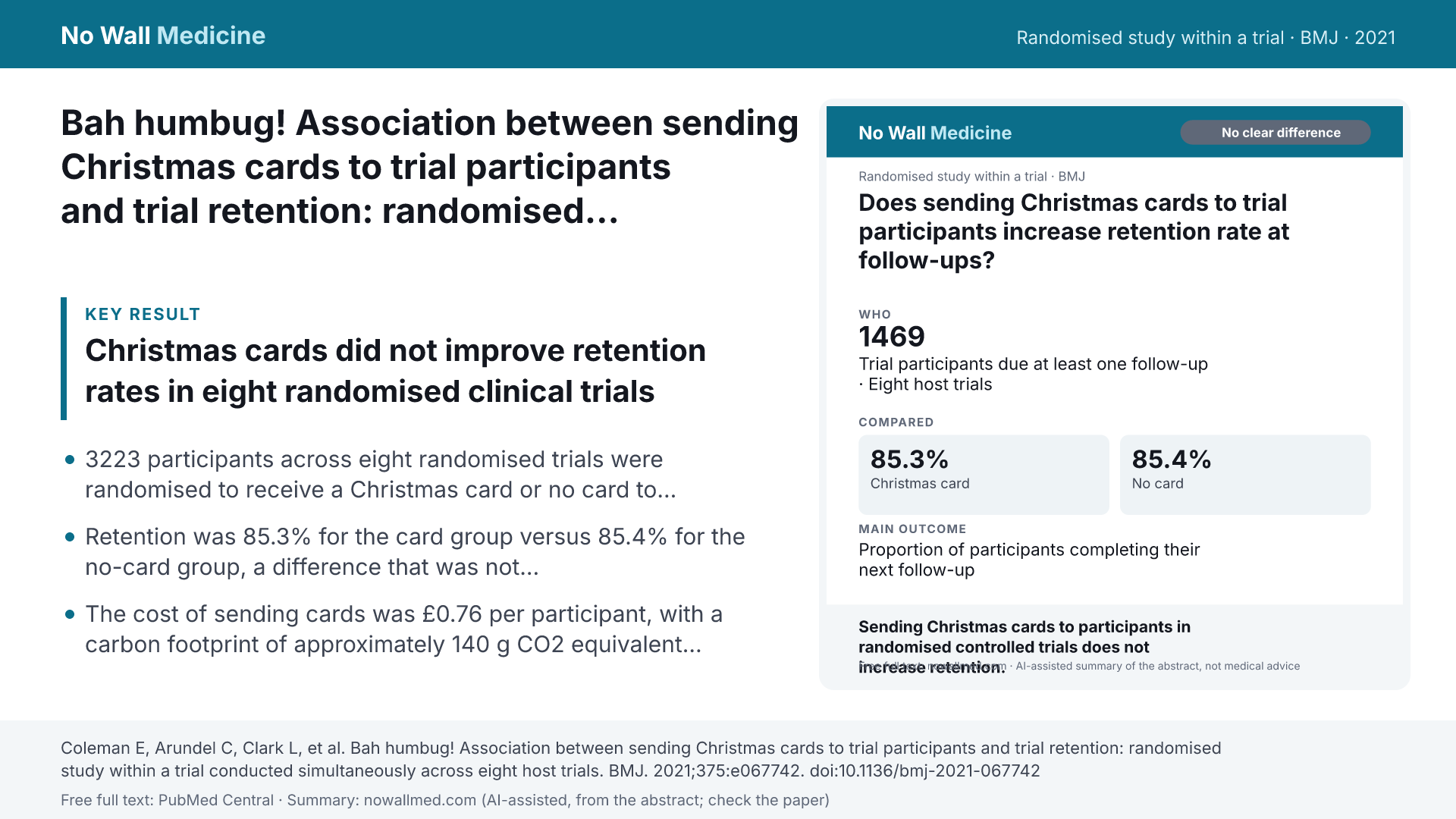
Christmas cards did not improve retention rates in eight randomised clinical trials
Bah humbug! Association between sending Christmas cards to trial participants and trial retention: randomised study within a trial conducted simultaneously across eight host trials
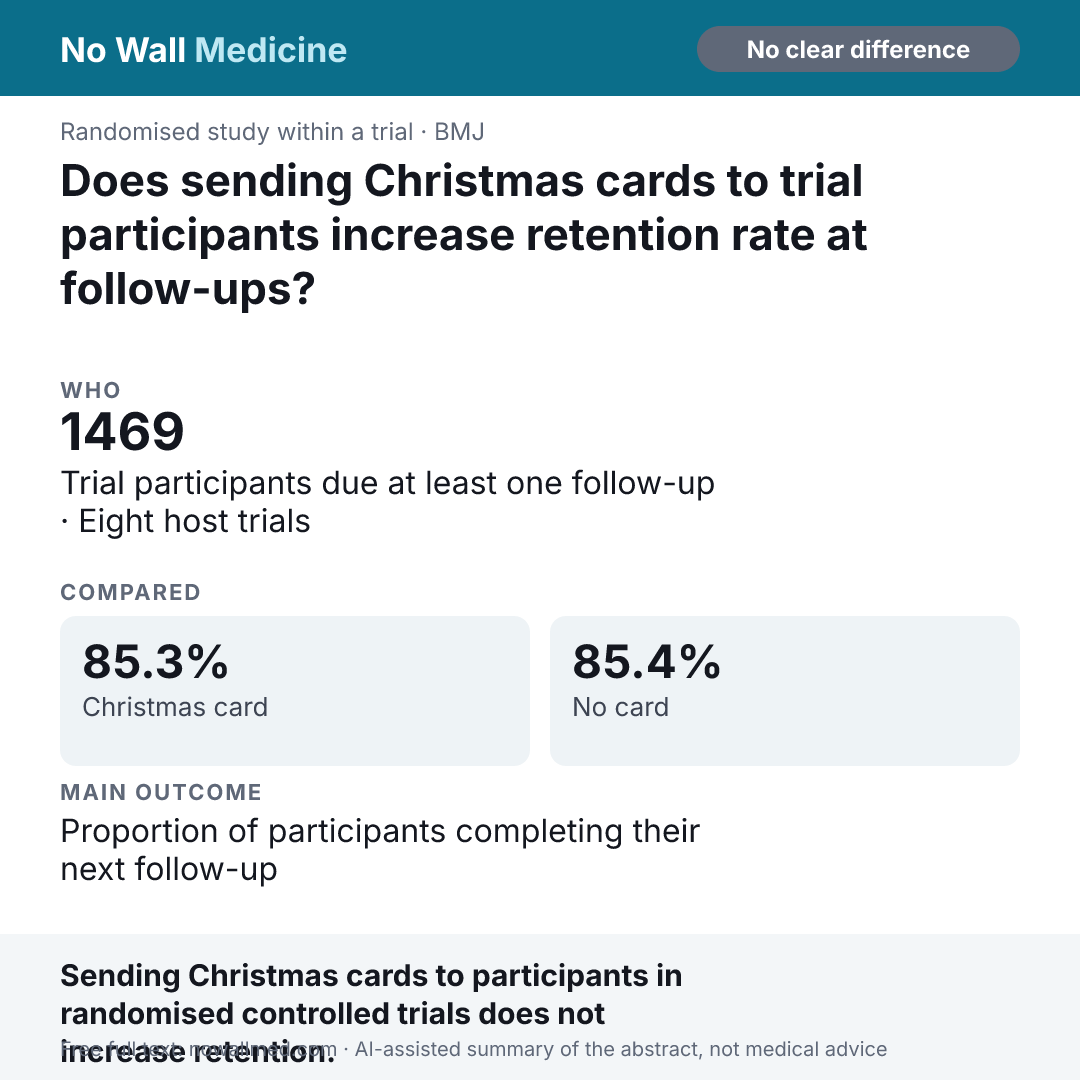
Randomised study within a trialNo clear difference
Does sending Christmas cards to trial participants increase retention rate at follow-ups?
Who
1469
Trial participants due at least one follow-up · Eight host trials
Compared
85.3%Christmas card (639/749)
85.4%No card (615/720)
Main outcome
Proportion of participants completing their next follow-up
Result: odds ratio 0.96, 95% confidence interval 0.71 to 1.29
Bottom line: Sending Christmas cards to participants in randomised controlled trials does not increase retention.
Limitation: Analysis was cut short owing to covid-19.
BMJ · 2021-12-14 · Save PNG
Clinical question: Does sending Christmas cards to trial participants increase retention rate at follow-ups?
Key points
- 3223 participants across eight randomised trials were randomised to receive a Christmas card or no card to test retention.
- Retention was 85.3% for the card group versus 85.4% for the no-card group, a difference that was not statistically significant.
- The cost of sending cards was £0.76 per participant, with a carbon footprint of approximately 140 g CO2 equivalent per card.
Limitation the authors note: The analysis was cut short owing to the impact of the covid-19 pandemic.
Headline and key points written with AI from the paper’s abstract, with every number checked against it. Read the paper before relying on them.
Was this summary helpful?
Abstract
Objectives
To determine the effectiveness of sending Christmas cards to participants in randomised controlled trials to increase retention rate at follow-ups, and to explore the feasibility of doing a study within a trial (SWAT) across multiple host trials simultaneously. Design
Randomised SWAT conducted simultaneously across eight host trials. Setting
Eight randomised controlled trials researching various areas including surgery and smoking cessation. Participants
3223 trial participants who were still due at least one follow-up from their host randomised controlled trial. Intervention
Participants were randomised (1:1, separately by each host trial) to either received a Christmas card in mid-December 2019 or to not receive a card. Main outcome measure
Proportion of participants completing their next follow-up (retention rate) within their host randomised controlled trial. Results
1469 participants (age 16-94 years; 70% (n=1033) female; 96% (813/847) white ethnicity) across the eight host randomised controlled trials were involved in the analysis (cut short owing to covid-19). No evidence was found of a difference in retention rate between the two arms for any of the host trials when analysed separately or when the results were combined (85.3% (639/749) for cards versus 85.4% (615/720) for no card; odds ratio 0.96, 95% confidence interval 0.71 to 1.29; P=0.77). No difference was observed when comparing just participants who were due a follow-up in the 30 days after receiving the card (odds ratio 0.96, 0.42 to 2.21). No evidence of a difference in time to complete the questionnaire was found (hazard ratio 1.01, 95% confidence interval 0.91 to 1.13; P=0.80). These results were robust to post hoc sensitivity analyses. The cost of this intervention was £0.76 (€0.91; $1.02) per participant, and it will have a carbon footprint of approximately 140 g CO2 equivalent per card. One benefit of this approach was the need to only submit one ethics application. Conclusions
Sending Christmas cards to participants in randomised controlled trials does not increase retention. Undertaking a SWAT within multiple randomised controlled trials at the same time is, however, possible. This approach should be used more often to build an evidence base to support selection of recruitment and retention strategies. Although no evidence of a boost to retention was found, embedding a SWAT in multiple host trials simultaneously has been shown to be possible. Study registration
SWAT repository https://www.qub.ac.uk/sites/TheNorthernIrelandNetworkforTrialsMethodologyResearch/FileStore/Filetoupload,846275,en.pdf#search=SWAT%2082.
Abstract reproduced under the article’s CC BY licence.
Subject terms
Headline, design, result, key points, caveat and citation as plain text.
Cite this article
Coleman E, Arundel C, Clark L, et al. Bah humbug! Association between sending Christmas cards to trial participants and trial retention: randomised study within a trial conducted simultaneously across eight host trials. BMJ. 2021. doi:10.1136/bmj-2021-067742
Spotted a mistake? Suggest a correction