Balanced fluids and saline showed no difference in major kidney events for children with septic shock
Balanced Fluid or 0.9% Saline in Children Treated for Septic Shock
Pragmatic clinical trialNo clear difference
Does balanced crystalloid fluid or 0.9% saline improve outcomes in children with septic shock?
Who
9041
Children aged 2 months to <18 years with suspected septic shock · 47 emergency departments in five countries
Compared
3.4%balanced fluid
3.0%0.9% saline
Main outcome
major adverse kidney event
Result: risk ratio 1.10 (95% CI 0.88 to 1.40)
Bottom line: In children with septic shock, balanced fluid resuscitation showed no significant difference in major adverse kidney events compared to 0.9% saline.
Funded by: Eunice Kennedy Shriver National Institute of Child Health and Human Development
NEJM · 2026-04-24Download image
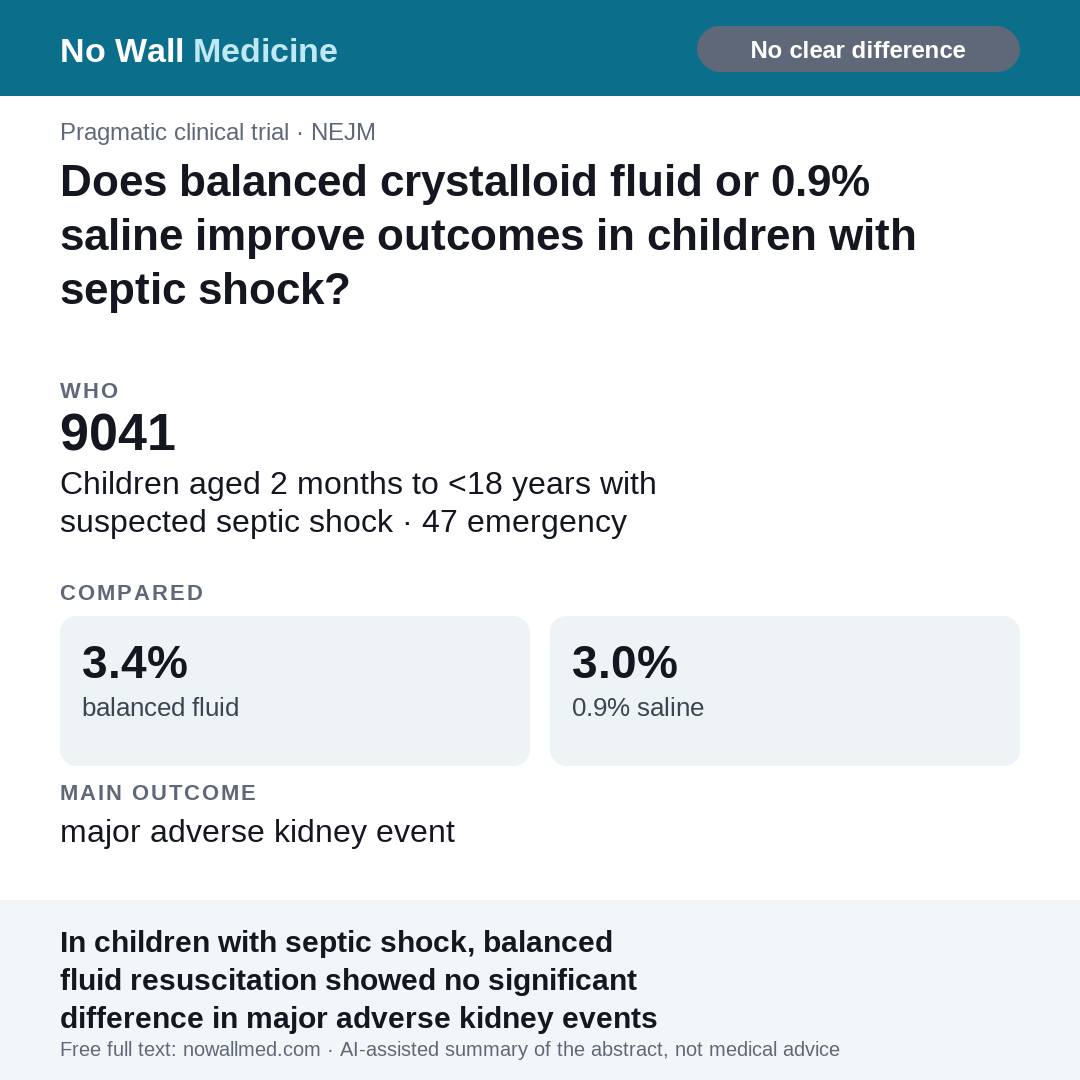
Clinical question: Does balanced crystalloid fluid or 0.9% saline improve outcomes in children with septic shock?
Why it matters: It is debated whether using balanced crystalloid fluids leads to better outcomes than 0.9% saline in children treated for septic shock.
Key points
- Researchers studied 9041 children aged 2 months to under 18 years who were randomly assigned to receive either balanced crystalloid fluid or 0.9% saline.
- The primary outcome of major adverse kidney events occurred in 3.4% of the balanced-fluid group and 3.0% of the 0.9%-saline group, showing no significant difference.
- Hyperchloremia, or high chloride levels in the blood, occurred in 31.4% of the balanced-fluid group compared to 49.0% in the 0.9%-saline group.
Headline and key points written with AI from the paper’s abstract, with every number checked against it. Read the paper before relying on them.
Topics
Cite this article
Balamuth F, Weiss SL, Long E, Thompson GC, Artis AS, Campos AB. Balanced Fluid or 0.9% Saline in Children Treated for Septic Shock. NEJM. 2026. doi:10.1056/NEJMoa2601969
Spotted a mistake? Suggest a correction