Research identifies service and patient factors affecting addiction treatment access for sexual minority adults
Barriers and facilitators to accessing addiction treatment services for sexual minority (LGBQ+) people: systematic review
Systematic reviewMixed results
What are the barriers and facilitators to accessing addiction treatment for sexual minority adults?
Who
62
Sexual minority adults
Compared
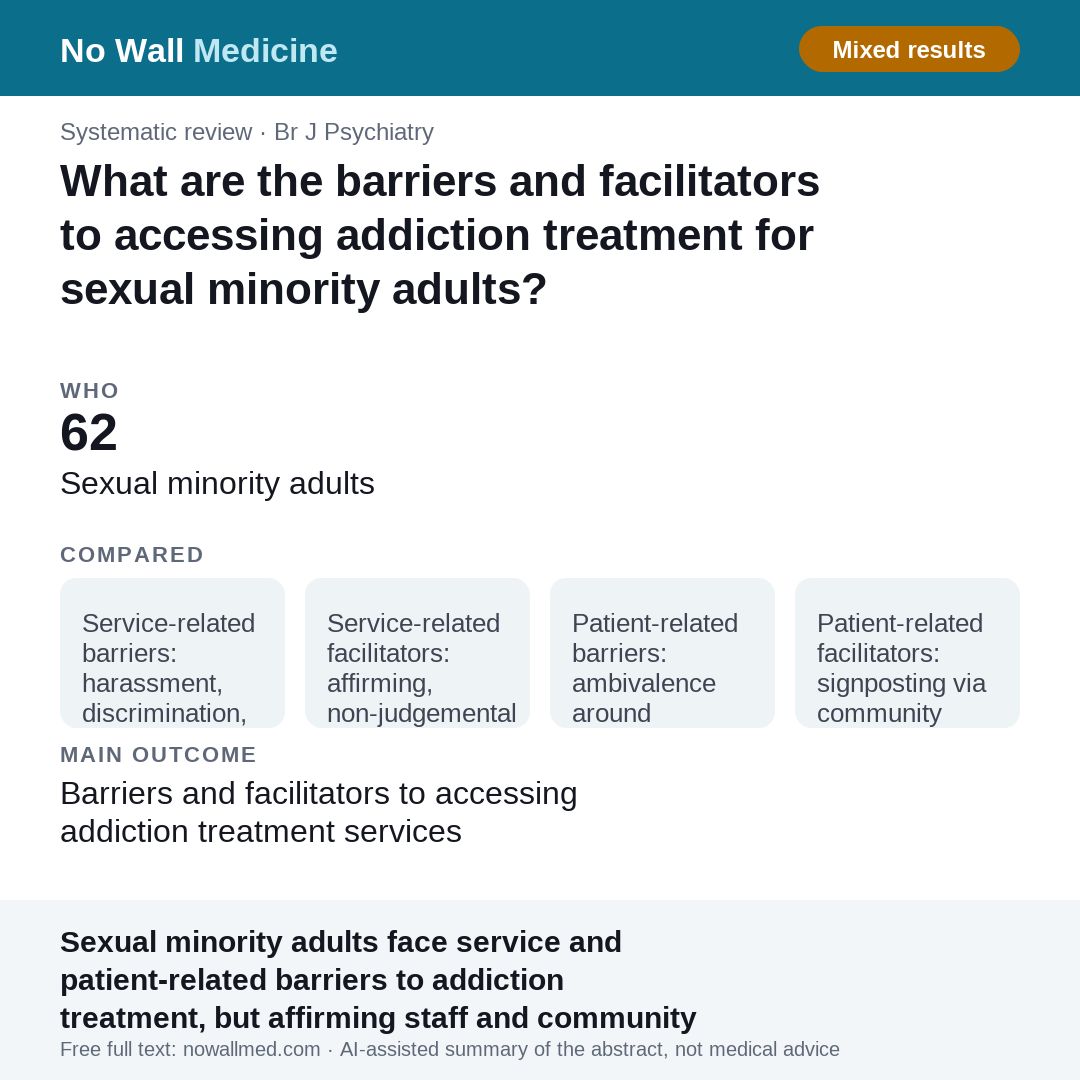
Service-related barriers: harassment, discrimination, violence, abuse, and lack of expertise
Service-related facilitators: affirming, non-judgemental staff attitudes and sexual minority-specific services
Patient-related barriers: ambivalence around drug/alcohol use and fear of stigma
Patient-related facilitators: signposting via community networks and patient-set treatment goals
Main outcome
Barriers and facilitators to accessing addiction treatment services
Bottom line: Sexual minority adults face service and patient-related barriers to addiction treatment, but affirming staff and community networks act as facilitators.
Br J Psychiatry · 2026-03-30Download image
Clinical question: What are the barriers and facilitators to accessing addiction treatment for sexual minority adults?
Why it matters: Sexual minority people experience significant disparities in addiction problems compared with heterosexual people.
Key points
- Researchers conducted a systematic review of 62 studies to identify barriers and facilitators for sexual minority people accessing drug and alcohol addiction treatment.
- Service-related barriers included harassment and discrimination, while facilitators included affirming staff attitudes and specialized outreach services.
- Patient-related barriers included fear of stigma, whereas facilitators included community network signposting and patient-led treatment goals.
Headline and key points written with AI from the paper’s abstract, with every number checked against it. Read the paper before relying on them.
Cite this article
Hillyard M, Cockbain B, Drummond C, Rimes K, Roberts E. Barriers and facilitators to accessing addiction treatment services for sexual minority (LGBQ+) people: systematic review. Br J Psychiatry. 2026. doi:10.1192/bjp.2026.10589
Spotted a mistake? Suggest a correction