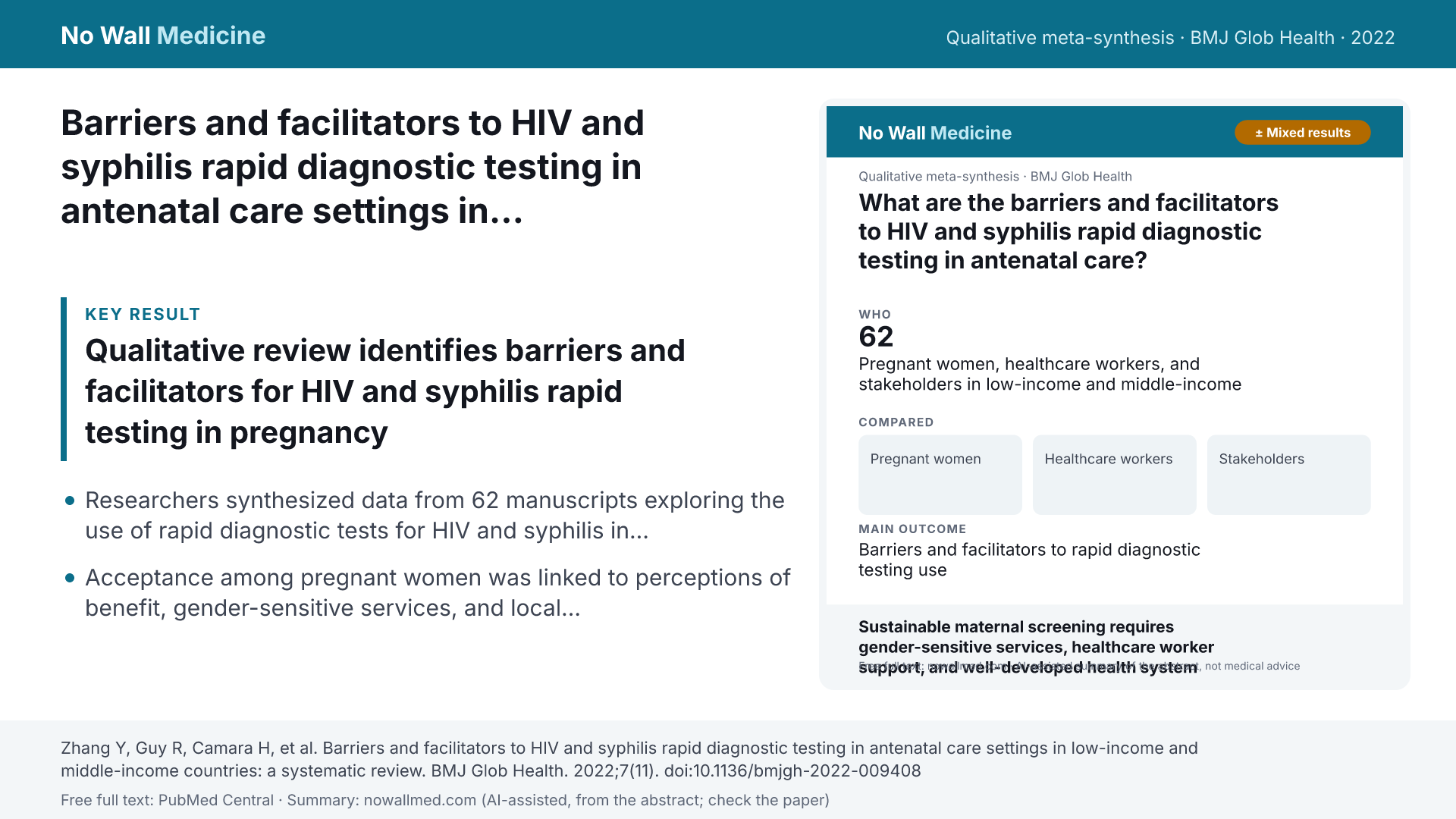
Qualitative review identifies barriers and facilitators for HIV and syphilis rapid testing in pregnancy
Barriers and facilitators to HIV and syphilis rapid diagnostic testing in antenatal care settings in low-income and middle-income countries: a systematic review
Qualitative meta-synthesisMixed results
What are the barriers and facilitators to HIV and syphilis rapid diagnostic testing in antenatal care?
Who
62
Pregnant women, healthcare workers, and stakeholders in low-income and middle-income countries · Antenatal care clinics in low-income and middle-income countries
Compared
Pregnant women
Healthcare workers
Stakeholders
Main outcome
Barriers and facilitators to rapid diagnostic testing use
Bottom line: Sustainable maternal screening requires gender-sensitive services, healthcare worker support, and well-developed health system infrastructures.
BMJ Glob Health · 2022-11-01Download image
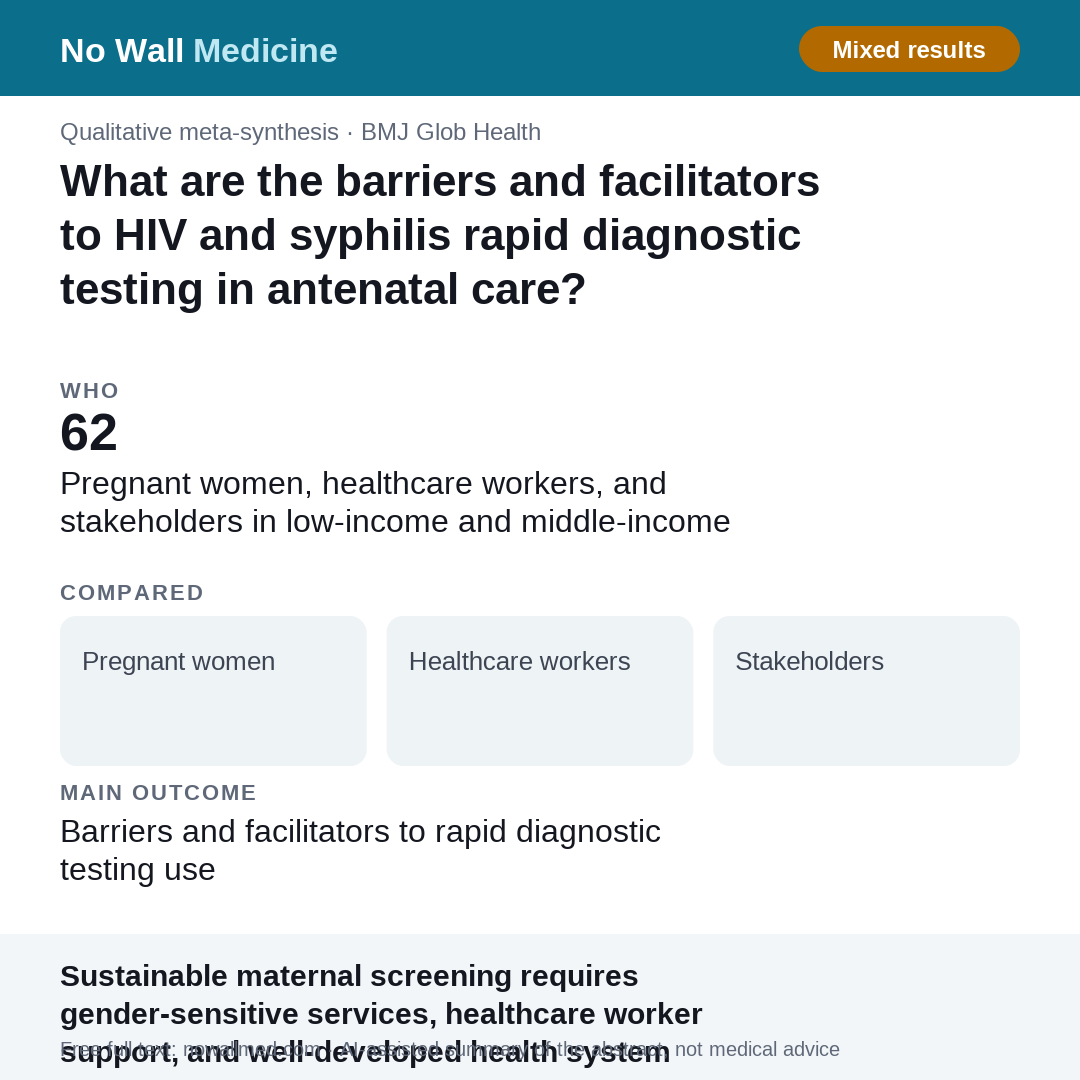
Clinical question: What are the barriers and facilitators to HIV and syphilis rapid diagnostic testing in antenatal care?
Why it matters: The uptake of rapid diagnostic tests for HIV and syphilis during pregnancy is suboptimal in many low-income and middle-income countries.
Key points
- Researchers synthesized data from 62 manuscripts exploring the use of rapid diagnostic tests for HIV and syphilis in antenatal care clinics.
- Acceptance among pregnant women was linked to perceptions of benefit, gender-sensitive services, and local sociocultural beliefs regarding pregnancy and disease.
- Healthcare worker capacity was linked to ongoing training, test usability, supervisor support, sufficient staffing, and reliable salaries.
Headline and key points written with AI from the paper’s abstract, with every number checked against it. Read the paper before relying on them.
Was this summary helpful?
Abstract
Background
Testing and treatment during pregnancy is a well-established and cost-effective prevention strategy, which relies largely on use of rapid diagnostic tests (RDTs). Yet, in many low-income and-middle-income countries, the uptake of RDTs is suboptimal. A qualitative meta-synthesis was conducted to identify the barriers and enablers to use of HIV and syphilis RDTs among pregnant women in low-income and middle-income countries. Methods
This review was conducted using PRISMA guidelines. Eligible studies included peer-reviewed publications, which used qualitative methods to explore HIV and syphilis RDT in antenatal care clinics in low-income and middle-income countries. Studies focusing on perspectives of pregnant women, healthcare workers and/or stakeholders were included. We used an inductive approach informed by a modified socioecological model to synthesise the data. Results
62 manuscripts met the eligibility criteria. For pregnant women, initial acceptance of the RDT and continuation in antenatal care depends on the perception that engaging in testing will be a beneficial experience for their baby and themselves, often influenced by the provision of services that are gender-sensitive, confidential, respectful, flexible and considers their well-being into the future. Local sociocultural beliefs about pregnancy and diseases, awareness of diseases and gender roles in society also influenced RDT acceptability among pregnant women. For healthcare workers, the ability to provide high-quality RDT care required ongoing training, accurate and easy to use tests, support from supervisors and communities, sufficient resources and staffing to provide services, and reliable salary. At the stakeholder level, well-developed guidelines and health system infrastructures were imperative to the delivery of RDT in antenatal clinics. Conclusion
Our findings highlight clear gaps to the provision of sustainable and culturally acceptable maternal HIV and/or syphilis screening using RDTs. In addition, greater attention needs to be paid to community stakeholders in promoting the uptake of RDT in antenatal clinics. Prospero registration number
CRD42018112190.
Abstract reproduced under the article’s CC BY NC licence.
Subject terms
Cite this article
Zhang Y, Guy R, Camara H, et al. Barriers and facilitators to HIV and syphilis rapid diagnostic testing in antenatal care settings in low-income and middle-income countries: a systematic review. BMJ Glob Health. 2022. doi:10.1136/bmjgh-2022-009408
Spotted a mistake? Suggest a correction