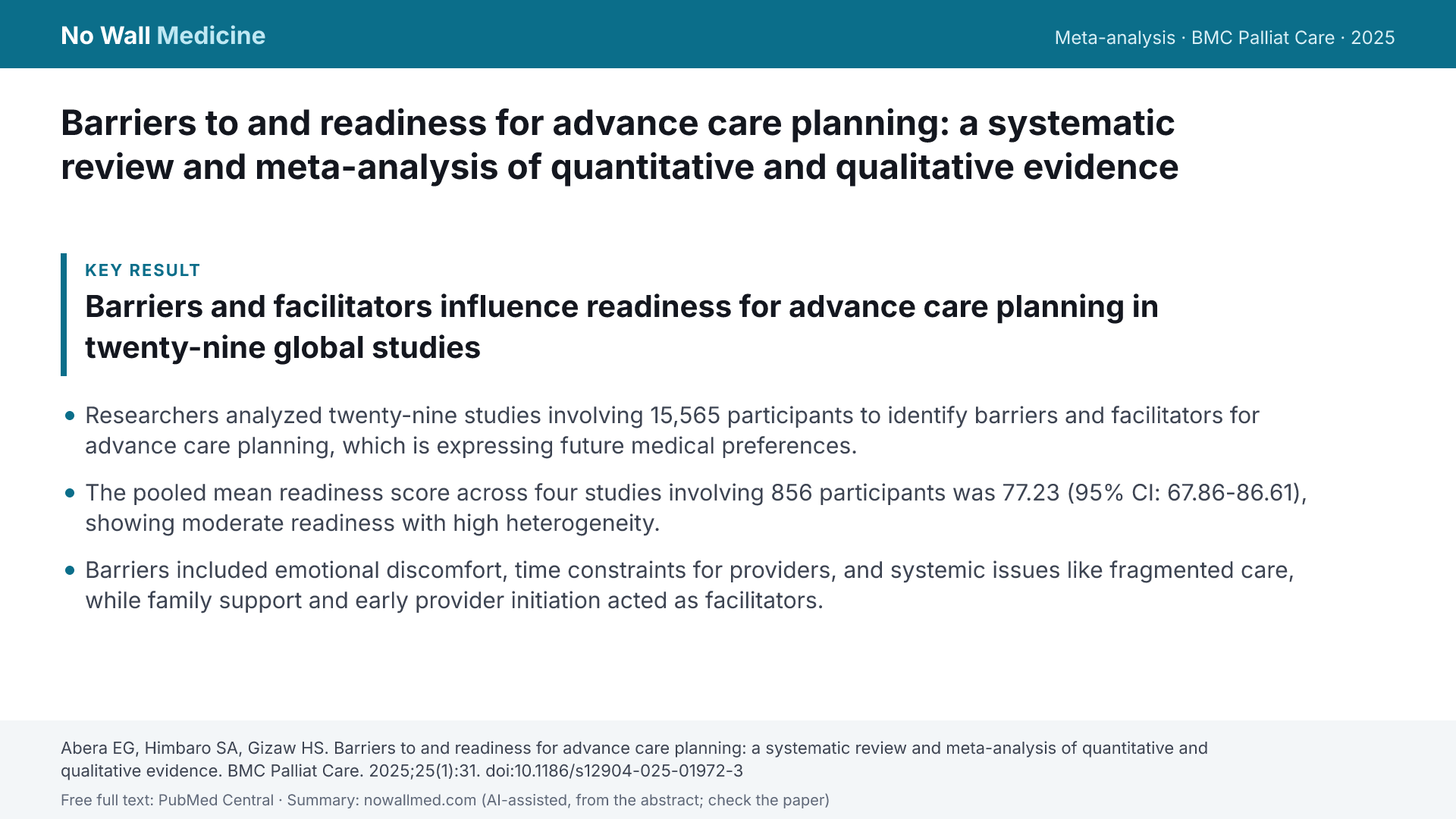
Barriers and facilitators influence readiness for advance care planning in twenty-nine global studies
Barriers to and readiness for advance care planning: a systematic review and meta-analysis of quantitative and qualitative evidence
Why it matters: Participation in advance care planning remains low globally, and more information is needed regarding the readiness and obstacles to engagement.
Key points
- Researchers analyzed twenty-nine studies involving 15,565 participants to identify barriers and facilitators for advance care planning, which is expressing future medical preferences.
- The pooled mean readiness score across four studies involving 856 participants was 77.23 (95% CI: 67.86-86.61), showing moderate readiness with high heterogeneity.
- Barriers included emotional discomfort, time constraints for providers, and systemic issues like fragmented care, while family support and early provider initiation acted as facilitators.
Headline and key points written with AI from the paper’s abstract, with every number checked against it. Read the paper before relying on them.
Was this summary helpful?
Subject terms
Headline, design, result, key points, caveat and citation as plain text.
Cite this article
Abera EG, Himbaro SA, Gizaw HS. Barriers to and readiness for advance care planning: a systematic review and meta-analysis of quantitative and qualitative evidence. BMC Palliat Care. 2025;25(1):31. doi:10.1186/s12904-025-01972-3
Spotted a mistake? Suggest a correction