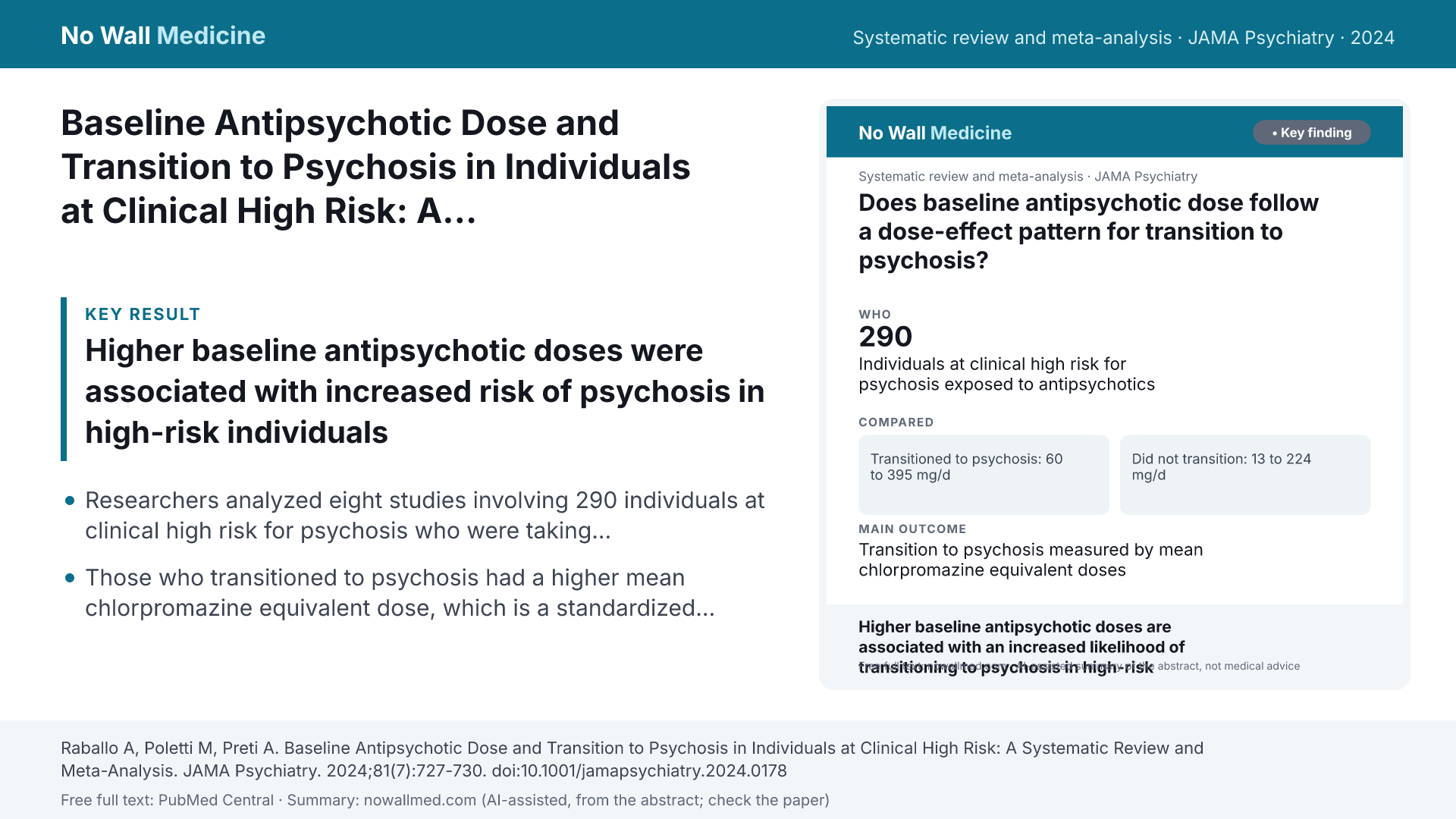
Higher baseline antipsychotic doses were associated with increased risk of psychosis in high-risk individuals
Baseline Antipsychotic Dose and Transition to Psychosis in Individuals at Clinical High Risk: A Systematic Review and Meta-Analysis
Systematic review and meta-analysisKey finding
Does baseline antipsychotic dose follow a dose-effect pattern for transition to psychosis?
Who
290
Individuals at clinical high risk for psychosis exposed to antipsychotics
Compared
Transitioned to psychosis: 60 to 395 mg/d
Did not transition: 13 to 224 mg/d
Main outcome
Transition to psychosis measured by mean chlorpromazine equivalent doses
Result: Hedges g, 0.41 (95% CI, 0.15 to 0.67)
Bottom line: Higher baseline antipsychotic doses are associated with an increased likelihood of transitioning to psychosis in high-risk individuals.
JAMA Psychiatry · 2024-03-20Download image
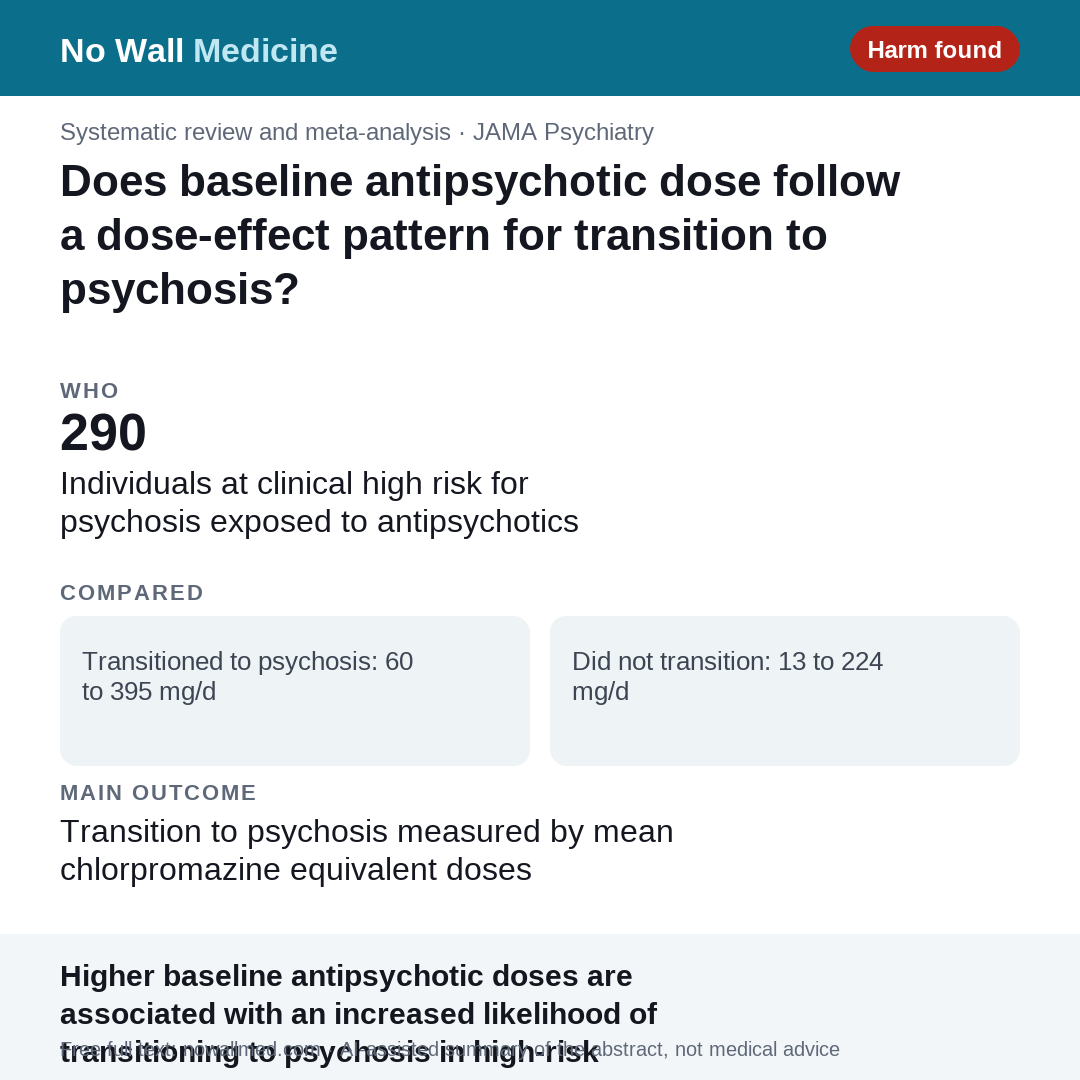
Clinical question: Does baseline antipsychotic dose follow a dose-effect pattern for transition to psychosis?
Key points
- Researchers analyzed eight studies involving 290 individuals at clinical high risk for psychosis who were taking antipsychotic medications at the start of the studies.
- Those who transitioned to psychosis had a higher mean chlorpromazine equivalent dose, which is a standardized measure of antipsychotic potency, ranging from 60 to 395 mg/d compared to 13 to 224 mg/d in those who did not.
- The association between higher baseline doses and the transition to psychosis was statistically significant in both common-effects and random-effects models.
Headline and key points written with AI from the paper’s abstract, with every number checked against it. Read the paper before relying on them.
Was this summary helpful?
Subject terms
Cite this article
Raballo A, Poletti M, Preti A. Baseline Antipsychotic Dose and Transition to Psychosis in Individuals at Clinical High Risk: A Systematic Review and Meta-Analysis. JAMA Psychiatry. 2024. doi:10.1001/jamapsychiatry.2024.0178
Spotted a mistake? Suggest a correction