Early suppression of basophil activation is associated with successful peanut allergy remission in children
Baseline basophil activation and early suppression is associated with clinical outcome after peanut sublingual immunotherapy
Randomized trialBenefit found
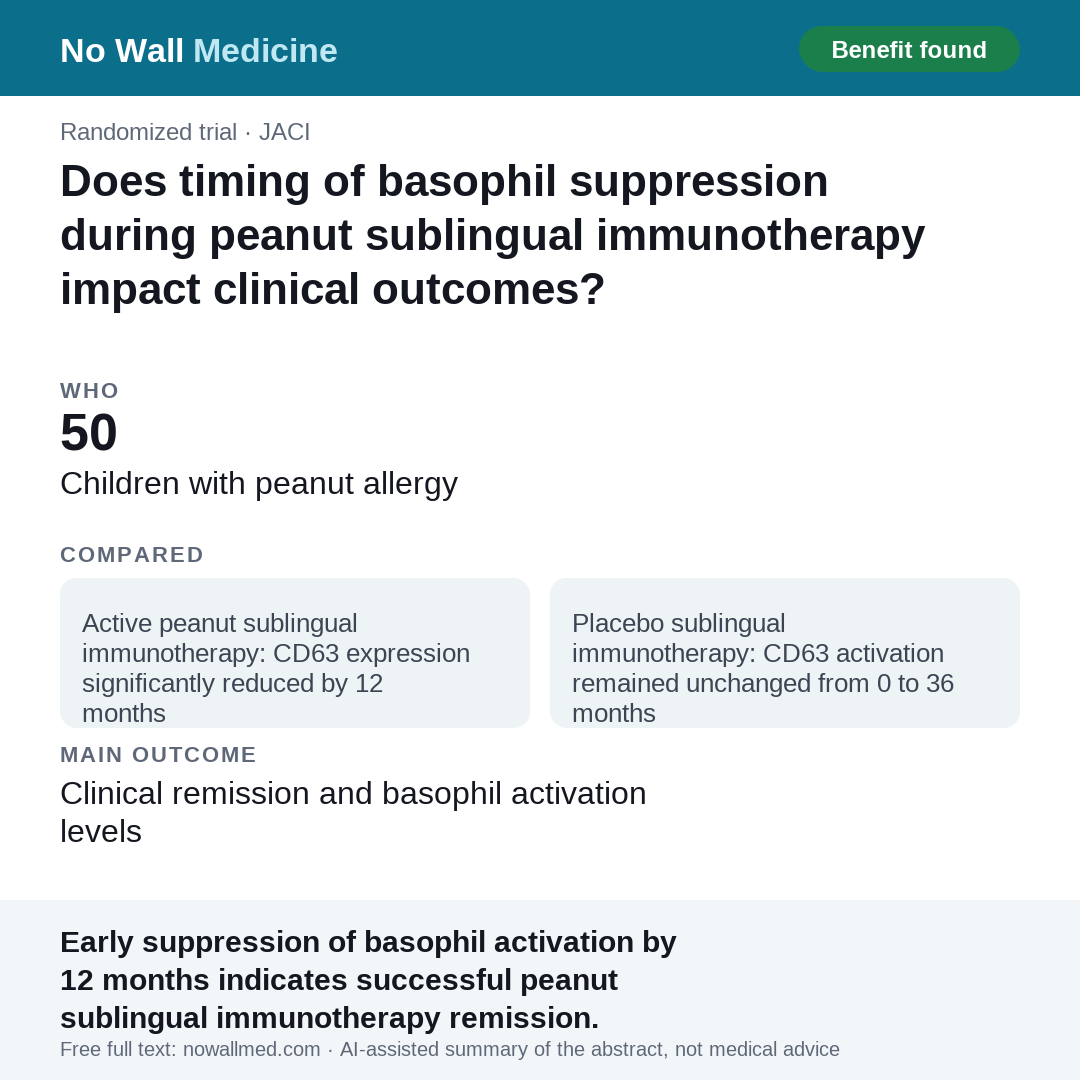
Does timing of basophil suppression during peanut sublingual immunotherapy impact clinical outcomes?
Who
50
Children with peanut allergy
Compared
Active peanut sublingual immunotherapy: CD63 expression significantly reduced by 12 months
Placebo sublingual immunotherapy: CD63 activation remained unchanged from 0 to 36 months
Main outcome
Clinical remission and basophil activation levels
Bottom line: Early suppression of basophil activation by 12 months indicates successful peanut sublingual immunotherapy remission.
JACI · 2025-04-15Download image
Clinical question: Does timing of basophil suppression during peanut sublingual immunotherapy impact clinical outcomes?
Why it matters: It is unclear how the timing of basophil suppression during peanut sublingual immunotherapy impacts clinical remission outcomes in young children.
Key points
- Researchers studied 50 children with peanut allergies randomized to receive either peanut sublingual immunotherapy (allergy drops under the tongue) or a placebo for 36 months.
- Participants who achieved remission had lower CD63 basophil activation at baseline and significant suppression of CD63 expression by 12 months compared to those who failed treatment.
- CD203c expression, another marker of basophil activation, remained unchanged for both the peanut immunotherapy and placebo groups throughout the trial.
Headline and key points written with AI from the paper’s abstract, with every number checked against it. Read the paper before relying on them.
Topics
Cite this article
Humphrey JR, Guo R, Yue X, Keet CA, Virkud YV, Bird JA. Baseline basophil activation and early suppression is associated with clinical outcome after peanut sublingual immunotherapy. JACI. 2025. doi:10.1016/j.jaci.2025.04.010
Spotted a mistake? Suggest a correction
Top studies every Monday
The week’s key trials and guidelines in your specialties, plus any topics you follow. By email, free.
Get the weekly digest