Baseline characteristics like age and lung function do not predict response to triple asthma therapy
Baseline Characteristics and ICS/LAMA/LABA Response in Asthma: Analyses From the CAPTAIN Study
Prespecified and post hoc analyses of randomized trial dataNo clear difference
Do baseline characteristics predict response to adding UMEC or doubling FF dose in asthma?
Who
Patients with moderate to severe asthma
Compared
Adding UMEC to FF/VI: greater improvements in trough FEV1
Doubling the FF dose: numerically greater reductions in annualized rate of moderate/severe exacerbations
Main outcome
lung function, exacerbation rate, and asthma control
Bottom line: Baseline demographic and physiologic variables do not predict response to inhaled therapy in asthma.
J Allergy Clin Immunol Pract · 2024-02-01Download image
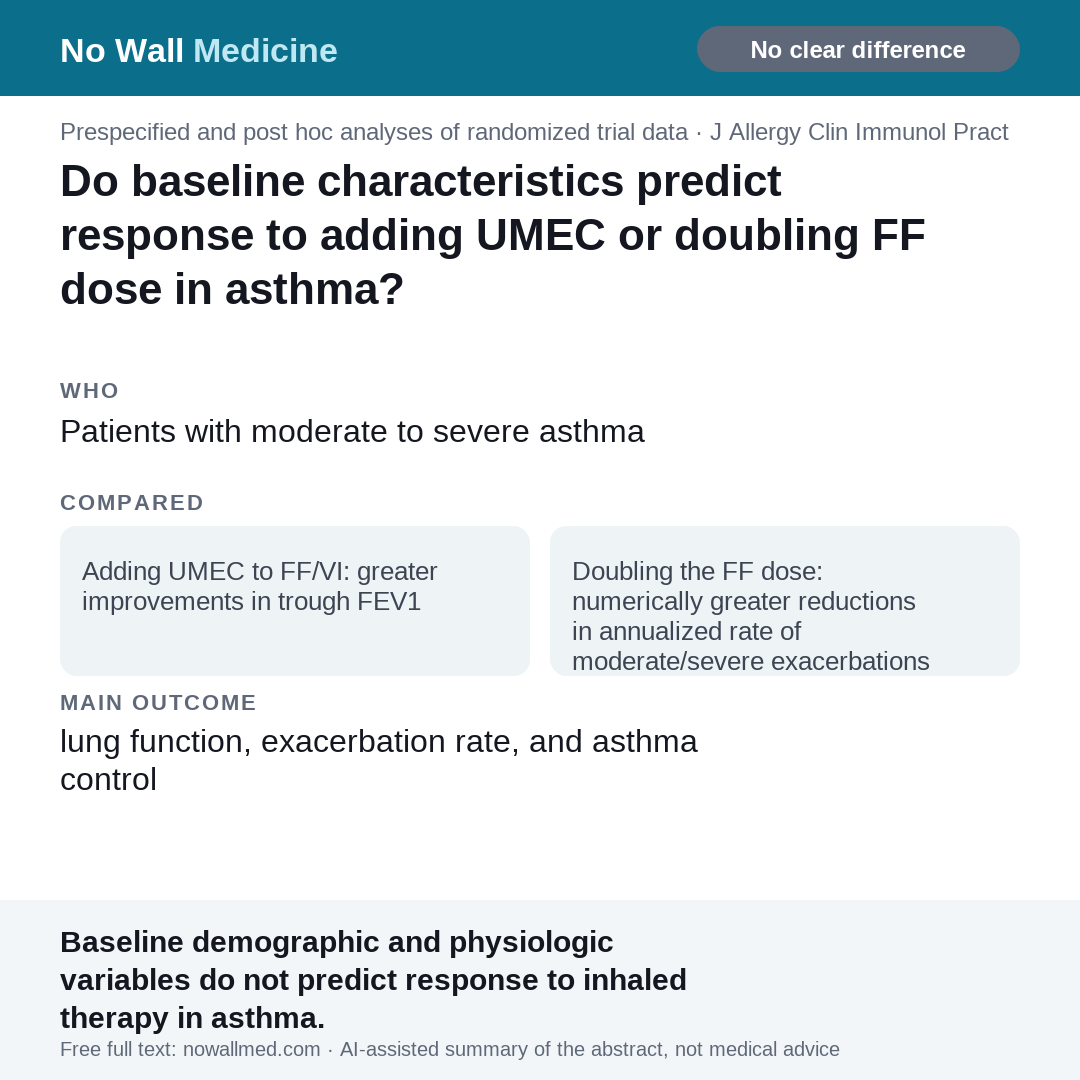
Clinical question: Do baseline characteristics predict response to adding UMEC or doubling FF dose in asthma?
Why it matters: It was unknown if demographic and physiologic variables like age or lung function could predict how patients with asthma respond to adding a third medication to their inhaled therapy.
Key points
- Researchers analyzed data from the CAPTAIN study to see if demographic and physiologic variables predicted how patients with moderate to severe asthma responded to different inhaled therapies.
- Adding umecclidinium (a long-acting muscarinic antagonist) to fluticasone furoate/vilanterol led to greater improvements in trough FEV1 (a measure of lung function) than doubling the fluticasone furoate dose.
- Lung function, bronchodilator reversibility, age, and age at asthma onset were not predictive of response to the inhaled therapies studied.
Headline and key points written with AI from the paper’s abstract, with every number checked against it. Read the paper before relying on them.
Was this summary helpful?
Subject terms
Cite this article
Boulet LP, Abbott C, Brusselle G, Edwards D, Oppenheimer J, Pavord ID. Baseline Characteristics and ICS/LAMA/LABA Response in Asthma: Analyses From the CAPTAIN Study. J Allergy Clin Immunol Pract. 2024. doi:10.1016/j.jaip.2024.01.039
Spotted a mistake? Suggest a correction
Top studies every Monday
The week’s key trials and guidelines in your specialties, plus any topics you follow. By email, free.
Get the weekly digest