Baseline Diastolic BP and BP-Lowering Effects on Cardiovascular Outcomes and All-Cause Mortality: A Meta-Analysis
Meta-analysis of five large trialsBenefit found
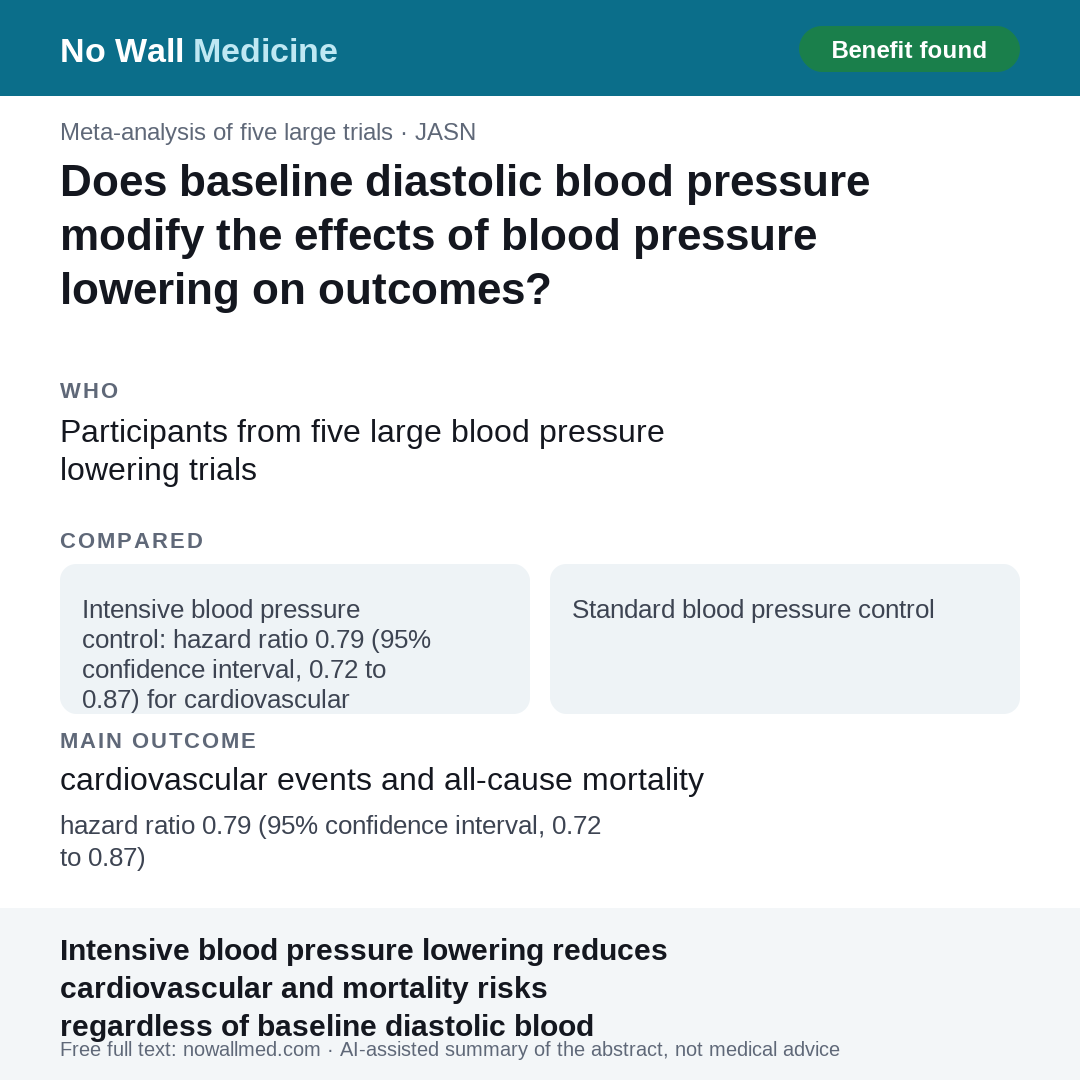
Does baseline diastolic blood pressure modify the effects of blood pressure lowering on outcomes?
Who
Participants from five large blood pressure lowering trials
Compared
Intensive blood pressure control: hazard ratio 0.79 (95% confidence interval, 0.72 to 0.87) for cardiovascular outcome
Standard blood pressure control
Main outcome
cardiovascular events and all-cause mortality
Result: hazard ratio 0.79 (95% confidence interval, 0.72 to 0.87)
Bottom line: Intensive blood pressure lowering reduces cardiovascular and mortality risks regardless of baseline diastolic blood pressure levels.
JASN · 2024-11-08Download image
Clinical question: Does baseline diastolic blood pressure modify the effects of blood pressure lowering on outcomes?
Abstract
Key points
There is concern that lowering systolic BP in persons with low diastolic BP could be harmful. In this meta-analysis of five large BP-lowering trials, BP interventions reduced the risks of cardiovascular events and all-cause mortality. However, there was no evidence that low baseline diastolic BP modified these beneficial effects of BP-lowering interventions. Background
Lowering BP in persons with low diastolic BP could be harmful. Hence, we examined whether baseline diastolic BP modifies the effects of BP lowering on clinical outcomes in a meta-analysis of five large BP-lowering trials. Methods
In a study-level meta-analysis on the basis of individual participant data of the Systolic Blood Pressure Intervention Trial (SPRINT; N=9361), the Action to Control Cardiovascular Risk in Diabetes Blood Pressure (ACCORD; N=2362), the Secondary Prevention of Small Subcortical Strokes (SPS3; N=3020), the African American Study of Kidney Disease and Hypertension (AASK; N=1094), and the Modification of Diet in Renal Disease (MDRD; N=840) studies, we used DerSimonian–Laird random-effects models to examine the dependence of the effect of the BP-lowering intervention on baseline diastolic BP for cardiovascular, all-cause mortality, and kidney outcomes. Results
The mean baseline age was 65±10 years. Mean baseline systolic and diastolic BP were 141±17 and 79±12 mm Hg, respectively. More intensive BP control resulted in lower risk of composite cardiovascular outcome (hazard ratio, 0.79; 95% confidence interval, 0.72 to 0.87) and all-cause mortality (hazard ratio, 0.86; 95% confidence interval, 0.75 to 0.99) without evidence that the BP intervention effects differed by level of baseline diastolic BP (interaction P = 0.76 for cardiovascular composite and 0.85 for all-cause mortality). The mean baseline diastolic BP in the lowest and upper three quartiles of baseline diastolic BP were 65±6 and 84±9 mm Hg, respectively, but the effects of the BP interventions on the outcomes were similar in both groups. Furthermore, there was no evidence of interaction of the BP intervention and baseline diastolic BP for kidney outcomes. Conclusions
Within the included diastolic BP range, there was no evidence that baseline diastolic BP modified the beneficial effects of intensive BP lowering.
Cite this article
Sarwal A, Boucher RE, Hartsell SE, Wei G, Shen J, Chertow GM. Baseline Diastolic BP and BP-Lowering Effects on Cardiovascular Outcomes and All-Cause Mortality: A Meta-Analysis. JASN. 2024. doi:10.1681/ASN.0000000539
Spotted a mistake? Suggest a correction
Top studies every Monday
The week’s key trials and guidelines in your specialties, plus any topics you follow. By email, free.
Get the weekly digest