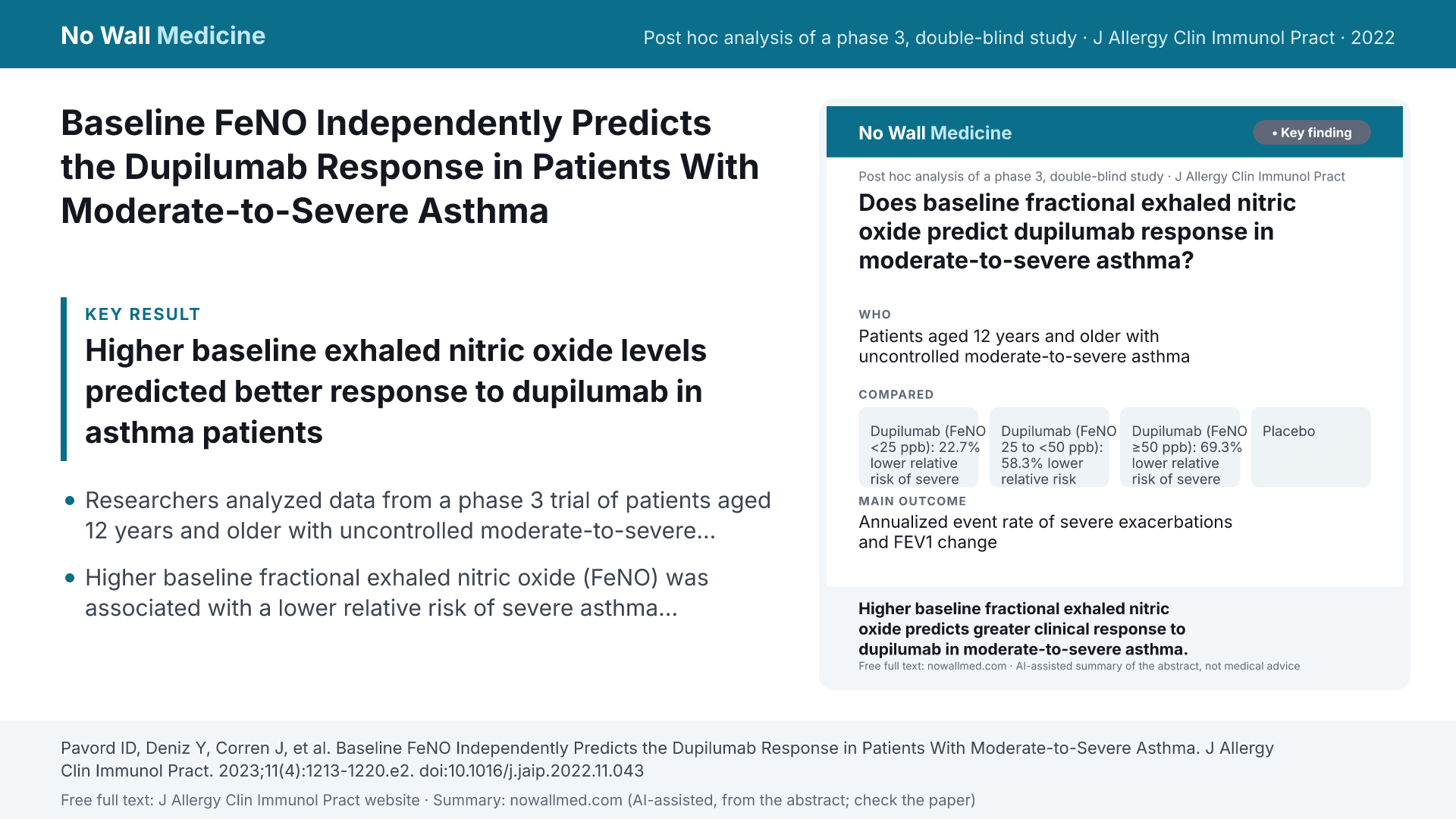
Higher baseline exhaled nitric oxide levels predicted better response to dupilumab in asthma patients
Baseline FeNO Independently Predicts the Dupilumab Response in Patients With Moderate-to-Severe Asthma
Post hoc analysis of a phase 3, double-blind studyBenefit found
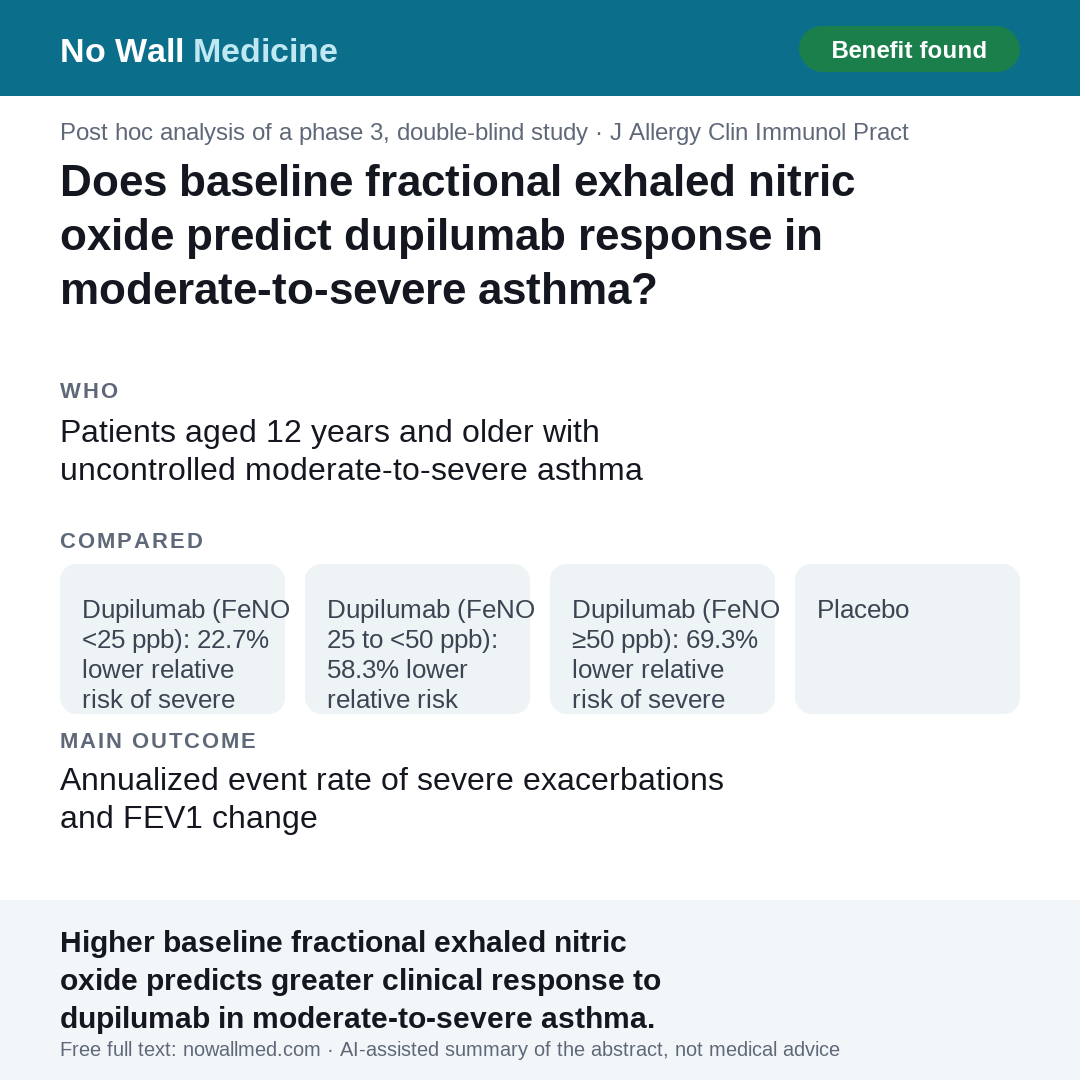
Does baseline fractional exhaled nitric oxide predict dupilumab response in moderate-to-severe asthma?
Who
Patients aged 12 years and older with uncontrolled moderate-to-severe asthma
Compared
Dupilumab (FeNO <25 ppb): 22.7% lower relative risk of severe exacerbations
Dupilumab (FeNO 25 to <50 ppb): 58.3% lower relative risk of severe exacerbations
Dupilumab (FeNO ≥50 ppb): 69.3% lower relative risk of severe exacerbations
Placebo
Main outcome
Annualized event rate of severe exacerbations and FEV1 change
Bottom line: Higher baseline fractional exhaled nitric oxide predicts greater clinical response to dupilumab in moderate-to-severe asthma.
J Allergy Clin Immunol Pract · 2022-12-16Download image
Clinical question: Does baseline fractional exhaled nitric oxide predict dupilumab response in moderate-to-severe asthma?
Why it matters: It is unknown if fractional exhaled nitric oxide (FeNO) can independently predict how patients with moderate-to-severe asthma will respond to dupilumab treatment.
Key points
- Researchers analyzed data from a phase 3 trial of patients aged 12 years and older with uncontrolled moderate-to-severe asthma receiving dupilumab or placebo.
- Higher baseline fractional exhaled nitric oxide (FeNO) was associated with a lower relative risk of severe asthma attacks for dupilumab versus placebo.
- The relative risk of severe exacerbations was 22.7%, 58.3%, and 69.3% lower for dupilumab compared to placebo in patients with FeNO levels under 25, 25 to 50, and 50 or greater parts per billion.
Headline and key points written with AI from the paper’s abstract, with every number checked against it. Read the paper before relying on them.
Was this summary helpful?
Subject terms
Cite this article
Pavord ID, Deniz Y, Corren J, Casale TB, FitzGerald JM, Izuhara K. Baseline FeNO Independently Predicts the Dupilumab Response in Patients With Moderate-to-Severe Asthma. J Allergy Clin Immunol Pract. 2022. doi:10.1016/j.jaip.2022.11.043
Spotted a mistake? Suggest a correction