Five optical coherence tomography biomarkers were associated with worse vision in diabetic macular edema
Baseline OCT Biomarkers Associated with Visual Acuity in Diabetic Macular Edema: A Systematic Review and Meta-analysis
Systematic review and meta-analysisMixed results
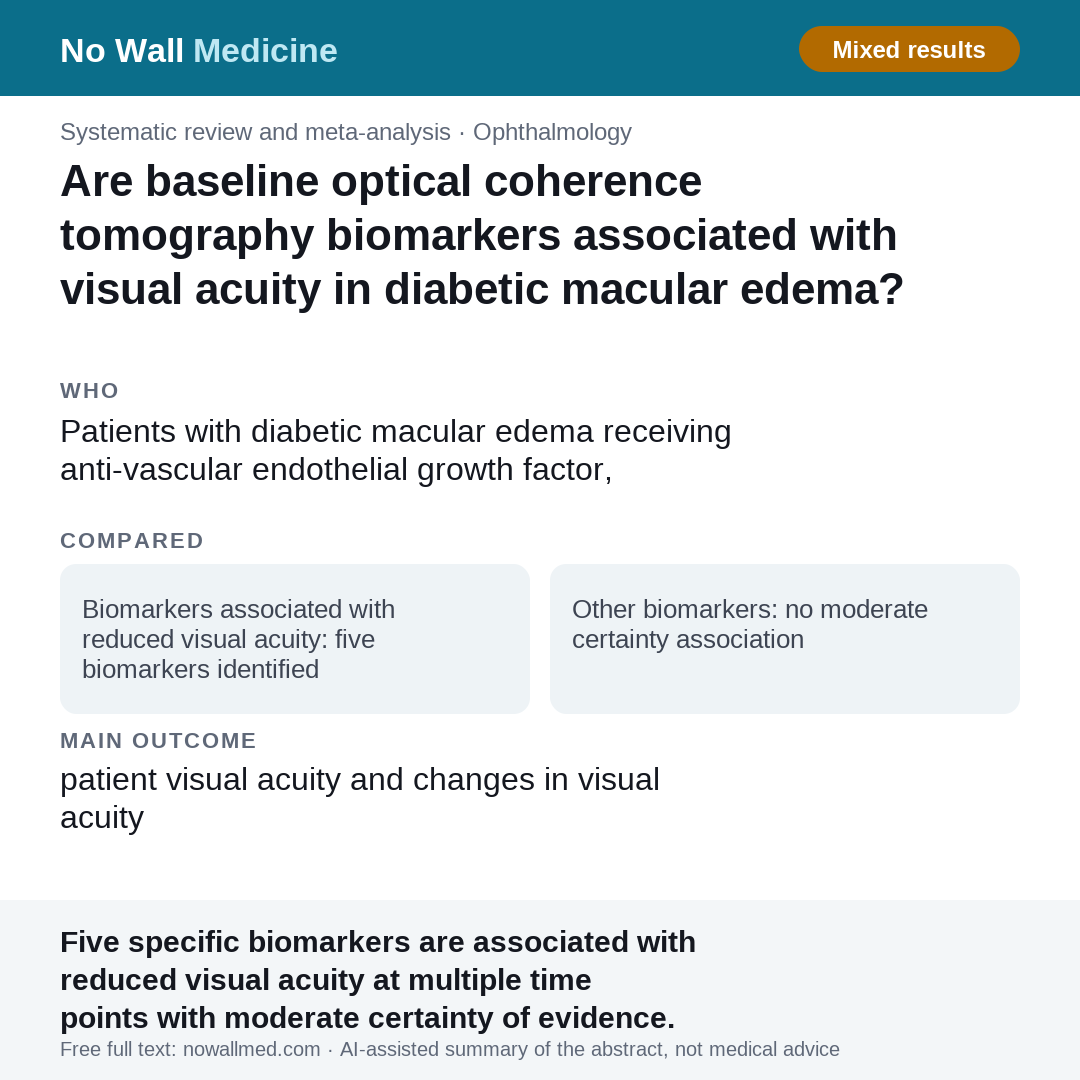
Are baseline optical coherence tomography biomarkers associated with visual acuity in diabetic macular edema?
Who
Patients with diabetic macular edema receiving anti-vascular endothelial growth factor, steroid, or laser treatment
Compared
Biomarkers associated with reduced visual acuity: five biomarkers identified
Other biomarkers: no moderate certainty association
Main outcome
patient visual acuity and changes in visual acuity
Bottom line: Five specific biomarkers are associated with reduced visual acuity at multiple time points with moderate certainty of evidence.
Limitation: Greater standardization in biomarker classification and better control of confounding variables are needed.
Ophthalmology · 2025-08-11Download image
Clinical question: Are baseline optical coherence tomography biomarkers associated with visual acuity in diabetic macular edema?
Why it matters: It is unclear if specific biomarkers measured by optical coherence tomography can predict how vision will change after anti-vascular endothelial growth factor, steroid, or laser treatment.
Key points
- Researchers analyzed 27 studies involving 75 biomarkers to evaluate their links to visual acuity in patients with diabetic macular edema.
- Five biomarkers, including hyperreflective retinal foci and disorganization of retinal inner layers, were associated with reduced visual acuity at two or more time points.
- No biomarker with at least moderate certainty was associated with improved visual acuity or changes in visual acuity after treatment.
Limitation the authors note: Greater standardization in biomarker classification and better control of confounding variables are needed.
Headline and key points written with AI from the paper’s abstract, with every number checked against it. Read the paper before relying on them.
Topics
Cite this article
Nanji K, Grad J, Hatamnejad A, El-Sayes A, Mihalache A, Gemae M. Baseline OCT Biomarkers Associated with Visual Acuity in Diabetic Macular Edema: A Systematic Review and Meta-analysis. Ophthalmology. 2025. doi:10.1016/j.ophtha.2025.07.038
Spotted a mistake? Suggest a correction