Biomarker risk score was associated with kidney outcomes in patients with type 2 diabetes
Baseline Risk and Longitudinal Changes in kidneyintelX.dkd and Its Association With Kidney Outcomes in the CANVAS and CREDENCE Trials
Analysis of two randomized controlled trialsBenefit found
Does kidneyintelX.dkd score predict kidney outcomes and respond to canagliflozin in diabetes?
Who
Patients with type 2 diabetes and chronic kidney disease · CANVAS and CREDENCE clinical trials
Compared
Canagliflozin: significantly lowered kidneyintelX.dkd score
Placebo
Main outcome
Kidney outcomes and kidneyintelX.dkd score changes
Bottom line: The kidneyintelX.dkd score predicts kidney outcomes and reflects treatment response to canagliflozin in diabetes.
Diabetes Care · 2025-11-11Download image
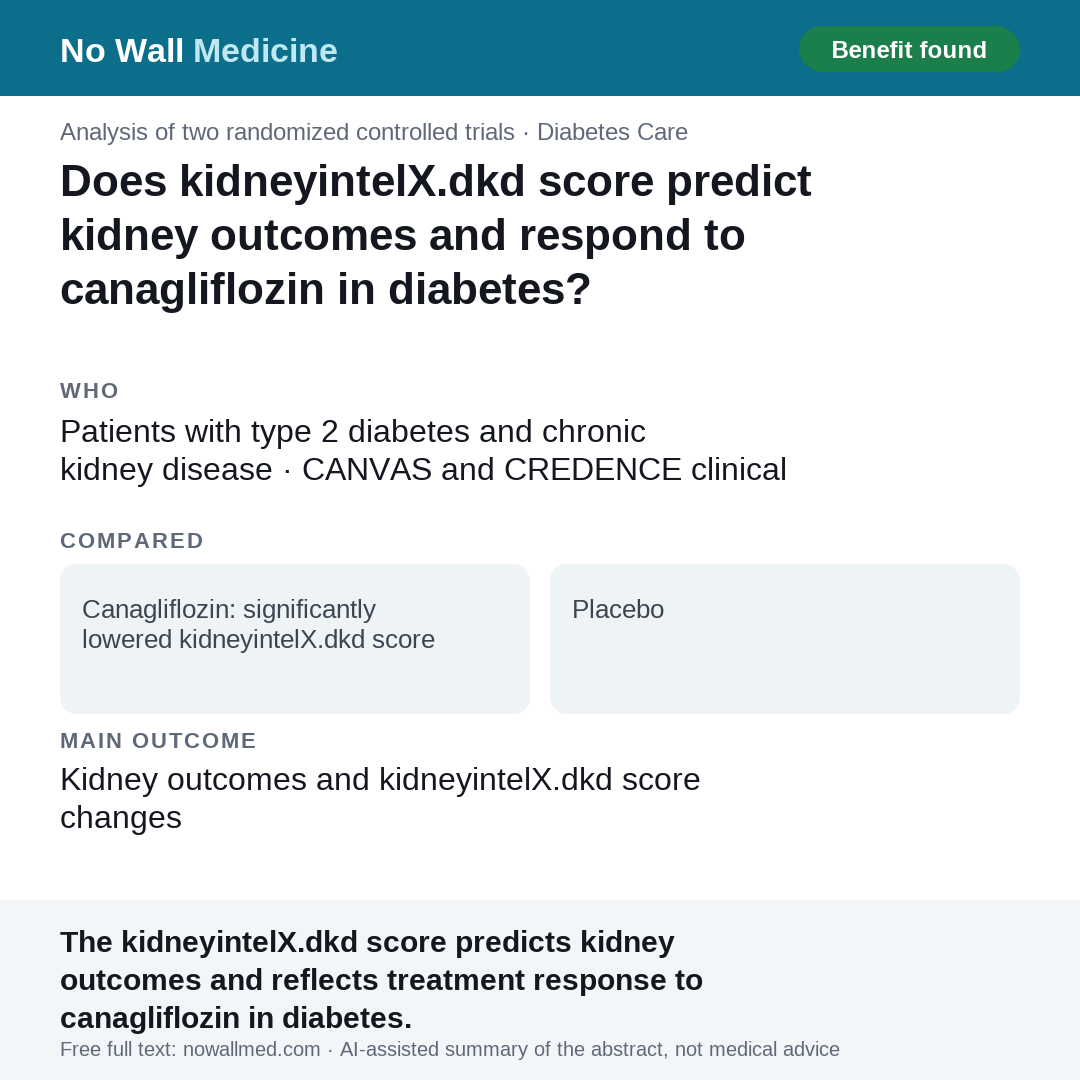
Clinical question: Does kidneyintelX.dkd score predict kidney outcomes and respond to canagliflozin in diabetes?
Why it matters: It is unclear if the kidneyintelX.dkd biomarker-based risk score provides better prognostic value than the established KDIGO risk classification for patients with type 2 diabetes.
Key points
- Researchers studied participants from the CANVAS and CREDENCE randomized controlled trials who had type 2 diabetes and chronic kidney disease.
- The kidneyintelX.dkd score, based on tumor necrosis factor receptor-1 and kidney injury molecule-1, was associated with kidney outcomes and was more predictive than the KDIGO classification.
- At 1 year, canagliflozin was associated with lower kidneyintelX.dkd scores compared to placebo, and longitudinal reductions were associated with lower subsequent risk of kidney outcomes.
Headline and key points written with AI from the paper’s abstract, with every number checked against it. Read the paper before relying on them.
Topics
Cite this article
Moedt E, Coca SG, Edwards K, Neuen BL, Arnott C, Bakker SJL. Baseline Risk and Longitudinal Changes in kidneyintelX.dkd and Its Association With Kidney Outcomes in the CANVAS and CREDENCE Trials. Diabetes Care. 2025. doi:10.2337/dc25-1722
Spotted a mistake? Suggest a correction