Higher baseline symptom severity was associated with larger symptom reductions after cognitive behavioral therapy
Baseline Severity as a Moderator of the Waiting List-Controlled Association of Cognitive Behavioral Therapy With Symptom Change in Social Anxiety Disorder: A Systematic Review and Individual Patient Data Meta-analysis
Systematic review and individual patient data meta-analysisBenefit found
Does baseline symptom severity moderate the association between cognitive behavioral therapy and symptom change in social anxiety disorder?
Who
1246
Adults with a primary clinical diagnosis of social anxiety disorder
Compared
Cognitive behavioral therapy: b = -20.3 (95% CI, -24.9 to -15.6)
Waiting list
Main outcome
Change in Liebowitz Social Anxiety Scale scores from baseline to posttreatment
Result: b = -0.22 (95% CI, -0.39 to -0.06)
Bottom line: Higher baseline social anxiety symptom severity was associated with greater absolute symptom reductions after cognitive behavioral therapy.
JAMA Psychiatry · 2023-05-31Download image
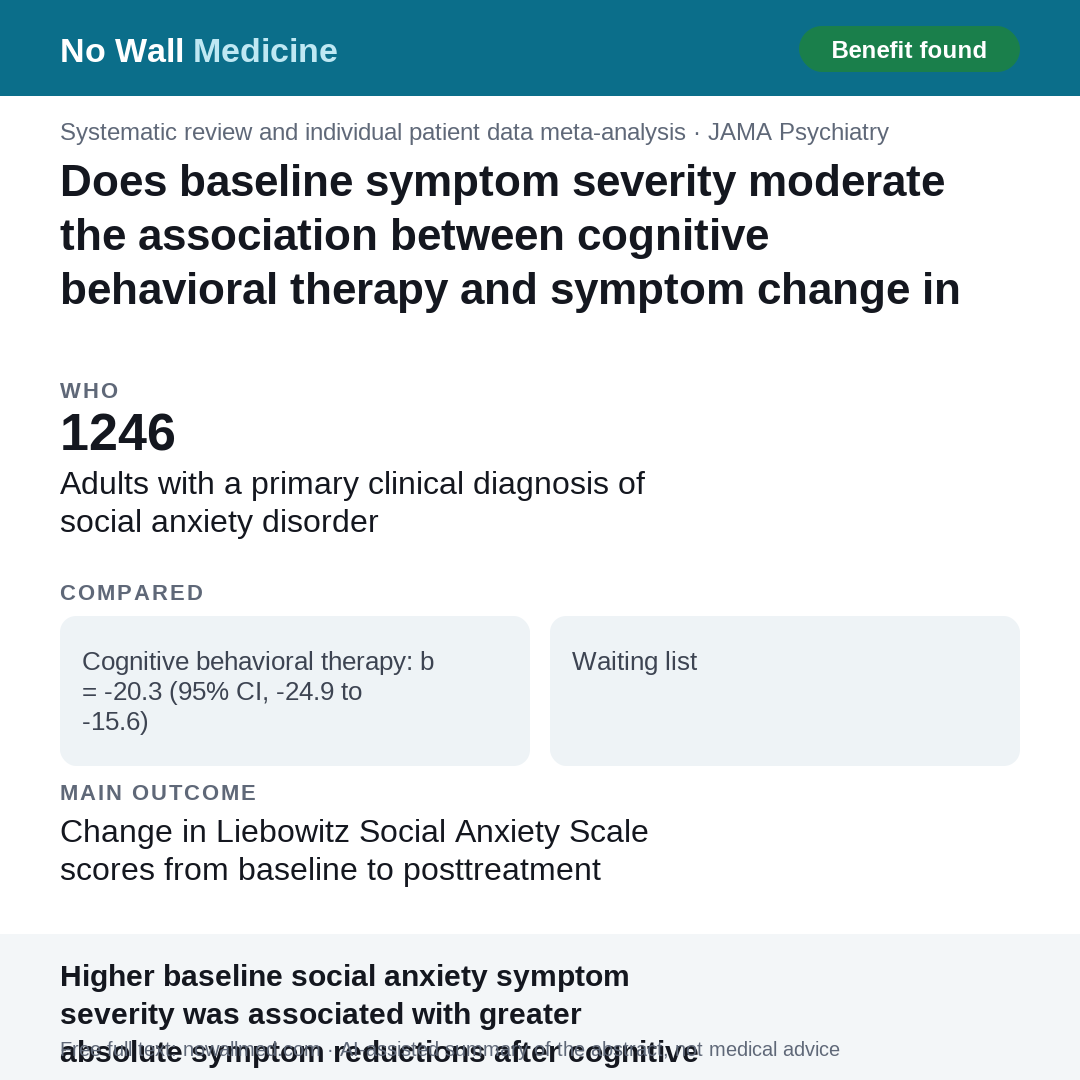
Clinical question: Does baseline symptom severity moderate the association between cognitive behavioral therapy and symptom change in social anxiety disorder?
Why it matters: It is unclear whether the initial severity of social anxiety symptoms predicts how much a patient will respond to cognitive behavioral therapy.
Key points
- Researchers analyzed 12 randomized controlled trials involving 1246 patients with social anxiety disorder to compare cognitive behavioral therapy against a waiting list.
- Patients with very severe symptoms had a Cohen d of -1.13, while those with mild symptoms had a Cohen d of -0.54.
- The meta-analysis found a waiting list-controlled association between cognitive behavioral therapy and changes in the Liebowitz Social Anxiety Scale scores.
Headline and key points written with AI from the paper’s abstract, with every number checked against it. Read the paper before relying on them.
Was this summary helpful?
Subject terms
Cite this article
Scholten W, Seldenrijk A, Hoogendoorn A, Bosman R, Muntingh A, Karyotaki E. Baseline Severity as a Moderator of the Waiting List-Controlled Association of Cognitive Behavioral Therapy With Symptom Change in Social Anxiety Disorder: A Systematic Review and Individual Patient Data Meta-analysis. JAMA Psychiatry. 2023. doi:10.1001/jamapsychiatry.2023.1291
Spotted a mistake? Suggest a correction
Top studies every Monday
The week’s key trials and guidelines in your specialties, plus any topics you follow. By email, free.
Get the weekly digest