Healthcare professionals in Ethiopia show low knowledge and suboptimal attitudes toward basic life support
Basic life support competency among healthcare professionals in Ethiopia: a systematic review and meta-analysis, 2025
Systematic review and meta-analysisMixed results
What are the knowledge and attitude levels regarding basic life support among Ethiopian healthcare professionals?
Who
3045
Healthcare professionals in Ethiopia · Ethiopia
Compared
42.87 %Good knowledge prevalence (95 % CI: 29.15-56.59 %)
71.46 %Favorable attitude prevalence (95 % CI: 69.89-73.04 %)
Main outcome
Knowledge and attitude levels regarding basic life support
Bottom line: Healthcare professionals in Ethiopia showed low knowledge levels and suboptimal attitudes towards basic life support.
Resusc Plus · 2025-09-11Download image
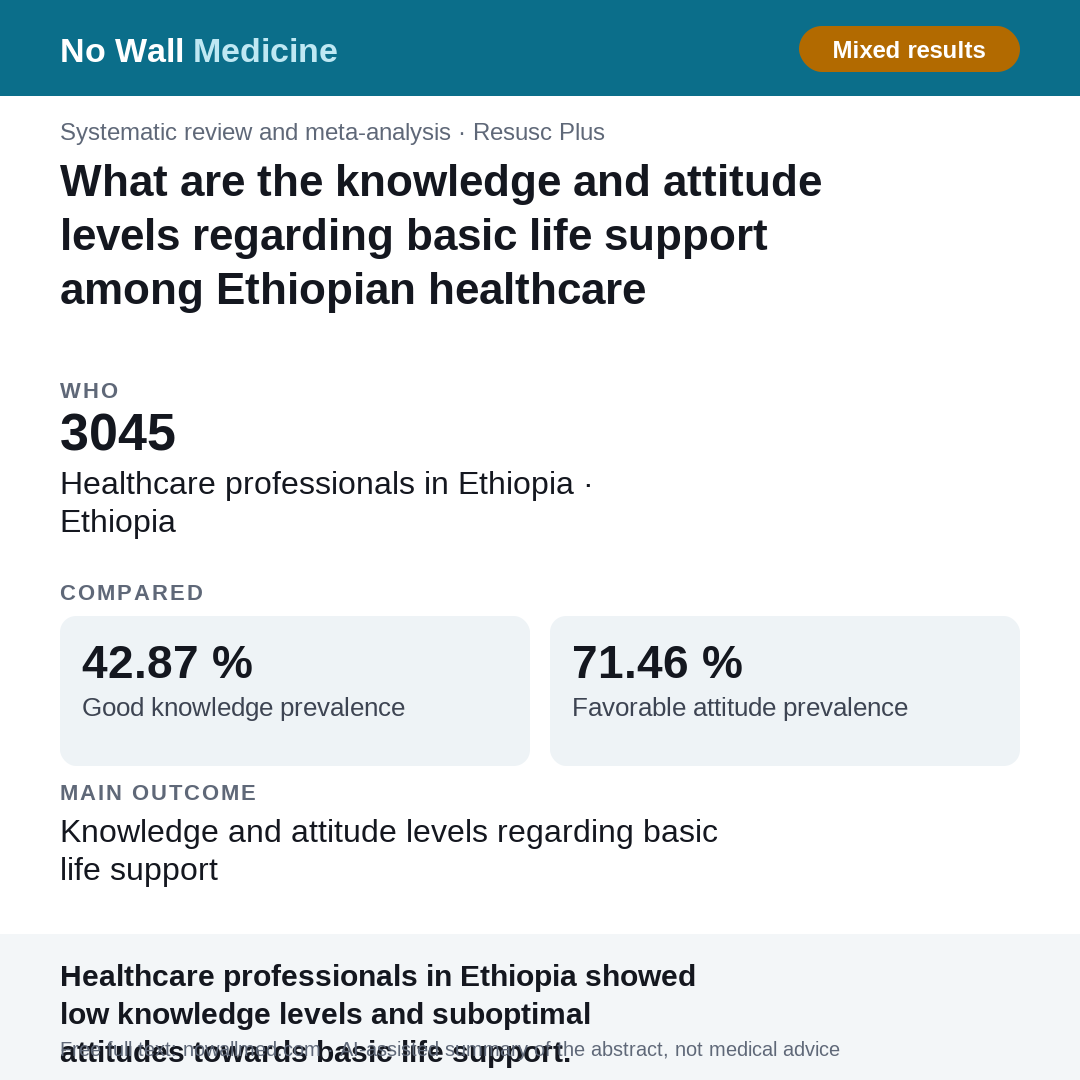
Clinical question: What are the knowledge and attitude levels regarding basic life support among Ethiopian healthcare professionals?
Why it matters: Early cardiopulmonary resuscitation can increase survival rates to 50-70%, but many cardiac arrest victims do not receive timely or adequate life-saving care.
Key points
- Researchers analyzed 12 studies involving 3045 healthcare professionals to assess knowledge and attitudes regarding basic life support, which includes cardiopulmonary resuscitation.
- The pooled prevalence of good knowledge was 42.87% (95% CI: 29.15-56.59%), while favorable attitudes were 71.46% (95% CI: 69.89-73.04%).
- Being male was negatively associated with knowledge, while previous exposure to basic life support was positively associated with knowledge.
Headline and key points written with AI from the paper’s abstract, with every number checked against it. Read the paper before relying on them.
Cite this article
Abebe GK, Alamaw AW, Abate BB, Tilahun BD, Zemariam AB, Habtie TE. Basic life support competency among healthcare professionals in Ethiopia: a systematic review and meta-analysis, 2025. Resusc Plus. 2025. doi:10.1016/j.resplu.2025.101098
Spotted a mistake? Suggest a correction