Blended cognitive behavioral therapy reduced severe fatigue in patients with stable diffuse glioma
Bayesian adaptive randomized trial of blended cognitive behavioral therapy for severe fatigue in stable diffuse glioma
Bayesian adaptive randomized trialBenefit found
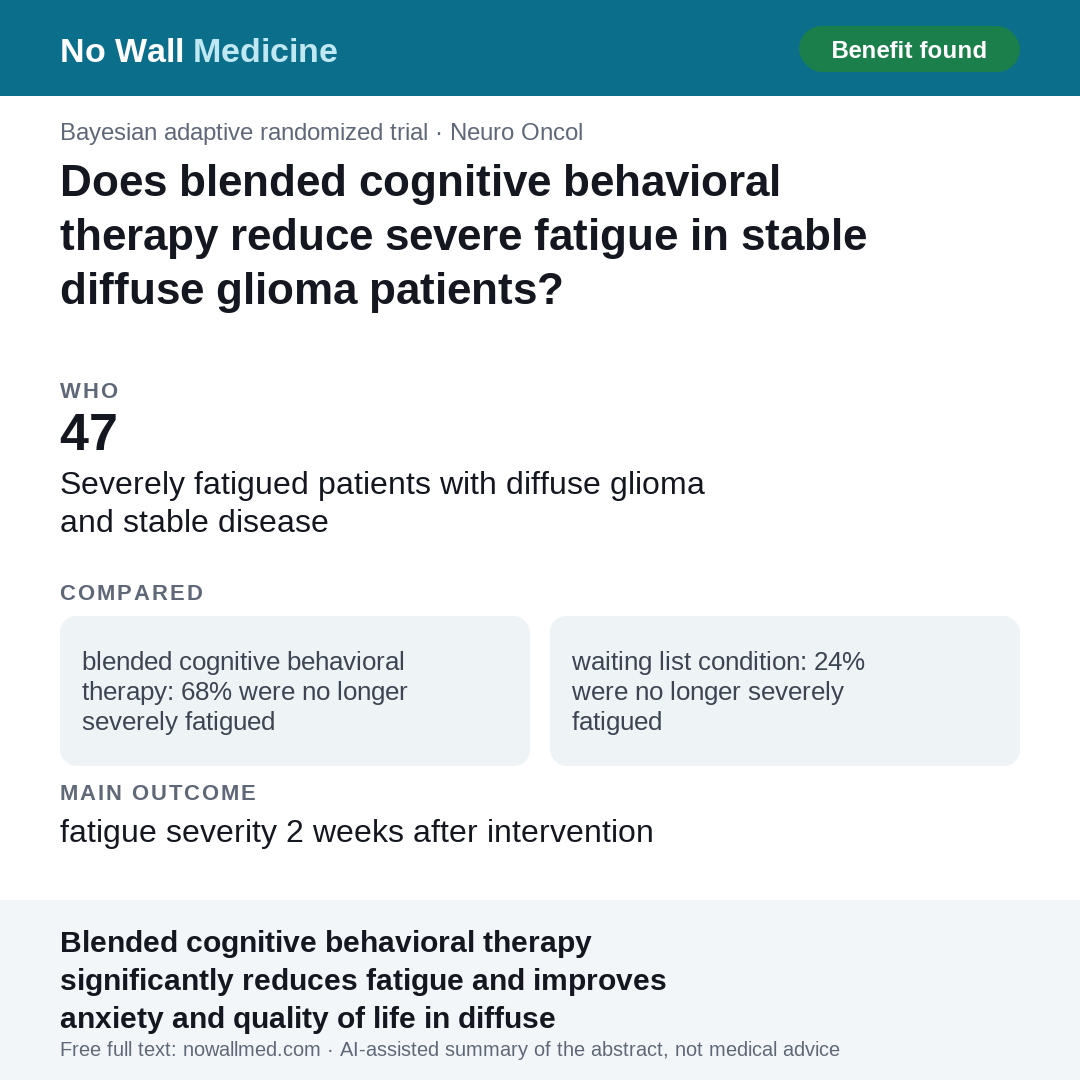
Does blended cognitive behavioral therapy reduce severe fatigue in stable diffuse glioma patients?
Who
47
Severely fatigued patients with diffuse glioma and stable disease
Compared
blended cognitive behavioral therapy: 68% were no longer severely fatigued
waiting list condition: 24% were no longer severely fatigued
Main outcome
fatigue severity 2 weeks after intervention
Result: Cohen's d 1.12 [95% CI: 0.43-1.81]
Bottom line: Blended cognitive behavioral therapy significantly reduces fatigue and improves anxiety and quality of life in diffuse glioma patients.
Neuro Oncol · 2025-11-10Download image
Clinical question: Does blended cognitive behavioral therapy reduce severe fatigue in stable diffuse glioma patients?
Why it matters: No evidence-based treatment is currently available for the severe fatigue commonly experienced by patients with diffuse glioma.
Key points
- Researchers studied 47 patients with stable diffuse glioma and severe fatigue, comparing 12 weeks of blended cognitive behavioral therapy to a waiting list condition.
- At 2 weeks after the intervention, 68% of patients receiving blended cognitive behavioral therapy were no longer severely fatigued compared to 24% in the waiting list group.
- The therapy was also associated with improvements in anxiety, health-related quality of life, and future uncertainty.
Headline and key points written with AI from the paper’s abstract, with every number checked against it. Read the paper before relying on them.
Topics
Cite this article
Gorter M, Röttgering JG, Belgers V, Blom MEC, Thomassen B, De Witt Hamer PC. Bayesian adaptive randomized trial of blended cognitive behavioral therapy for severe fatigue in stable diffuse glioma. Neuro Oncol. 2025. doi:10.1093/neuonc/noaf256
Spotted a mistake? Suggest a correction