Bayesian Network Meta-Analysis of Long-Term Survival: Single vs Multiple vs Total Arterial Coronary Bypass Grafting
Bayesian network meta-analysisBenefit found
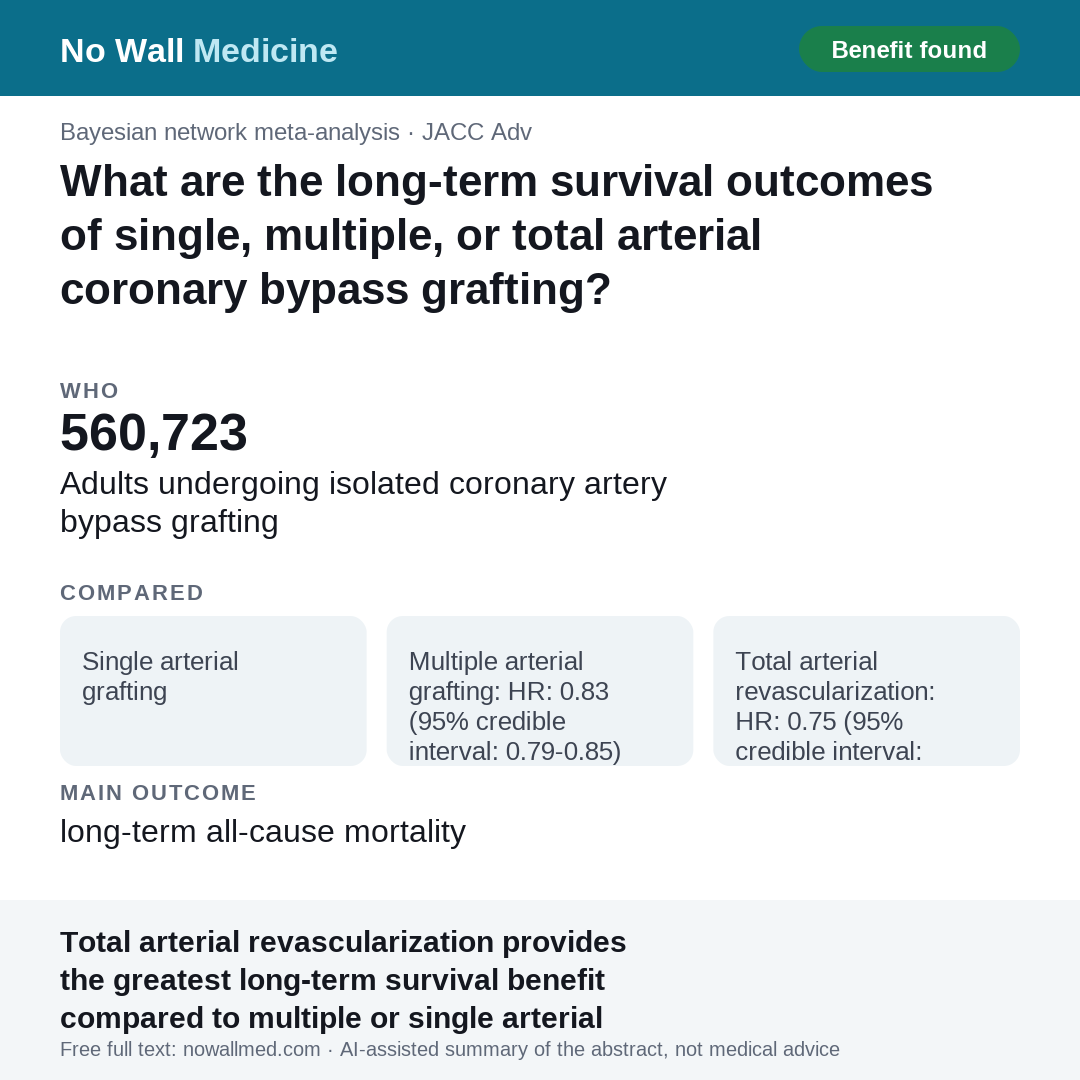
What are the long-term survival outcomes of single, multiple, or total arterial coronary bypass grafting?
Who
560,723
Adults undergoing isolated coronary artery bypass grafting
Compared
Single arterial grafting
Multiple arterial grafting: HR: 0.83 (95% credible interval: 0.79-0.85)
Total arterial revascularization: HR: 0.75 (95% credible interval: 0.70-0.79)
Main outcome
long-term all-cause mortality
Result: HR: 0.90 (95% CrI: 0.85-0.96) for total arterial revascularization versus multiple arterial grafting
Bottom line: Total arterial revascularization provides the greatest long-term survival benefit compared to multiple or single arterial grafting.
JACC Adv · 2026-08-09Download image
Clinical question: What are the long-term survival outcomes of single, multiple, or total arterial coronary bypass grafting?
Abstract
Background
Arterial conduit strategies in coronary artery bypass grafting (CABG) have been associated with superior graft durability to saphenous vein grafts. However, the relative benefits of multiple arterial grafting (MAG) and total arterial revascularization (TAR) remain uncertain due to limited direct comparative evidence. Objectives
This systematic review and Bayesian network meta-analysis (PROSPERO; CRD420251117898) evaluated long-term survival outcomes associated with single arterial grafting (SAG), MAG, and TAR. Methods
Medical Literature Analysis and Retrieval System Online, Excerpta Medica Database, and the Cochrane Library were searched from inception to March 2026 for studies comparing CABG conduit strategies reporting adjusted HRs for long-term all-cause mortality. Studies including adults undergoing isolated CABG with SAG, MAG, or TAR were eligible. A Bayesian random-effects network meta-analysis was performed to integrate direct and indirect evidence. This framework permitted quantification of TAR-versus MAG comparisons, which had previously been limited by scarce direct evidence. Treatment ranking was assessed using the surface under the cumulative ranking curve. Results
Fifty-four studies including 560,723 patients were analyzed. Compared with SAG, MAG was associated with lower long-term mortality (HR: 0.83; 95% credible interval [CrI]: 0.79-0.85), whereas TAR demonstrated a greater survival benefit (HR: 0.75; 95% CrI: 0.70-0.79). Indirect comparison within the network suggested an incremental survival advantage of TAR over MAG (HR: 0.90; 95% CrI: 0.85-0.96). Treatment ranking suggested a hierarchy in which TAR was associated with superior survival, followed by MAG and SAG. Conclusions
Increasing use of arterial conduits during CABG is associated with progressively improved long-term survival, with TAR demonstrating the greatest benefit.
Spotted a mistake? Suggest a correction