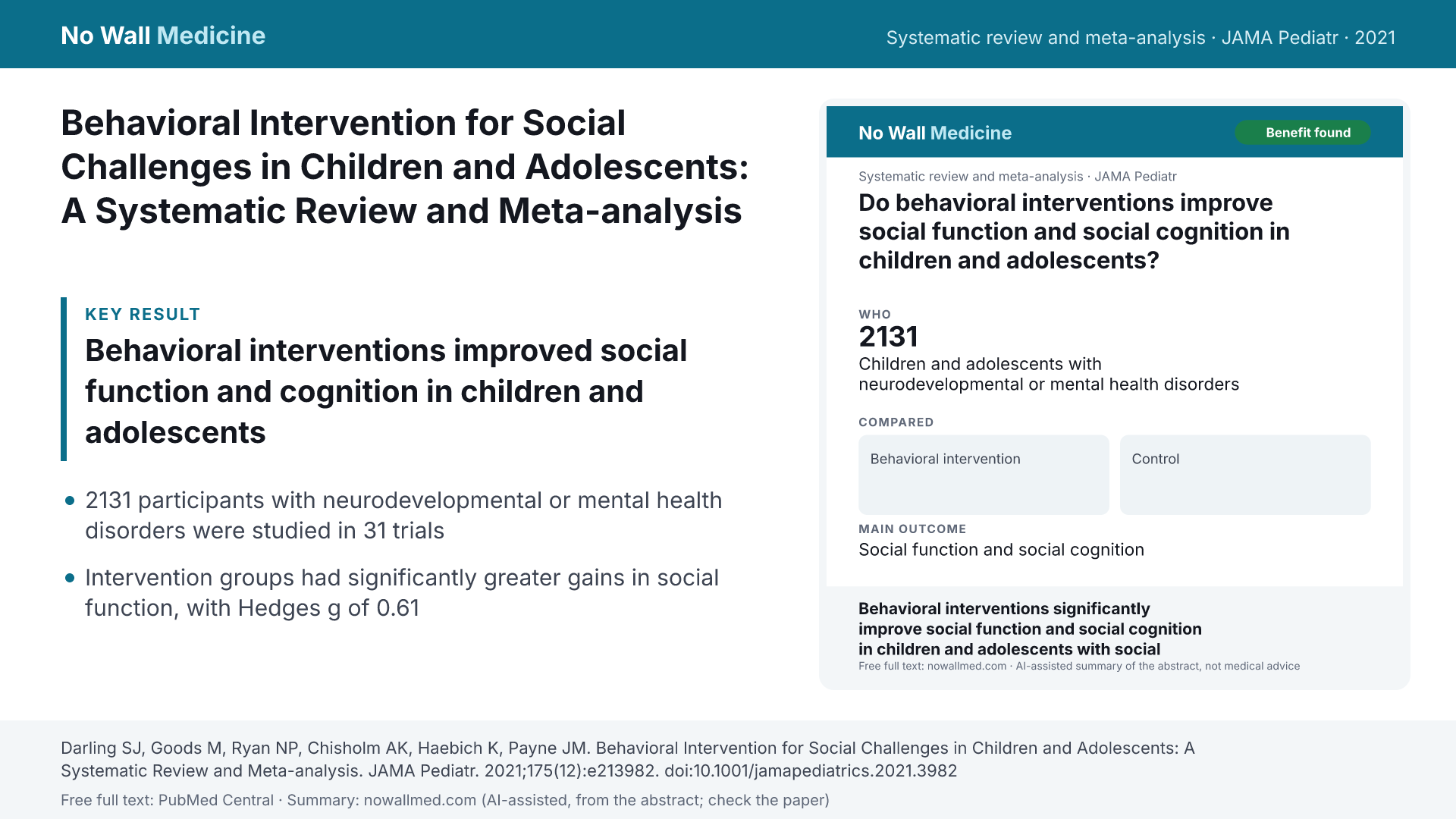
Behavioral Intervention for Social Challenges in Children and Adolescents: A Systematic Review and Meta-analysis
Key result: Behavioral interventions improved social function and cognition in children and adolescents
Systematic review and meta-analysisBenefit found
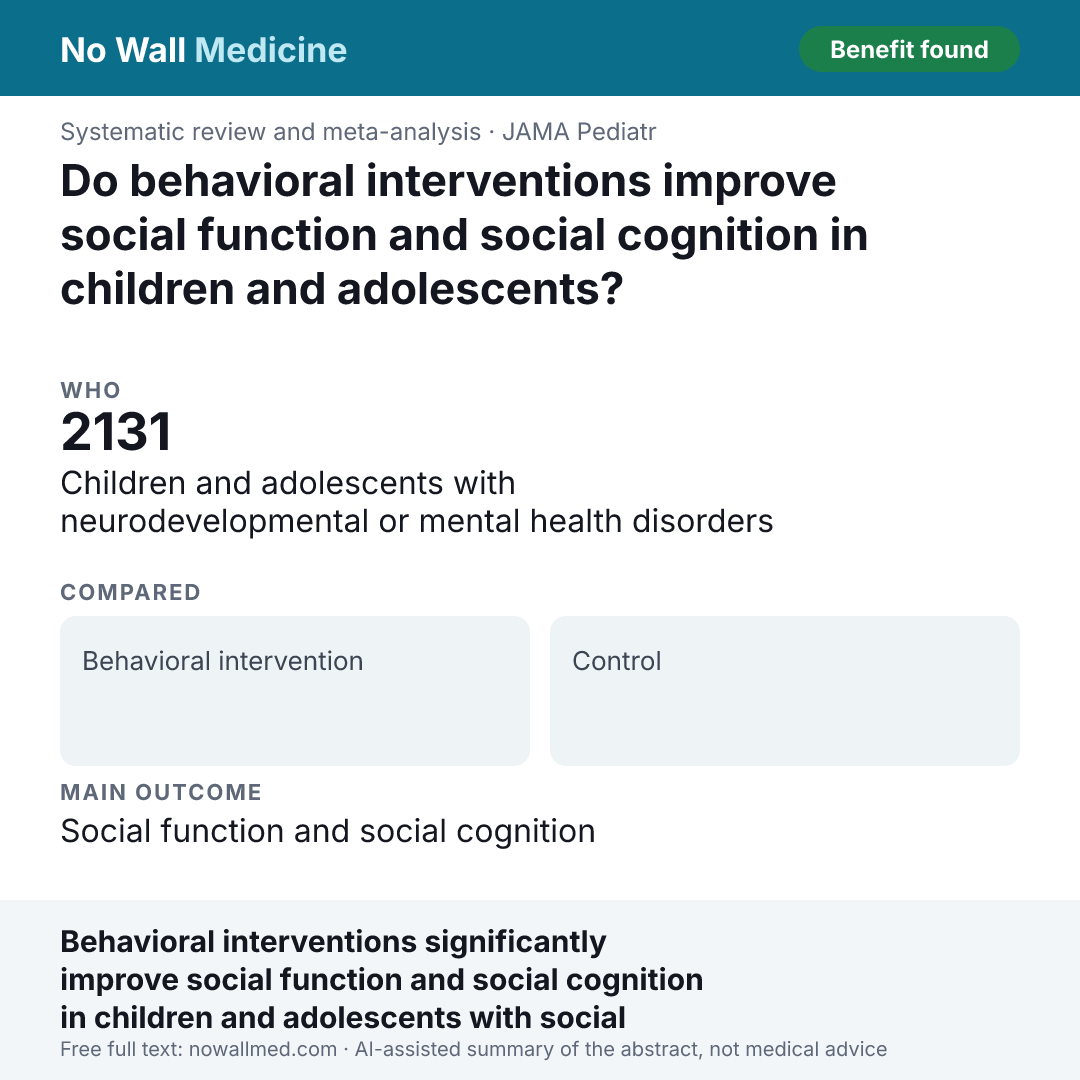
Do behavioral interventions improve social function and social cognition in children and adolescents?
Who
2131
Children and adolescents with neurodevelopmental or mental health disorders
Compared
Behavioral intervention
Control
Main outcome
Social function and social cognition
Result: Hedges g 0.61 (95% CI, 0.40-0.83) for social function; Hedges g 0.67 (95% CI, 0.39-0.96) for social cognition
Bottom line: Behavioral interventions significantly improve social function and social cognition in children and adolescents with social deficits.
JAMA Pediatr · 2021-12-06 · Save PNG
Key points
- 2131 participants with neurodevelopmental or mental health disorders were studied in 31 trials.
- Intervention groups had significantly greater gains in social function, with Hedges g of 0.61.
- Intervention groups also had better performance on social cognitive tasks, with Hedges g of 0.67.
Limitation the authors note: None stated in the abstract
Discussion prompts
- Would these patients look like yours? Who was left out?
- Is the main outcome one that matters to patients?
- Is the difference large enough to change what you do?
Cite: Darling SJ, Goods M, Ryan NP, Chisholm AK, Haebich K, Payne JM. Behavioral Intervention for Social Challenges in Children and Adolescents: A Systematic Review and Meta-analysis. JAMA Pediatr. 2021;175(12):e213982. doi:10.1001/jamapediatrics.2021.3982
Free full text: PubMed Central · Summary and visual abstract: nowallmed.com/a/behavioral-intervention-for-social-challenges-in-children-and-pngodr/ (AI-assisted from the abstract; check the paper before relying on it).