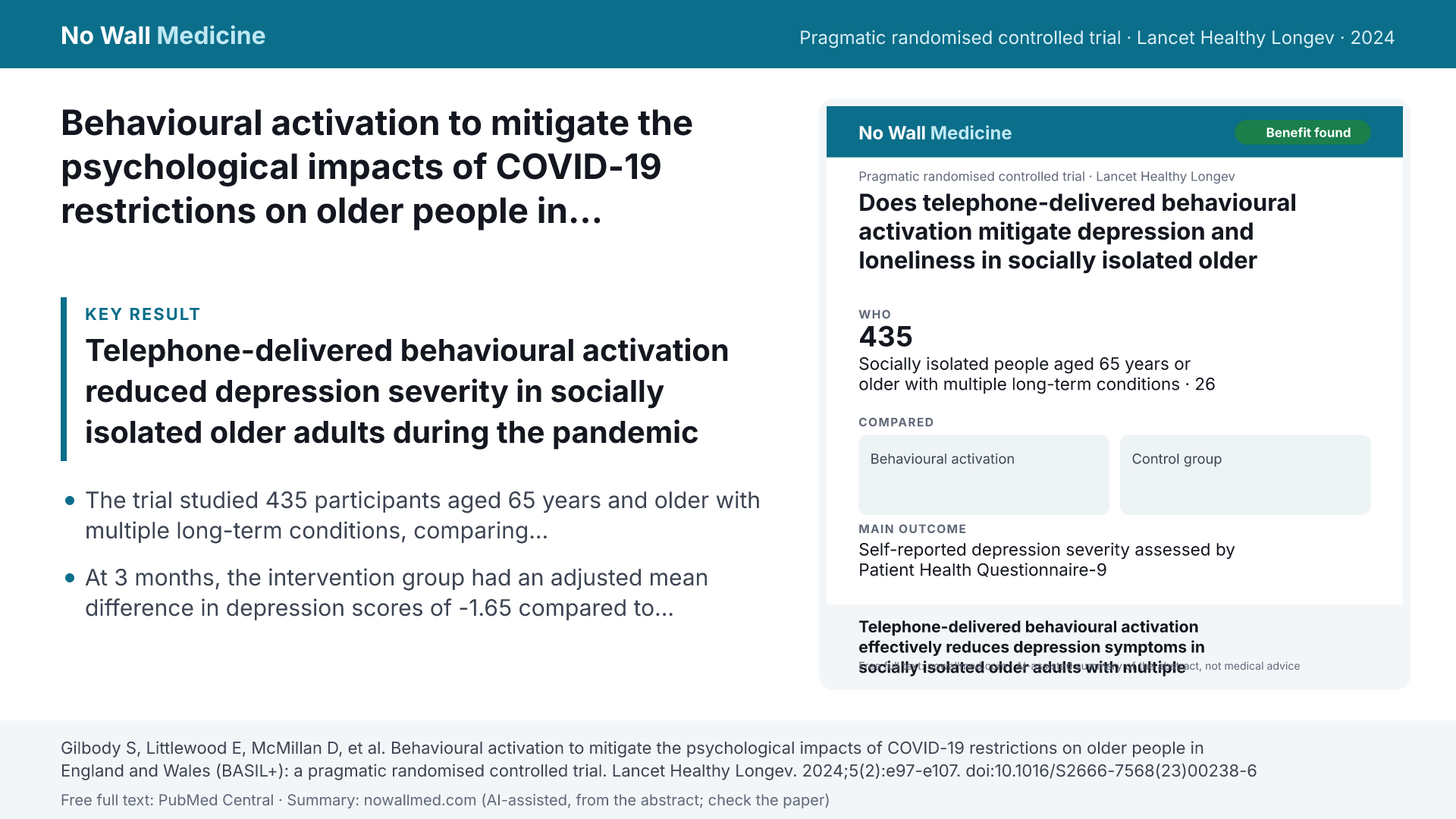
Telephone-delivered behavioural activation reduced depression severity in socially isolated older adults during the pandemic
Behavioural activation to mitigate the psychological impacts of COVID-19 restrictions on older people in England and Wales (BASIL+): a pragmatic randomised controlled trial
Pragmatic randomised controlled trialBenefit found
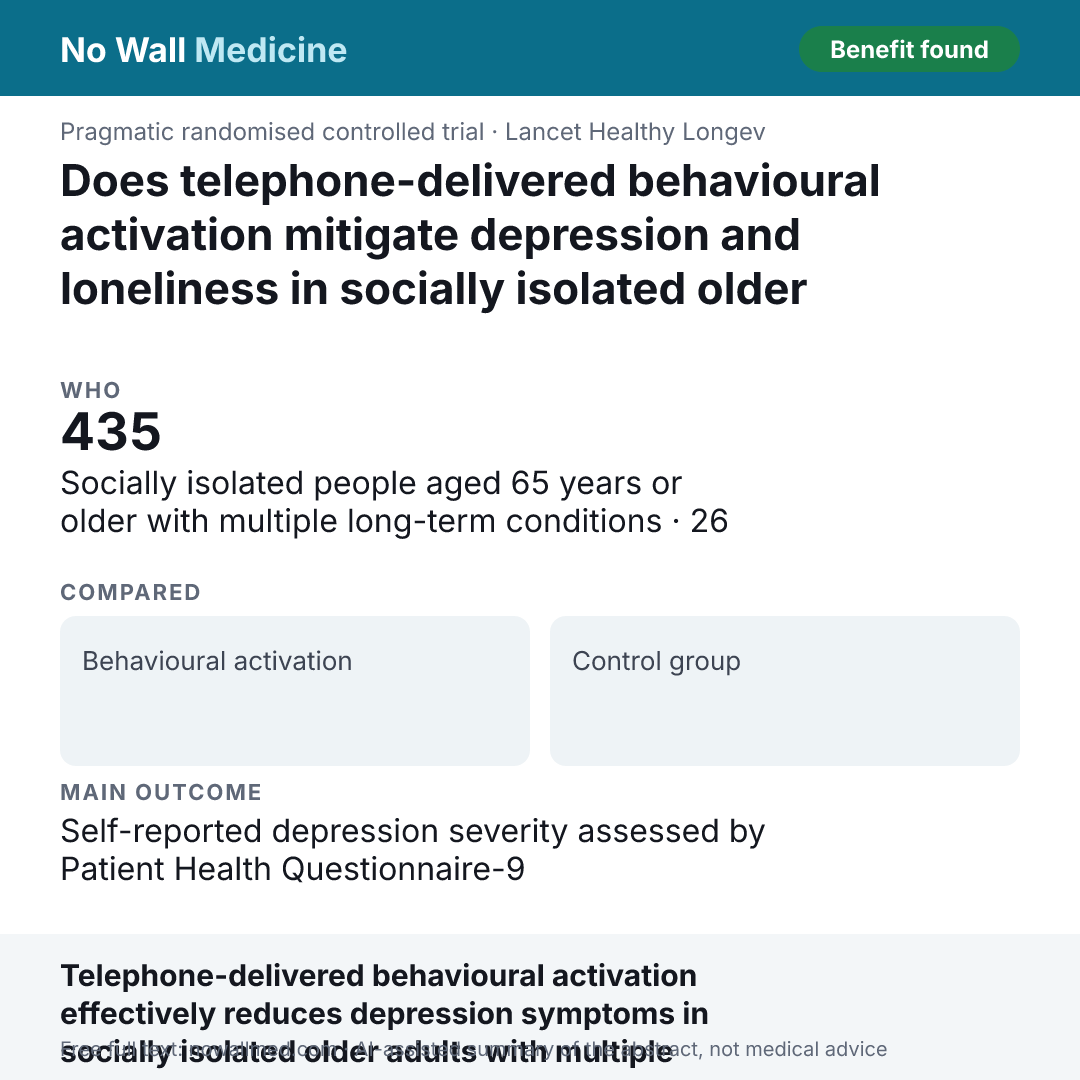
Does telephone-delivered behavioural activation mitigate depression and loneliness in socially isolated older people?
Who
435
Socially isolated people aged 65 years or older with multiple long-term conditions · 26 general practices in England and Wales
Compared
Behavioural activation
Control group
Main outcome
Self-reported depression severity assessed by Patient Health Questionnaire-9
Result: adjusted mean difference -1·65 (95% CI -2·54 to -0·75)
Bottom line: Telephone-delivered behavioural activation effectively reduces depression symptoms in socially isolated older adults with multiple long-term conditions.
Funded by: UK National Institute for Health and Care Research
Lancet Healthy Longev · 2024-02-05 · Save PNG
Clinical question: Does telephone-delivered behavioural activation mitigate depression and loneliness in socially isolated older people?
Key points
- The trial studied 435 participants aged 65 years and older with multiple long-term conditions, comparing telephone-delivered behavioural activation to usual care.
- At 3 months, the intervention group had an adjusted mean difference in depression scores of -1.65 compared to the control group.
- No adverse events were reported that were linked to the behavioural activation intervention.
Headline and key points written with AI from the paper’s abstract, with every number checked against it. Read the paper before relying on them.
Was this summary helpful?
Abstract
Background
Older adults were more likely to be socially isolated during the COVID-19 pandemic, with increased risk of depression and loneliness. We aimed to investigate whether a behavioural activation intervention delivered via telephone could mitigate depression and loneliness in at-risk older people during the COVID-19 pandemic. Methods
BASIL+ (Behavioural Activation in Social Isolation) was a pragmatic randomised controlled trial conducted among patients recruited from general practices in England and Wales, and was designed to assess the effectiveness of behavioural activation in mitigating depression and loneliness among older people during the COVID-19 pandemic. Eligible participants were aged 65 years and older, socially isolated, with a score of 5 or higher on the Patient Health Questionnaire-9 (PHQ-9), and had multiple long-term conditions. Participants were allocated in a 1:1 ratio to the intervention (behavioural activation) or control groups by use of simple randomisation without stratification. Behavioural activation was delivered by telephone; participants were offered up to eight weekly sessions with trained BASIL+ Support Workers. Behavioural activation was adapted to maintain social connections and encourage socially reinforcing activities. Participants in the control group received usual care with existing COVID-19 wellbeing resources. The primary clinical outcome was self-reported depression severity, assessed by the PHQ-9, at 3 months. Outcomes were assessed masked to allocation and analysis was by treatment allocation. This trial is registered with the ISRCTN registry (ISRCTN63034289). Findings
Between Feb 8, 2021, and Feb 28, 2022, 449 eligible participants were identified and 435 from 26 general practices were recruited and randomly assigned (1:1) to the behavioural activation intervention (n=218) or to the control group (usual care with signposting; n=217). The mean age of participants was 75·7 years (SD 6·7); 270 (62·1%) of 435 participants were female, and 418 (96·1%) were White. Participants in the intervention group attended an average of 5·2 (SD 2·9) of eight remote behavioural activation sessions. The adjusted mean difference in PHQ-9 scores between the control and intervention groups at 3 months was -1·65 (95% CI -2·54 to -0·75, p=0·0003). No adverse events were reported that were attributable to the behavioural activation intervention. Interpretation
Behavioural activation is an effective and potentially scalable intervention that can reduce symptoms of depression and emotional loneliness in at-risk groups in the short term. The findings of this trial add to the range of strategies to improve the mental health of older adults with multiple long-term conditions. These results can be helpful to policy makers beyond the pandemic in reducing the global burden of depression and addressing the health impacts of loneliness, particularly in at-risk groups. Funding
UK National Institute for Health and Care Research.
Abstract reproduced under the article’s CC BY NC ND licence.
Subject terms
Headline, design, result, key points, caveat and citation as plain text.
Cite this article
Gilbody S, Littlewood E, McMillan D, et al. Behavioural activation to mitigate the psychological impacts of COVID-19 restrictions on older people in England and Wales (BASIL+): a pragmatic randomised controlled trial. Lancet Healthy Longev. 2024;5(2):e97-e107. doi:10.1016/S2666-7568(23)00238-6
Spotted a mistake? Suggest a correction