Non-pharmacological interventions were effective for challenging behaviors in children with intellectual disabilities
Behaviours that challenge in children with intellectual disability: systematic review and meta-analysis of pharmacological and non-pharmacological interventions
Systematic review and meta-analysis of 18 trialsMixed results
Are pharmacological or non-pharmacological interventions effective for behaviours that challenge in children?
Who
1443
Children with an intellectual disability aged 18 years or younger
Compared
Non-pharmacological interventions: Hedges' g = -0.20 (95% CI -0.35 to -0.05)
Pharmacological interventions: g = 0.03 (95% CI -0.17 to 0.24)
Main outcome
Reduction in behaviours that challenge
Result: g = -0.12 (95% CI -0.24 to 0.00)
Bottom line: Non-pharmacological interventions were effective, but pharmacological interventions were not, supporting non-pharmacological treatments as first-line care.
Limitation: Most studies were in Western countries with small sample sizes and findings may depend on outcome measures.
BJPsych Open · 2025-10-27Download image
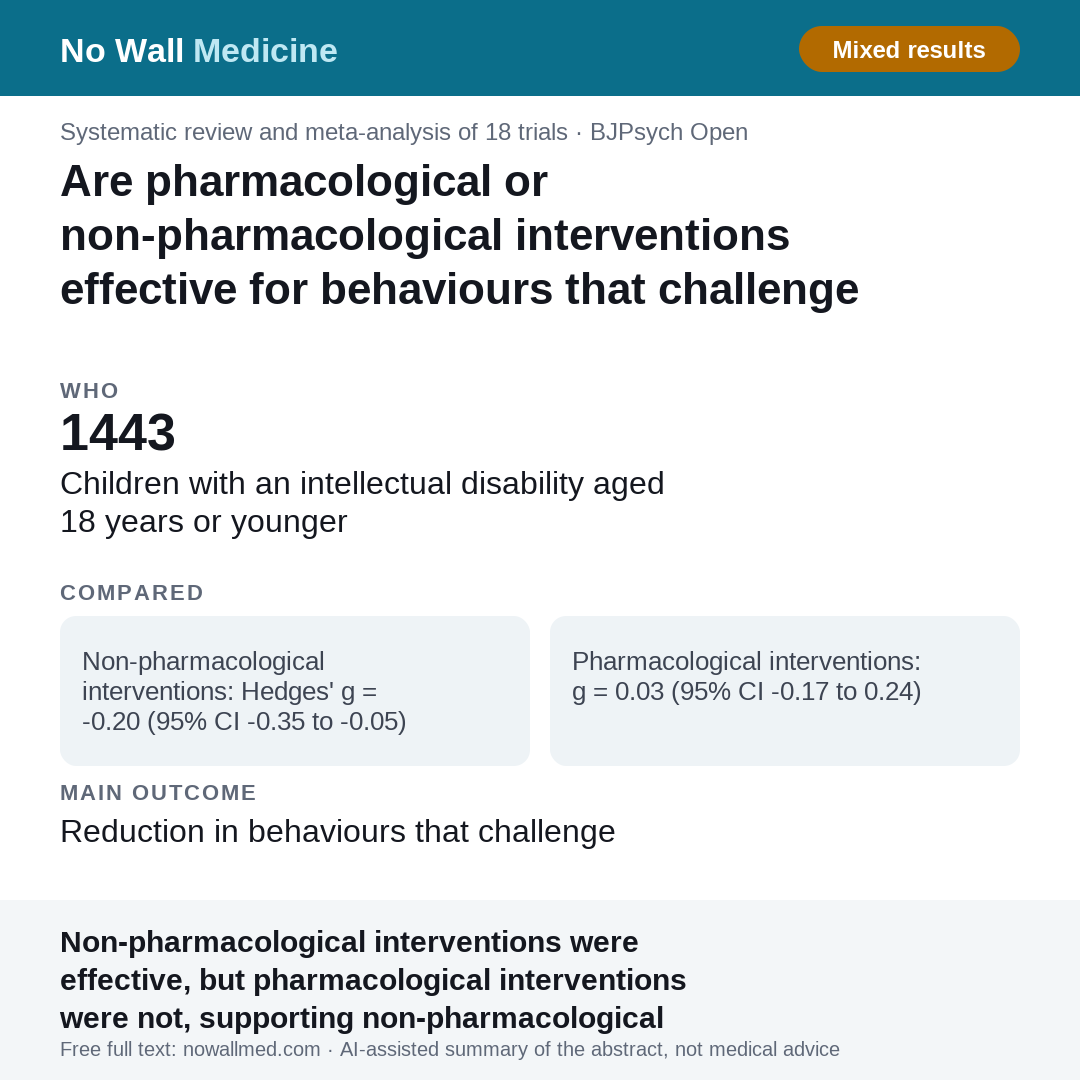
Clinical question: Are pharmacological or non-pharmacological interventions effective for behaviours that challenge in children?
Why it matters: The effectiveness of current pharmacological and non-pharmacological interventions for managing challenging behaviors in children with intellectual disabilities is not fully established.
Key points
- Researchers analyzed 18 randomized controlled trials involving 1443 participants to compare drug-based and non-drug-based treatments for children with intellectual disabilities.
- Non-pharmacological interventions, mostly psychosocial, were significantly effective (Hedges' g = -0.20; 95% CI [-0.35, -0.05]), while pharmacological interventions were not (g = 0.03; 95% CI [-0.17, 0.24]).
- Results varied by measurement tool, as the Child Behaviour Checklist showed significant reductions (g = -0.18; 95% CI [-0.34, -0.02]) but the Aberrant Behaviour Checklist did not (g = 0.04; 95% CI [-0.16, 0.25]).
Limitation the authors note: Most included studies were conducted in Western countries and had small sample sizes.
Headline and key points written with AI from the paper’s abstract, with every number checked against it. Read the paper before relying on them.
Cite this article
Lye V, Hassiotis A, Timmerman A, Alqazlan S, Dimitrova E, Vegh B. Behaviours that challenge in children with intellectual disability: systematic review and meta-analysis of pharmacological and non-pharmacological interventions. BJPsych Open. 2025. doi:10.1192/bjo.2025.10871
Spotted a mistake? Suggest a correction