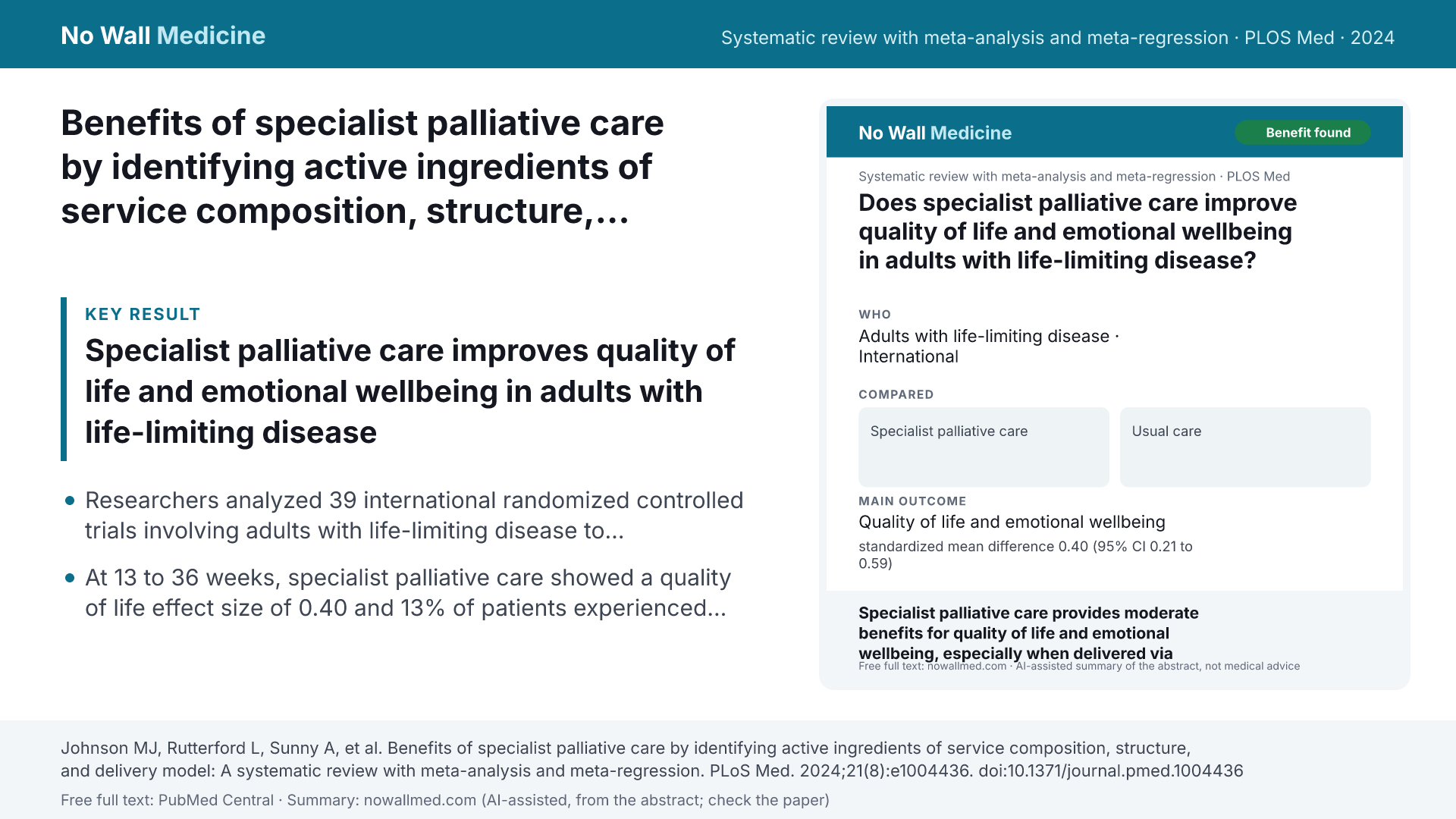
Specialist palliative care improves quality of life and emotional wellbeing in adults with life-limiting disease
Benefits of specialist palliative care by identifying active ingredients of service composition, structure, and delivery model: A systematic review with meta-analysis and meta-regression
Systematic review with meta-analysis and meta-regressionBenefit found
Does specialist palliative care improve quality of life and emotional wellbeing in adults with life-limiting disease?
Who
Adults with life-limiting disease · International
Compared
Specialist palliative care
Usual care
Main outcome
Quality of life and emotional wellbeing
Result: standardized mean difference 0.40 (95% CI 0.21 to 0.59)
Bottom line: Specialist palliative care provides moderate benefits for quality of life and emotional wellbeing, especially when delivered via multidisciplinary models.
Limitation: Minimally clinically important difference effect sizes may be biased by relying on non-palliative care samples.
PLOS Med · 2024-08-02 · Save PNG
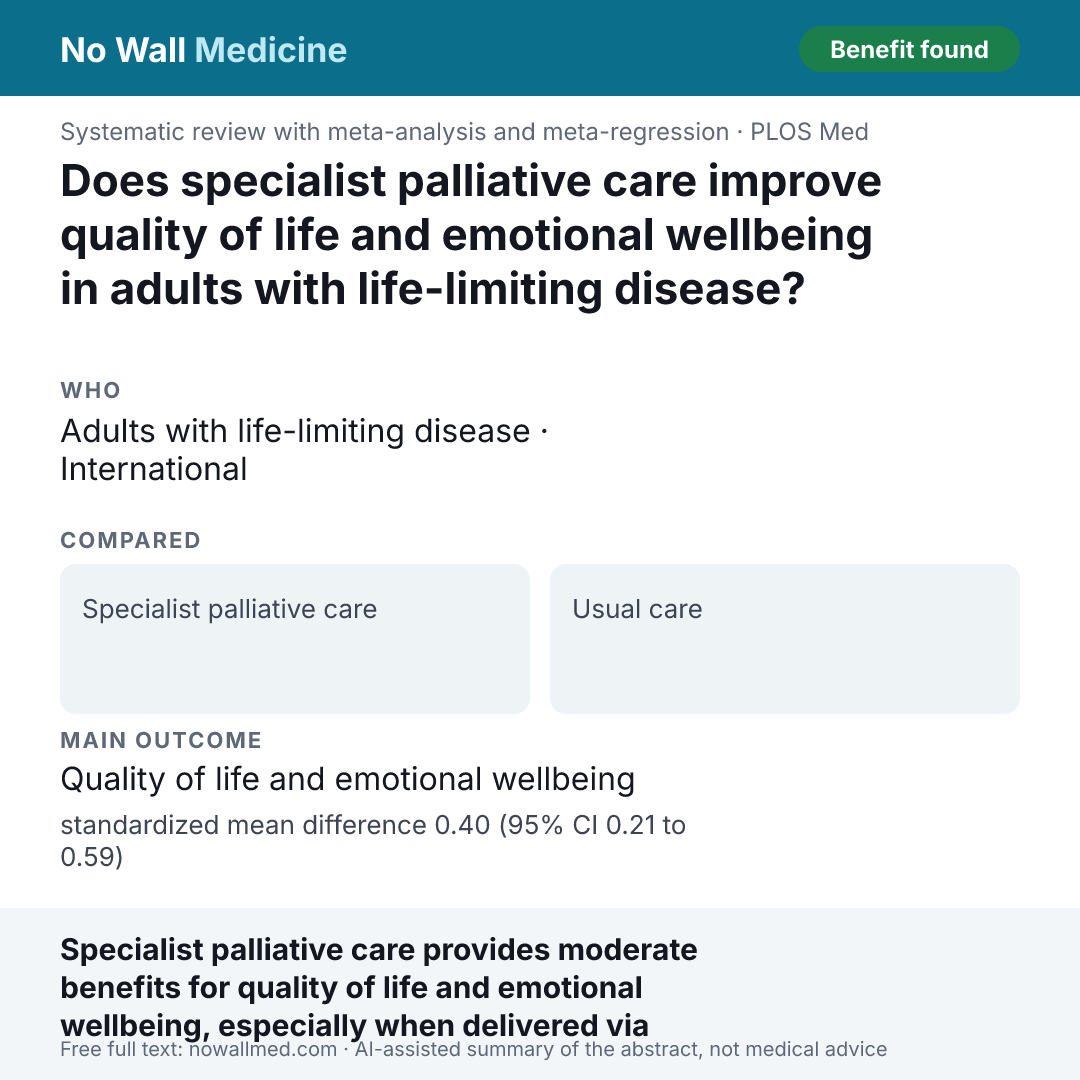
Clinical question: Does specialist palliative care improve quality of life and emotional wellbeing in adults with life-limiting disease?
Why it matters: The best service models for specialist palliative care and their specific effects on quality of life and emotional wellbeing were unknown due to differences in service models and outcome measures.
Key points
- Researchers analyzed 39 international randomized controlled trials involving adults with life-limiting disease to compare specialist palliative care against usual care.
- At 13 to 36 weeks, specialist palliative care showed a quality of life effect size of 0.40 and 13% of patients experienced a change of at least 1 minimally clinically important difference unit.
- For emotional wellbeing at 13 to 36 weeks, 16% of patients experienced a change of at least 1 minimally clinically important difference unit.
Limitation the authors note: The authors state that minimally clinically important difference effect sizes may be biased by relying on derivation in non-palliative care samples.
Headline and key points written with AI from the paper’s abstract, with every number checked against it. Read the paper before relying on them.
Was this summary helpful?
Subject terms
Headline, design, result, key points, caveat and citation as plain text.
Cite this article
Johnson MJ, Rutterford L, Sunny A, et al. Benefits of specialist palliative care by identifying active ingredients of service composition, structure, and delivery model: A systematic review with meta-analysis and meta-regression. PLoS Med. 2024;21(8):e1004436. doi:10.1371/journal.pmed.1004436
Spotted a mistake? Suggest a correction