Review of intensive care unit bereavement interventions shows no significant improvement in caregiver grief
Bereavement interventions to support informal caregivers in the intensive care unit: a systematic review
Systematic review of randomized controlled trialsNo clear difference
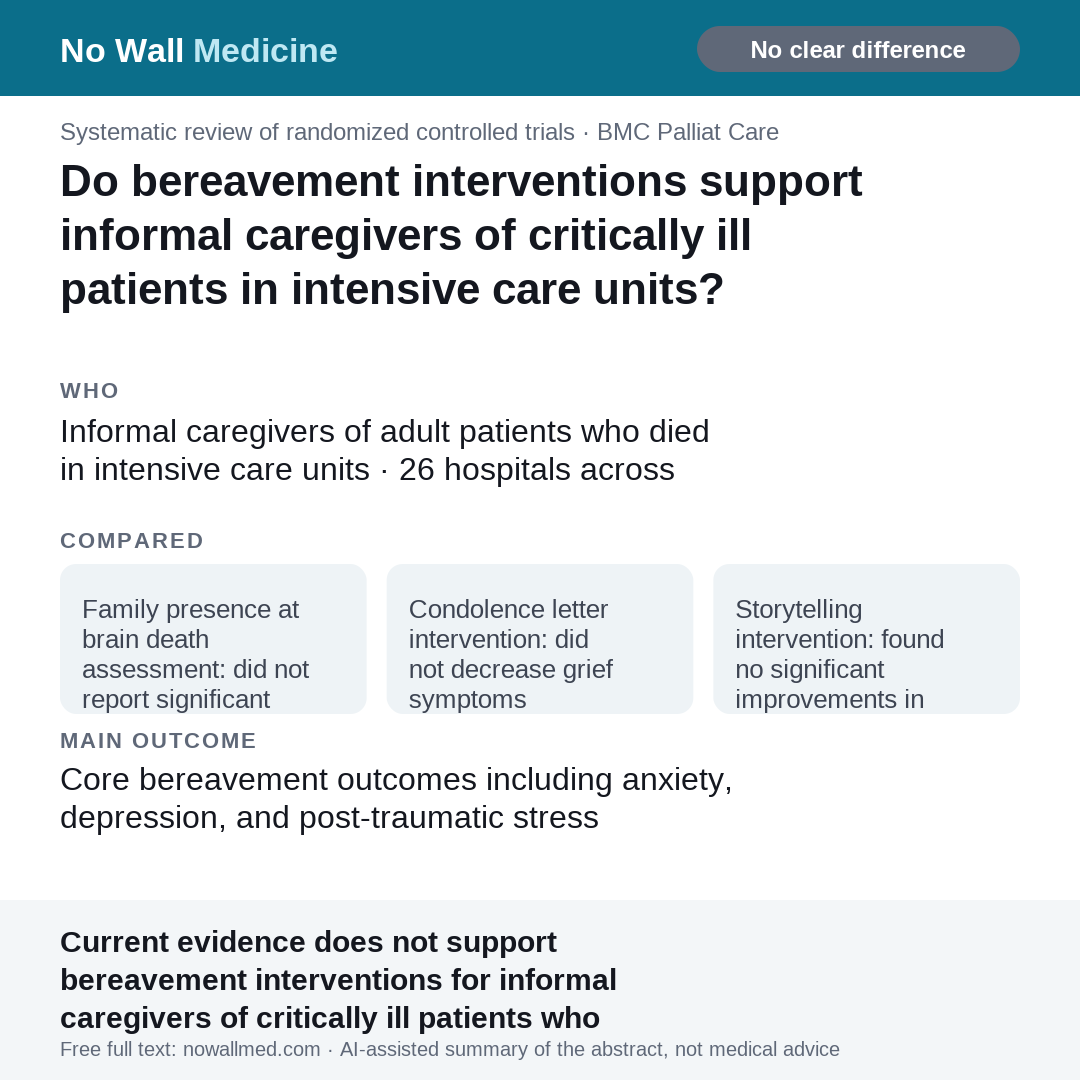
Do bereavement interventions support informal caregivers of critically ill patients in intensive care units?
Who
Informal caregivers of adult patients who died in intensive care units · 26 hospitals across 31 intensive care units
Compared
Family presence at brain death assessment: did not report significant improvement in emotional or psychological distress
Condolence letter intervention: did not decrease grief symptoms
Storytelling intervention: found no significant improvements in anxiety, depression, post-traumatic stress, or complicated grief
Main outcome
Core bereavement outcomes including anxiety, depression, and post-traumatic stress
Bottom line: Current evidence does not support bereavement interventions for informal caregivers of critically ill patients who die in intensive care units.
BMC Palliat Care · 2021-05-12Download image
Clinical question: Do bereavement interventions support informal caregivers of critically ill patients in intensive care units?
Why it matters: It is unknown if bereavement interventions effectively help informal caregivers cope with grief after a loved one dies in the intensive care unit.
Key points
- Researchers reviewed three randomized controlled trials involving 31 intensive care units across 26 hospitals to evaluate support for informal caregivers.
- Interventions including condolence letters and storytelling did not show significant improvements in anxiety, depression, post-traumatic stress, or complicated grief.
- One trial involving family presence during brain death assessment did not report significant improvement in emotional or psychological distress.
Headline and key points written with AI from the paper’s abstract, with every number checked against it. Read the paper before relying on them.
Was this summary helpful?
Subject terms
Cite this article
Moss SJ, Wollny K, Poulin TG, Cook DJ, Stelfox HT, Ordons ARD. Bereavement interventions to support informal caregivers in the intensive care unit: a systematic review. BMC Palliat Care. 2021. doi:10.1186/s12904-021-00763-w
Spotted a mistake? Suggest a correction
Top studies every Monday
The week’s key trials and guidelines in your specialties, plus any topics you follow. By email, free.
Get the weekly digest