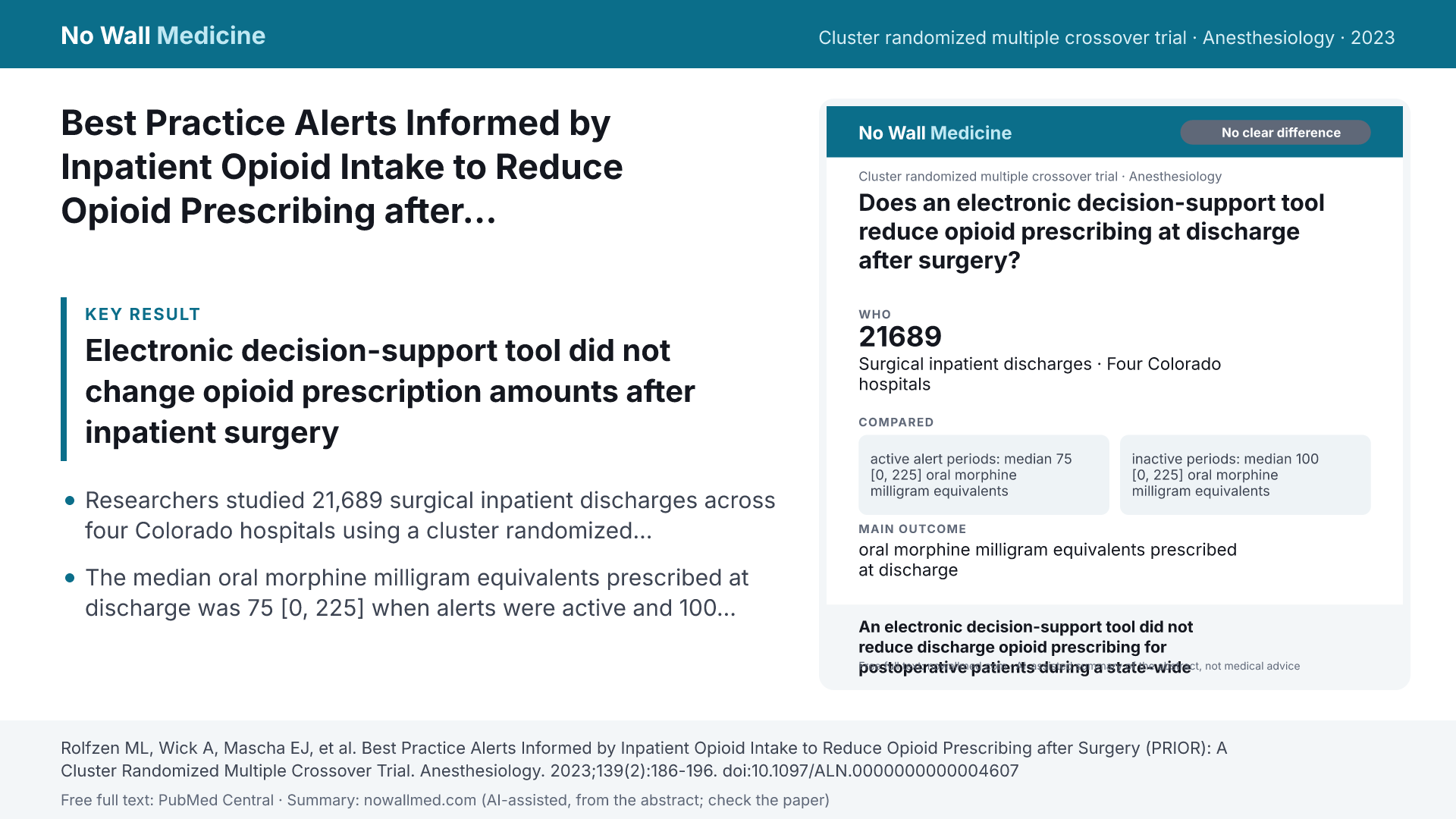
Electronic decision-support tool did not change opioid prescription amounts after inpatient surgery
Best Practice Alerts Informed by Inpatient Opioid Intake to Reduce Opioid Prescribing after Surgery (PRIOR): A Cluster Randomized Multiple Crossover Trial
Cluster randomized multiple crossover trialNo clear difference
Does an electronic decision-support tool reduce opioid prescribing at discharge after surgery?
Who
21689
Surgical inpatient discharges · Four Colorado hospitals
Compared
active alert periods: median 75 [0, 225] oral morphine milligram equivalents
inactive periods: median 100 [0, 225] oral morphine milligram equivalents
Main outcome
oral morphine milligram equivalents prescribed at discharge
Result: ratio of geometric means 0.95 (95% CI, 0.80 to 1.13)
Bottom line: An electronic decision-support tool did not reduce discharge opioid prescribing for postoperative patients during a state-wide education campaign.
Anesthesiology · 2023-05-08Download image
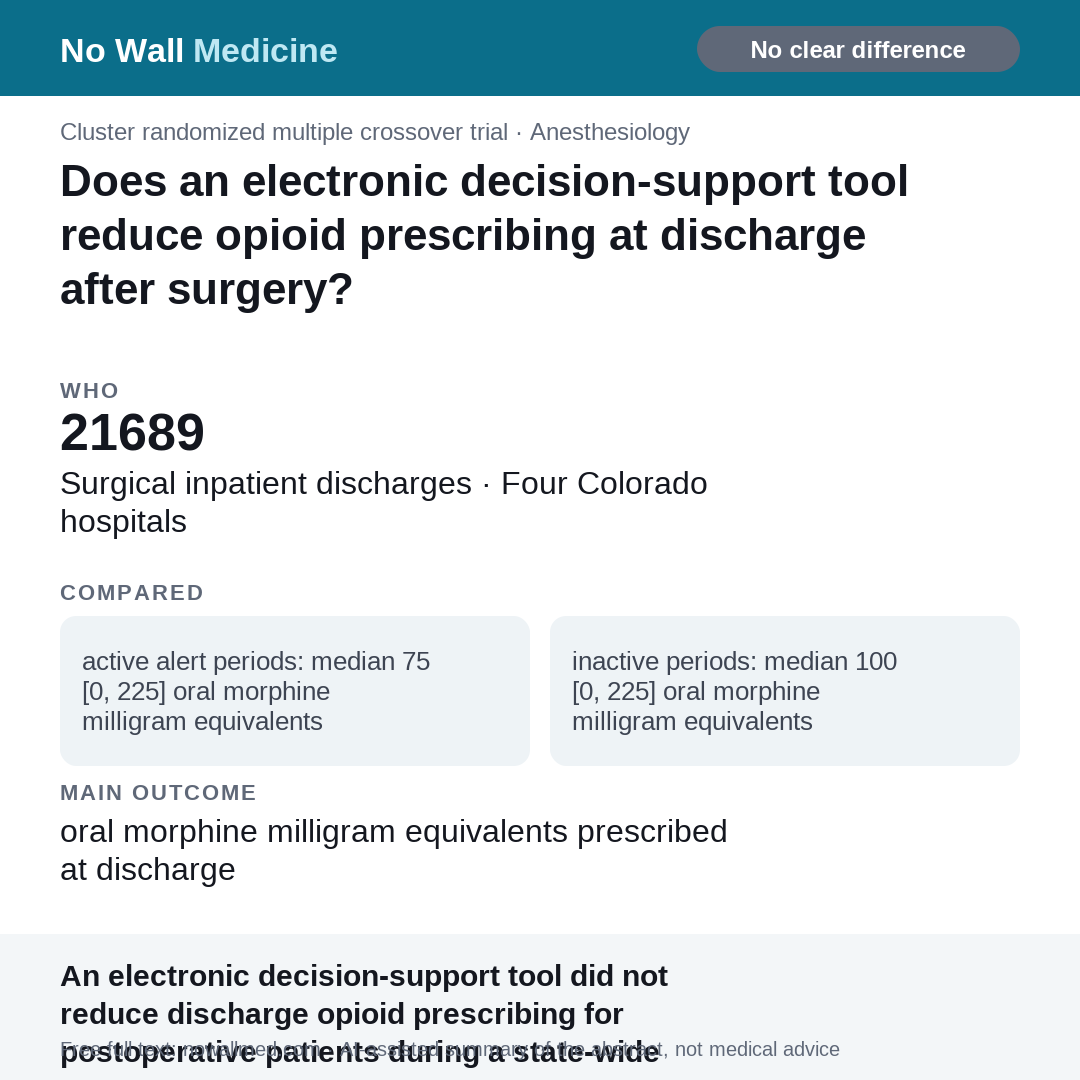
Clinical question: Does an electronic decision-support tool reduce opioid prescribing at discharge after surgery?
Why it matters: It was unknown if an electronic decision-support tool recommending tailored discharge prescriptions based on inpatient opioid intake could guide clinicians to prescribe fewer opioids.
Key points
- Researchers studied 21,689 surgical inpatient discharges across four Colorado hospitals using a cluster randomized multiple crossover trial design.
- The median oral morphine milligram equivalents prescribed at discharge was 75 [0, 225] when alerts were active and 100 [0, 225] when inactive.
- The alert was displayed in 28% (3,074 of 11,003) of discharges during active periods and showed no relationship with additional opioid prescriptions.
Headline and key points written with AI from the paper’s abstract, with every number checked against it. Read the paper before relying on them.
Was this summary helpful?
Subject terms
Cite this article
Rolfzen ML, Wick A, Mascha EJ, Shah K, Krause M, Fernandez-Bustamante A. Best Practice Alerts Informed by Inpatient Opioid Intake to Reduce Opioid Prescribing after Surgery (PRIOR): A Cluster Randomized Multiple Crossover Trial. Anesthesiology. 2023. doi:10.1097/ALN.0000000000004607
Spotted a mistake? Suggest a correction