Better Outcome After Thyroplasty Type I in Unilateral Vocal Fold Paralysis Without Synkinesis and Synkinetically-Reinnervated Type IV Vocal Fold Paralysis
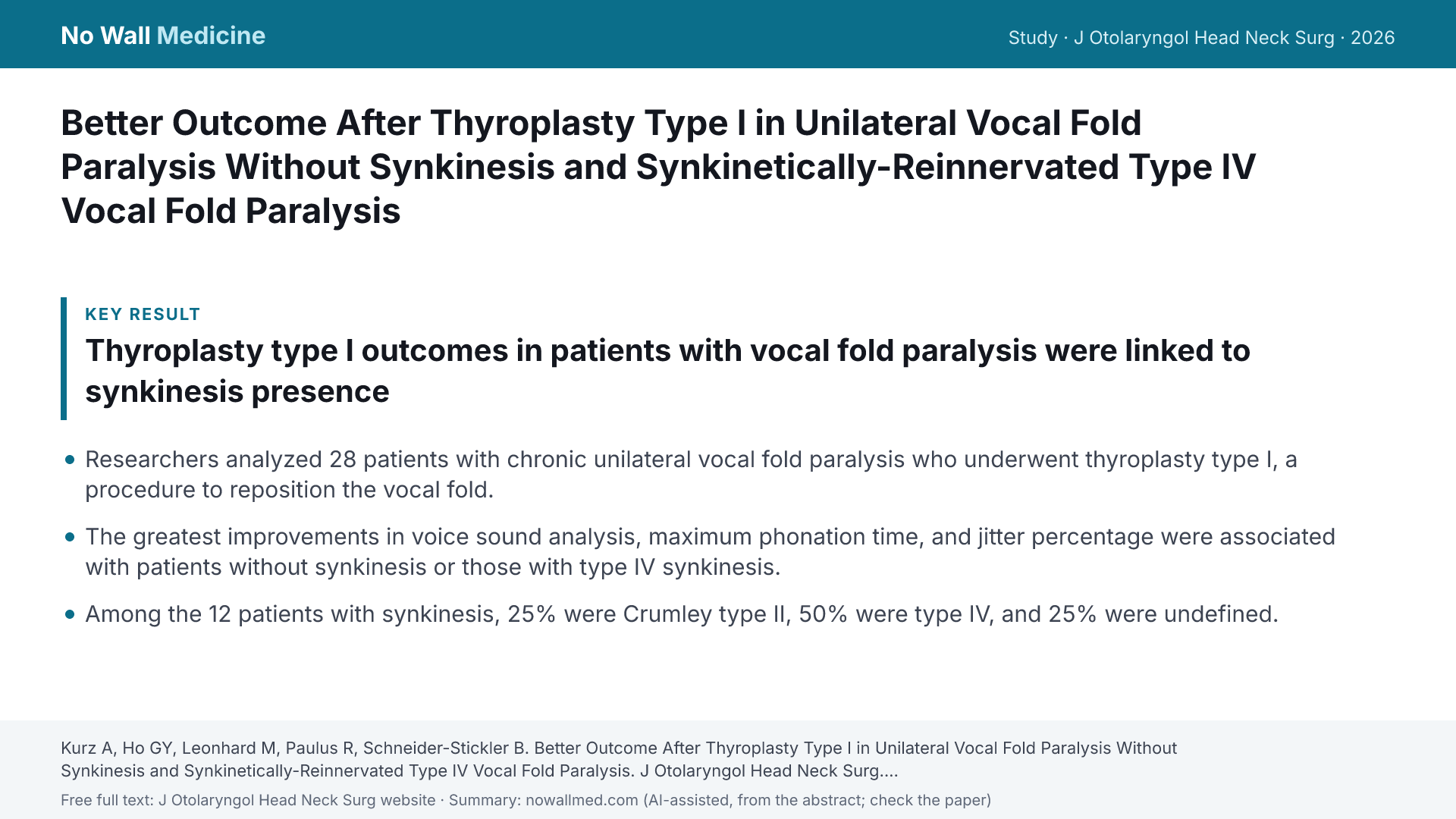
Key result: Thyroplasty type I outcomes in patients with vocal fold paralysis were linked to synkinesis presence
Key points
- Researchers analyzed 28 patients with chronic unilateral vocal fold paralysis who underwent thyroplasty type I, a procedure to reposition the vocal fold.
- The greatest improvements in voice sound analysis, maximum phonation time, and jitter percentage were associated with patients without synkinesis or those with type IV synkinesis.
- Among the 12 patients with synkinesis, 25% were Crumley type II, 50% were type IV, and 25% were undefined.
Limitation the authors note: The study used a retrospective data analysis design and exploratory statistical analyses.
Discussion prompts
- Would these patients look like yours? Who was left out?
- Is the main outcome one that matters to patients?
- Is the difference large enough to change what you do?
Cite: Kurz A, Ho GY, Leonhard M, Paulus R, Schneider-Stickler B. Better Outcome After Thyroplasty Type I in Unilateral Vocal Fold Paralysis Without Synkinesis and Synkinetically-Reinnervated Type IV Vocal Fold Paralysis. J Otolaryngol Head Neck Surg. 2026;55:19160216261487371. doi:10.1177/19160216261487371
Free full text: J Otolaryngol Head Neck Surg website · Summary and visual abstract: nowallmed.com/a/better-outcome-after-thyroplasty-type-i-in-unilateral-vocal-fold-14q6238/ (AI-assisted from the abstract; check the paper before relying on it).