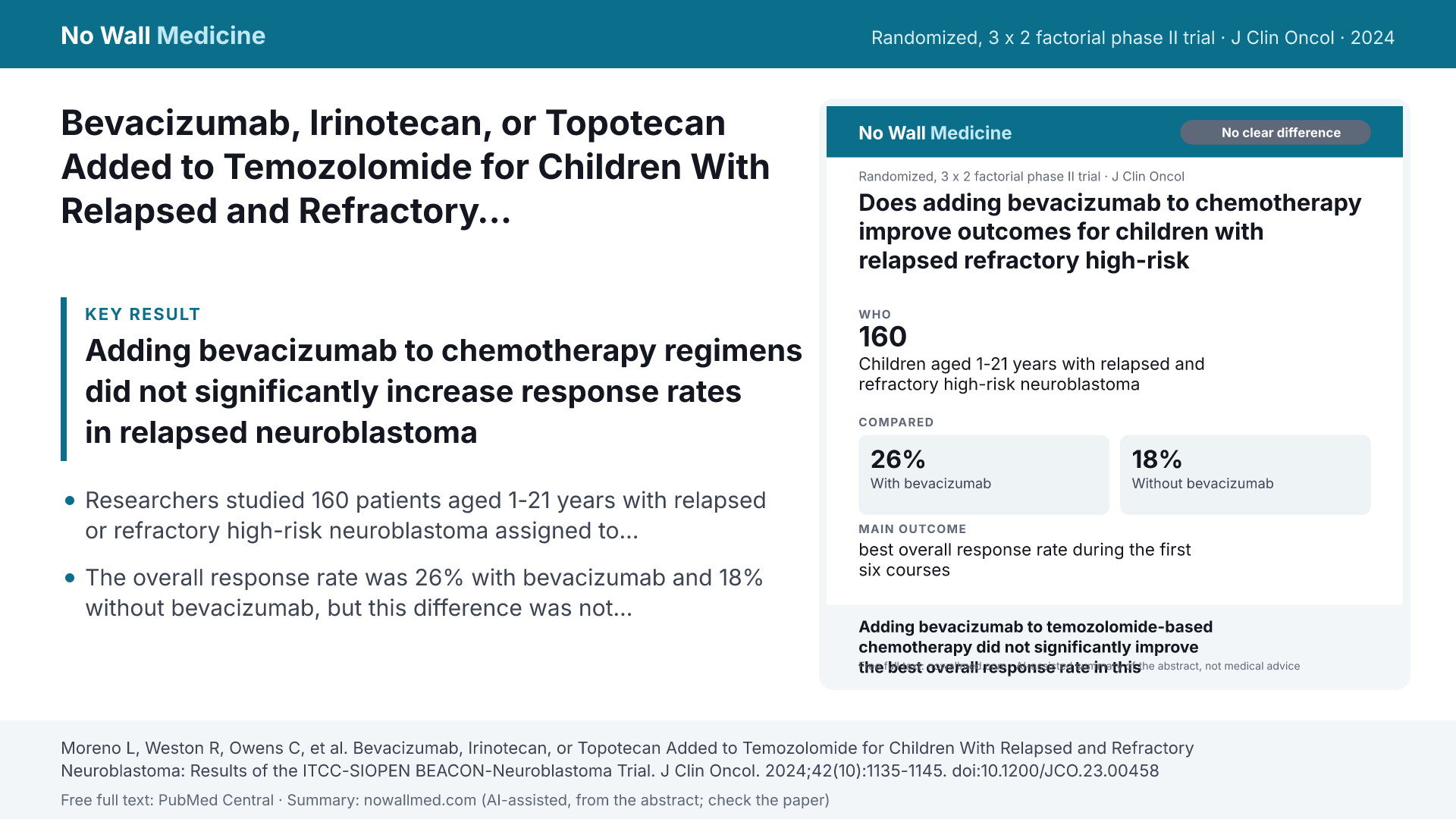
Adding bevacizumab to chemotherapy regimens did not significantly increase response rates in relapsed neuroblastoma
Bevacizumab, Irinotecan, or Topotecan Added to Temozolomide for Children With Relapsed and Refractory Neuroblastoma: Results of the ITCC-SIOPEN BEACON-Neuroblastoma Trial
Randomized, 3 x 2 factorial phase II trialNo clear difference
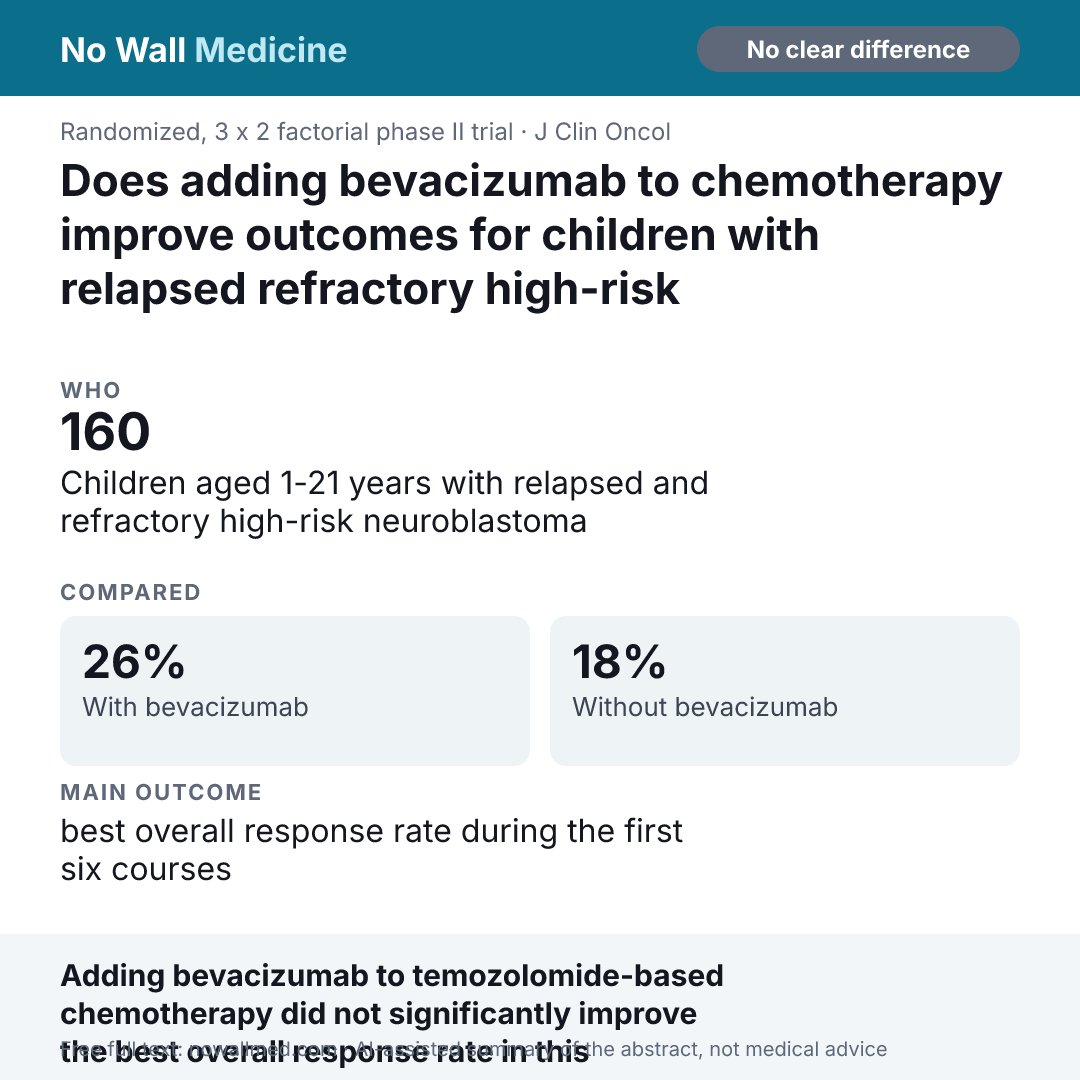
Does adding bevacizumab to chemotherapy improve outcomes for children with relapsed refractory high-risk neuroblastoma?
Who
160
Children aged 1-21 years with relapsed and refractory high-risk neuroblastoma
Compared
26%With bevacizumab (95% CI, 17 to 37)
18%Without bevacizumab (95% CI, 10 to 28)
Main outcome
best overall response rate during the first six courses
Result: risk ratio 1.52 (95% CI, 0.83 to 2.77)
Bottom line: Adding bevacizumab to temozolomide-based chemotherapy did not significantly improve the best overall response rate in this trial.
J Clin Oncol · 2024-01-08 · Save PNG
Clinical question: Does adding bevacizumab to chemotherapy improve outcomes for children with relapsed refractory high-risk neuroblastoma?
Why it matters: Outcomes for children with relapsed and refractory high-risk neuroblastoma remain poor, and it is unknown if adding bevacizumab to standard chemotherapy improves response rates.
Key points
- Researchers studied 160 patients aged 1-21 years with relapsed or refractory high-risk neuroblastoma assigned to temozolomide, irinotecan, or topotecan, with or without bevacizumab.
- The overall response rate was 26% with bevacizumab and 18% without bevacizumab, but this difference was not statistically significant (P = .17).
- For the group receiving bevacizumab, irinotecan, and temozolomide, the overall response rate was 23% and the 1-year progression-free survival estimate was 0.67.
Headline and key points written with AI from the paper’s abstract, with every number checked against it. Read the paper before relying on them.
Was this summary helpful?
Subject terms
Headline, design, result, key points, caveat and citation as plain text.
Cite this article
Moreno L, Weston R, Owens C, et al. Bevacizumab, Irinotecan, or Topotecan Added to Temozolomide for Children With Relapsed and Refractory Neuroblastoma: Results of the ITCC-SIOPEN BEACON-Neuroblastoma Trial. J Clin Oncol. 2024;42(10):1135-1145. doi:10.1200/JCO.23.00458
Spotted a mistake? Suggest a correction