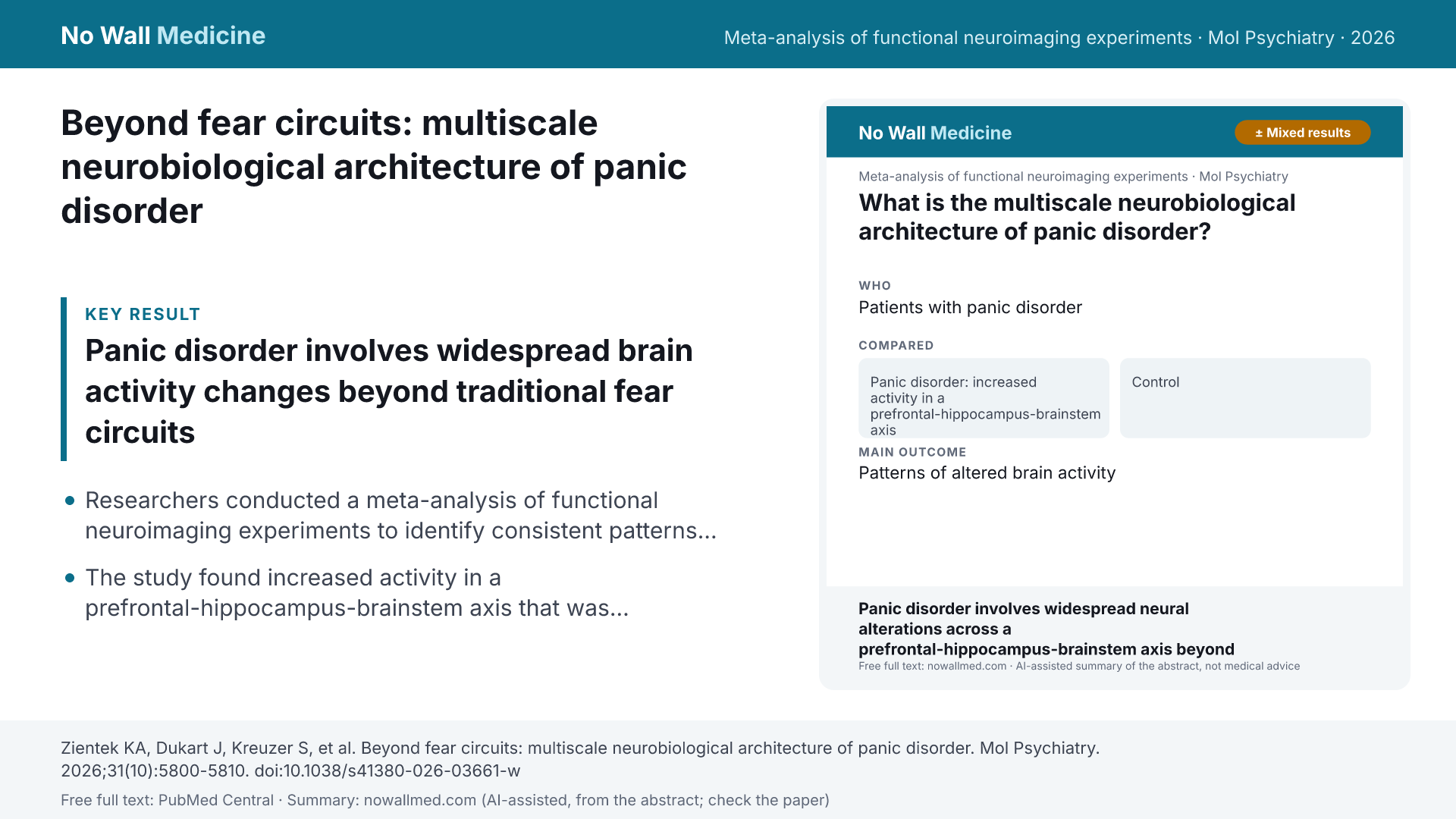
Panic disorder involves widespread brain activity changes beyond traditional fear circuits
Beyond fear circuits: multiscale neurobiological architecture of panic disorder
Meta-analysis of functional neuroimaging experimentsMixed results
What is the multiscale neurobiological architecture of panic disorder?
Who
Patients with panic disorder
Compared
Panic disorder: increased activity in a prefrontal-hippocampus-brainstem axis
Control
Main outcome
Patterns of altered brain activity
Bottom line: Panic disorder involves widespread neural alterations across a prefrontal-hippocampus-brainstem axis beyond traditional fear circuitry.
Mol Psychiatry · 2026-05-27Download image

Clinical question: What is the multiscale neurobiological architecture of panic disorder?
Key points
- Researchers conducted a meta-analysis of functional neuroimaging experiments to identify consistent patterns of brain activity in people with panic disorder.
- The study found increased activity in a prefrontal-hippocampus-brainstem axis that was significantly explained by gene expression profiles, accounting for over one-third of the variance.
- The identified brain pattern was linked to emotional arousal, memory, learning, and goal-directed behavior.
Headline and key points written with AI from the paper’s abstract, with every number checked against it. Read the paper before relying on them.
Was this summary helpful?
Subject terms
Headline, design, result, key points, caveat and citation as plain text.
Cite this article
Zientek KA, Dukart J, Kreuzer S, et al. Beyond fear circuits: multiscale neurobiological architecture of panic disorder. Mol Psychiatry. 2026;31(10):5800-5810. doi:10.1038/s41380-026-03661-w
Spotted a mistake? Suggest a correction