Higher load-capacity indices were associated with increased risk of cardiometabolic diseases
Beyond Traditional Body Composition Metrics: Load-Capacity Indices Emerge as Predictors of Cardiometabolic Outcomes-A Systematic Review and Meta-Analysis
Systematic review and meta-analysisBenefit found
Do load-capacity indices predict cardiometabolic outcomes and sarcopenic obesity prevalence?
Who
Individuals across 48 observational studies
Compared
Higher load-capacity indices
Cardiometabolic outcomes
Main outcome
Sarcopenic obesity prevalence and cardiometabolic disease risk
Result: odds ratio 2.22 (95% CI 1.81, 2.72)
Bottom line: Higher load-capacity indices are significantly associated with increased risk of cardiometabolic diseases.
Adv Nutr · 2025-01-03Download image
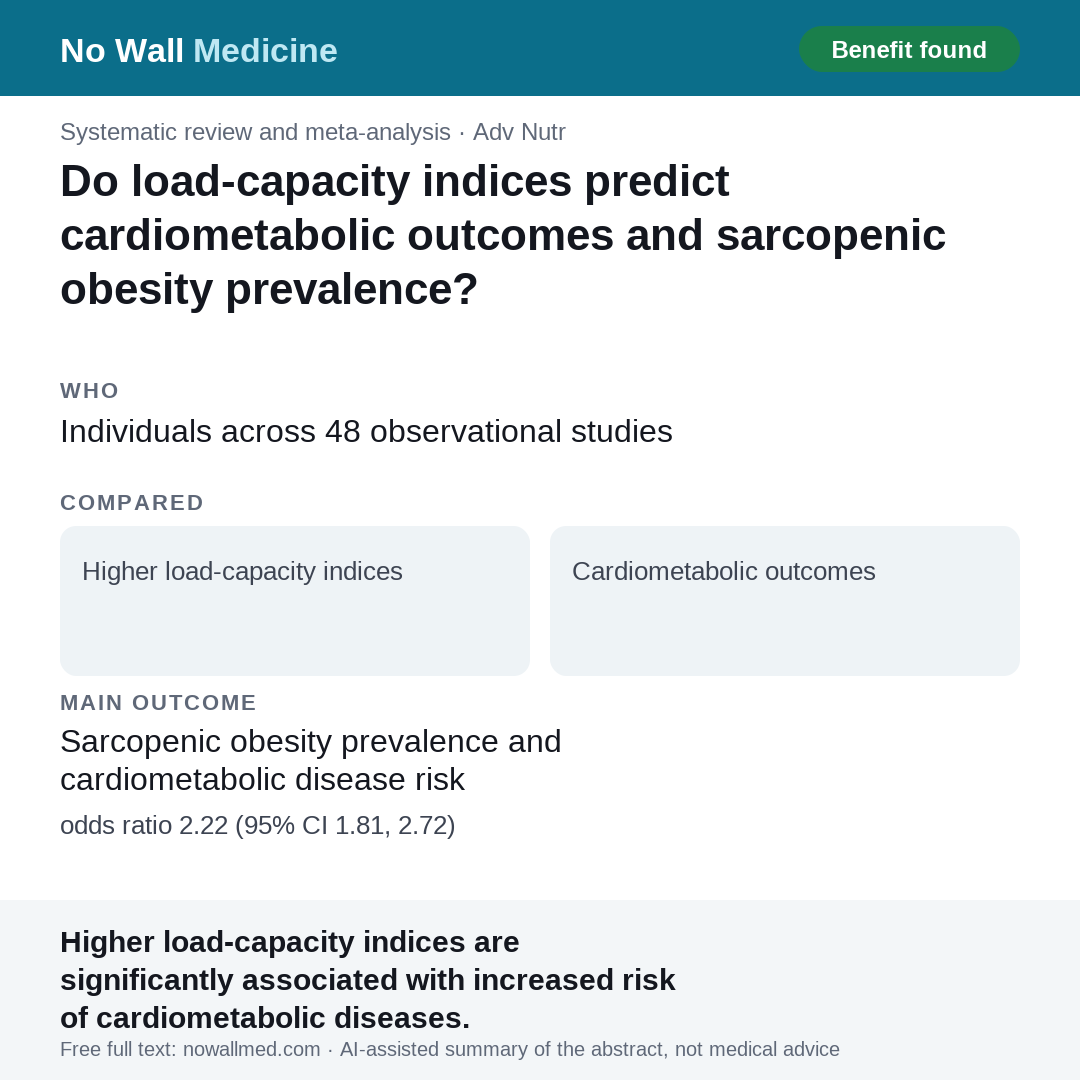
Clinical question: Do load-capacity indices predict cardiometabolic outcomes and sarcopenic obesity prevalence?
Why it matters: It was unknown how load-capacity indices, which measure the ratio of metabolic load to metabolic capacity, relate to the risk of cardiometabolic outcomes.
Key points
- Researchers analyzed 48 observational studies involving 22 different load-capacity indices, which are ratios of fat mass to lean mass.
- Higher load-capacity index values were associated with an increased risk of cardiometabolic diseases, such as diabetes, with an odds ratio of 2.22.
- Ten studies used these indices to identify sarcopenic obesity, which is the combination of low muscle mass and high fat mass, showing a pooled prevalence of 14.5%.
Limitation the authors note: The included studies were all observational in design.
Headline and key points written with AI from the paper’s abstract, with every number checked against it. Read the paper before relying on them.
Topics
Cite this article
Guan Z, Minnetti M, Heymsfield SB, Poggiogalle E, Prado CM, Sim M. Beyond Traditional Body Composition Metrics: Load-Capacity Indices Emerge as Predictors of Cardiometabolic Outcomes-A Systematic Review and Meta-Analysis. Adv Nutr. 2025. doi:10.1016/j.advnut.2024.100364
Spotted a mistake? Suggest a correction
Top studies every Monday
The week’s key trials and guidelines in your specialties, by email. Free.
Get the weekly digest