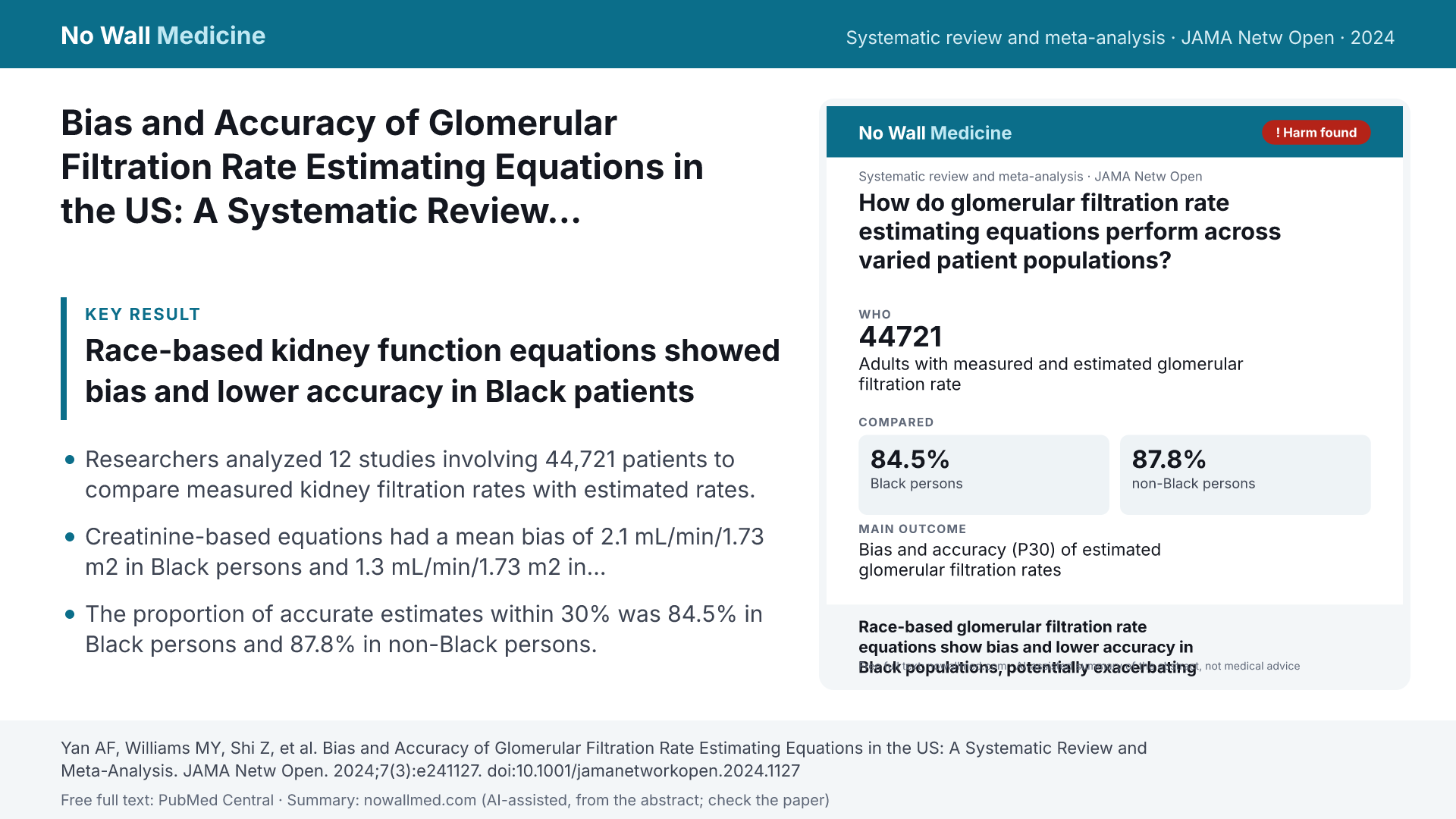
Race-based kidney function equations showed bias and lower accuracy in Black patients
Bias and Accuracy of Glomerular Filtration Rate Estimating Equations in the US: A Systematic Review and Meta-Analysis
Systematic review and meta-analysisHarm found
How do glomerular filtration rate estimating equations perform across varied patient populations?
Who
44721
Adults with measured and estimated glomerular filtration rate
Compared
84.5%Black persons
87.8%non-Black persons
Main outcome
Bias and accuracy (P30) of estimated glomerular filtration rates
Result: mean bias 2.1 mL/min/1.73 m2 (95% CI, -0.2 mL/min/1.73 m2 to 4.4 mL/min/1.73 m2) in Black persons
Bottom line: Race-based glomerular filtration rate equations show bias and lower accuracy in Black populations, potentially exacerbating kidney disease disparities.
Limitation: Significant heterogeneity was found in the bias of various estimating equations.
JAMA Netw Open · 2024-03-04 · Save PNG
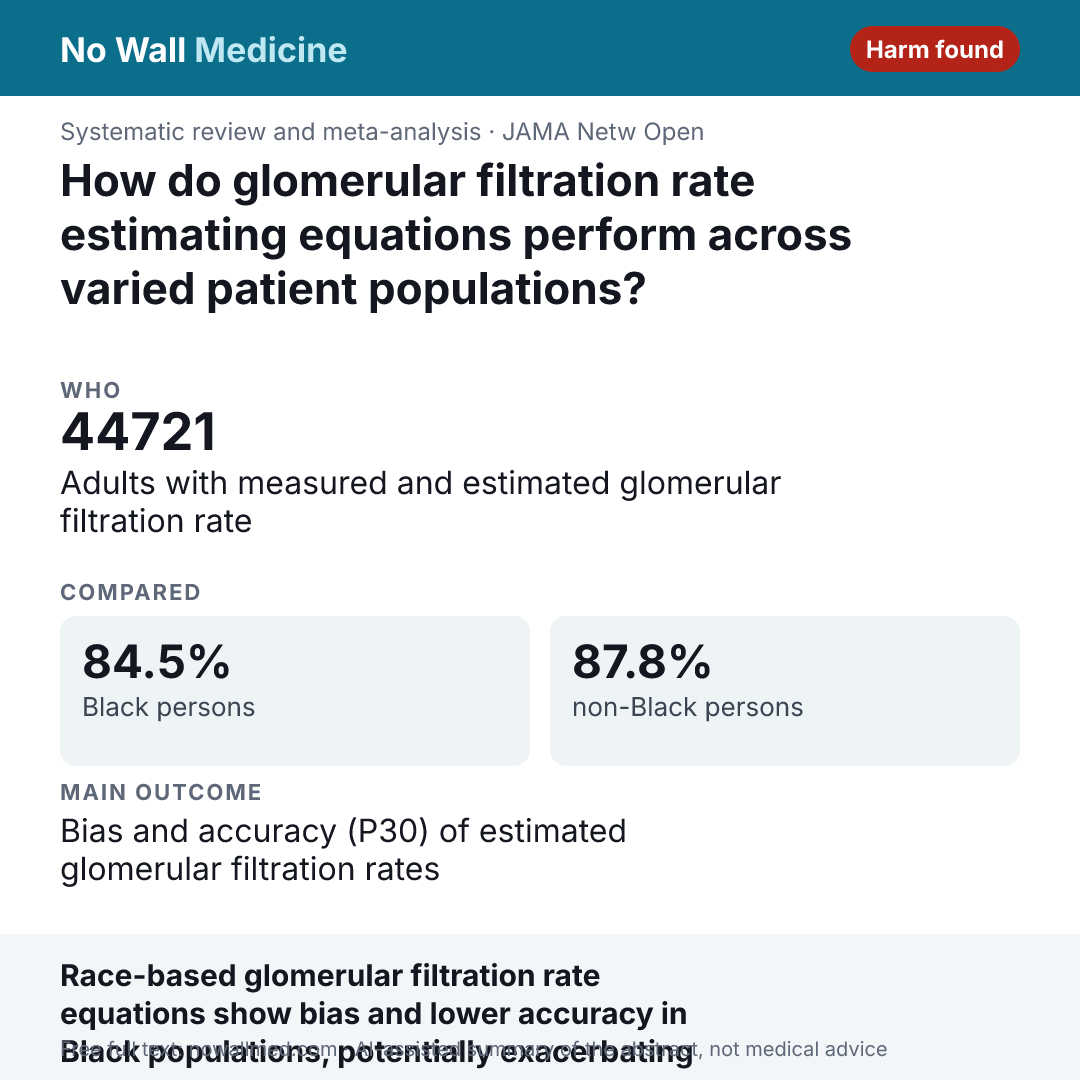
Clinical question: How do glomerular filtration rate estimating equations perform across varied patient populations?
Key points
- Researchers analyzed 12 studies involving 44,721 patients to compare measured kidney filtration rates with estimated rates.
- Creatinine-based equations had a mean bias of 2.1 mL/min/1.73 m2 in Black persons and 1.3 mL/min/1.73 m2 in non-Black persons.
- The proportion of accurate estimates within 30% was 84.5% in Black persons and 87.8% in non-Black persons.
Headline and key points written with AI from the paper’s abstract, with every number checked against it. Read the paper before relying on them.
Was this summary helpful?
Subject terms
Headline, design, result, key points, caveat and citation as plain text.
Cite this article
Yan AF, Williams MY, Shi Z, et al. Bias and Accuracy of Glomerular Filtration Rate Estimating Equations in the US: A Systematic Review and Meta-Analysis. JAMA Netw Open. 2024;7(3):e241127. doi:10.1001/jamanetworkopen.2024.1127
Spotted a mistake? Suggest a correction