Bio-impedance spectroscopy did not improve preservation of kidney function in patients starting hemodialysis
Bio-impedance spectroscopy added to a fluid management protocol does not improve preservation of residual kidney function in incident hemodialysis patients in a randomized controlled trial
Open label, randomized controlled trialNo clear difference
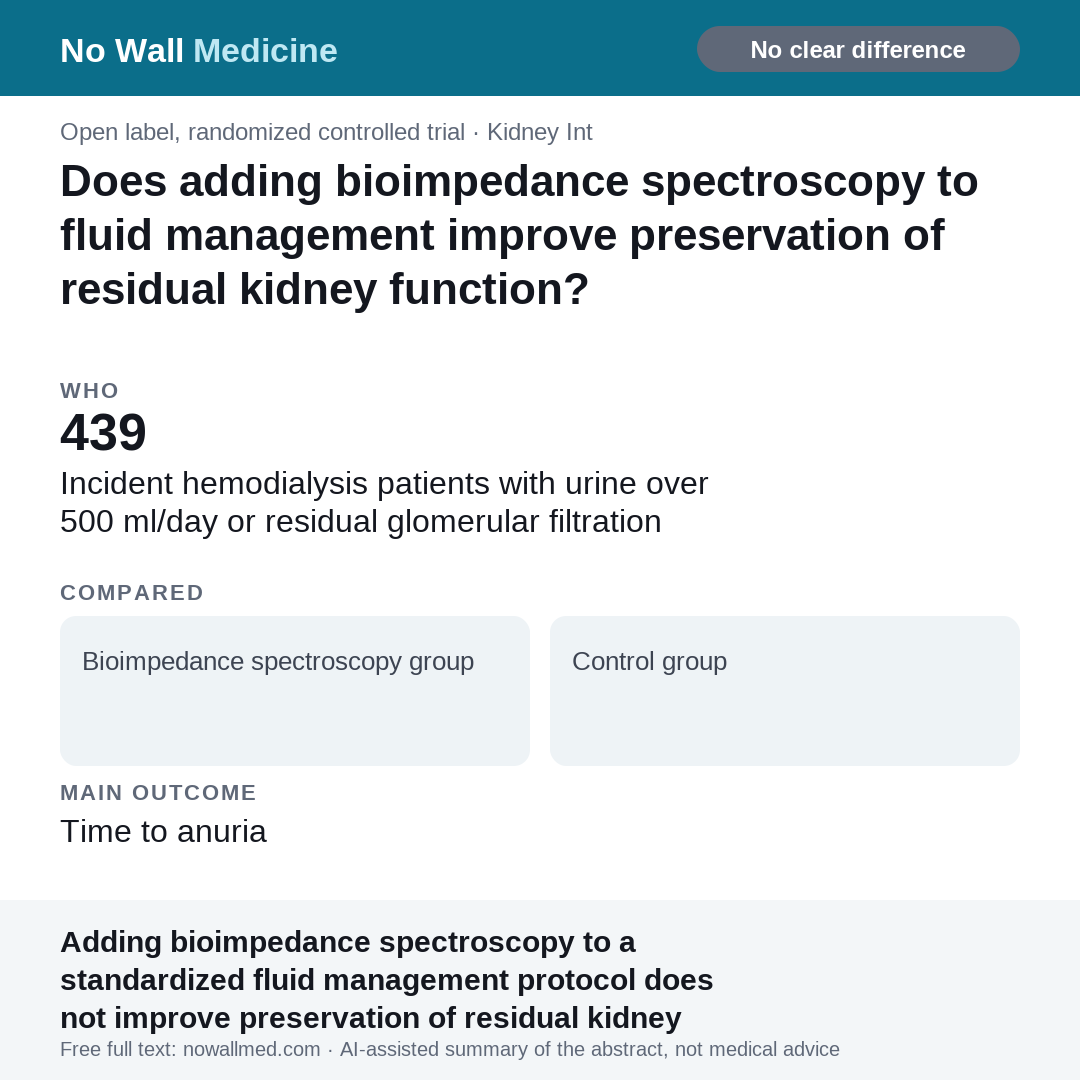
Does adding bioimpedance spectroscopy to fluid management improve preservation of residual kidney function?
Who
439
Incident hemodialysis patients with urine over 500 ml/day or residual glomerular filtration rate · 34 United Kingdom centers
Compared
Bioimpedance spectroscopy group
Control group
Main outcome
Time to anuria
Result: cause-specific hazard rates 0.751 (95% confidence interval 0.459, 1.229)
Bottom line: Adding bioimpedance spectroscopy to a standardized fluid management protocol does not improve preservation of residual kidney function.
Kidney Int · 2023-05-30Download image
Clinical question: Does adding bioimpedance spectroscopy to fluid management improve preservation of residual kidney function?
Why it matters: It was unknown whether using bio-impedance spectroscopy to estimate normally hydrated weight when setting post-dialysis target weight could mitigate the loss of residual kidney function.
Key points
- Researchers randomized 439 patients receiving hemodialysis from 34 United Kingdom centers to either a standard fluid management protocol or one supplemented by bio-impedance spectroscopy.
- The addition of bio-impedance spectroscopy showed no group differences in the time to anuria, with a cause-specific hazard rate of 0.751 (95% confidence interval (0.459, 1.229)).
- Secondary outcomes including blood pressure, patient-reported outcomes, and the rate of residual kidney function decline did not differ between the two groups.
Headline and key points written with AI from the paper’s abstract, with every number checked against it. Read the paper before relying on them.
Was this summary helpful?
Subject terms
Cite this article
Davies SJ, Coyle D, Lindley EJ, Keane D, Belcher J, Caskey FJ. Bio-impedance spectroscopy added to a fluid management protocol does not improve preservation of residual kidney function in incident hemodialysis patients in a randomized controlled trial. Kidney Int. 2023. doi:10.1016/j.kint.2023.05.016
Spotted a mistake? Suggest a correction
Top studies every Monday
The week’s key trials and guidelines in your specialties, plus any topics you follow. By email, free.
Get the weekly digest