Multicentre, randomised, controlled, phase 3 trialBenefit found
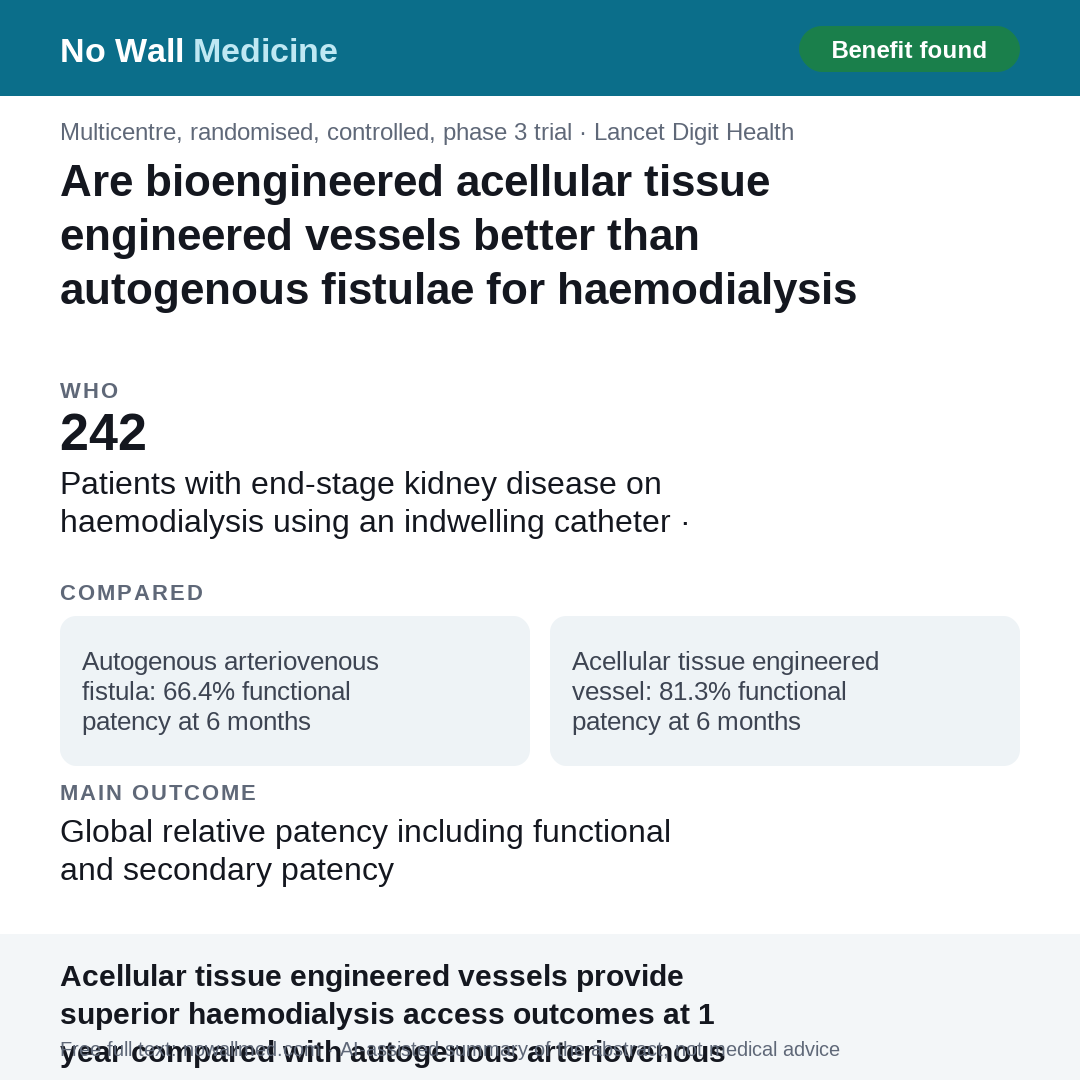
Are bioengineered acellular tissue engineered vessels better than autogenous fistulae for haemodialysis access?
Who
242
Patients with end-stage kidney disease on haemodialysis using an indwelling catheter · 31 centres across the USA
Compared
Autogenous arteriovenous fistula: 66.4% functional patency at 6 months
Acellular tissue engineered vessel: 81.3% functional patency at 6 months
Main outcome
Global relative patency including functional and secondary patency
Result: global relative patency of 1·17 (95% CI 1·04-1·31)
Bottom line: Acellular tissue engineered vessels provide superior haemodialysis access outcomes at 1 year compared with autogenous arteriovenous fistulae.
Clinical question: Are bioengineered acellular tissue engineered vessels better than autogenous fistulae for haemodialysis access?
Why it matters: Many patients with end-stage kidney disease fail to achieve successful maturation of traditional arteriovenous fistulas, especially females and those with diabetes or obesity.
Key points
Researchers studied 242 patients with end-stage kidney disease across 31 centers, comparing bioengineered acellular tissue engineered vessels to autogenous arteriovenous fistulas.
The bioengineered vessels achieved a global relative patency of 1.17, with 6-month functional patency at 81.3% compared to 66.4% for traditional fistulas.
The bioengineered group had a 1-year usability duration of 7.4 months versus 6.0 months for the fistula group, though they required more interventions.
Headline and key points written with AI from the paper’s abstract, with every number checked against it. Read the paper before relying on them.
ClinicalAge, a framework for modelling ageing trajectories from longitudinal electronic health records in the UK: a model development and validation study
A prognostic model for use at labour onset to estimate the risk of severe fetal compromise at birth: a retrospective, model development and validation study