Bioimpedance-guided fluid management did not increase the proportion of patients reaching estimated euvolemia
Bioimpedance-Guided Fluid Removal in Continuous KRT: The VENUS Randomized Clinical Trial
Multicenter randomized controlled trialNo clear difference
Does bioimpedance analysis-guided volume management improve achieving estimated euvolemia in continuous kidney replacement therapy patients?
Who
208
Patients with acute kidney injury requiring continuous kidney replacement therapy · Multicenter
Compared
47%Bioimpedance analysis-guided fluid management
41%Conventional fluid management
Main outcome
Proportion of attaining estimated euvolemia 7 days postrandomization
Bottom line: Bioimpedance analysis-guided volume management did not influence the proportion of patients achieving estimated euvolemia at 7 days.
CJASN · 2024-09-12Download image
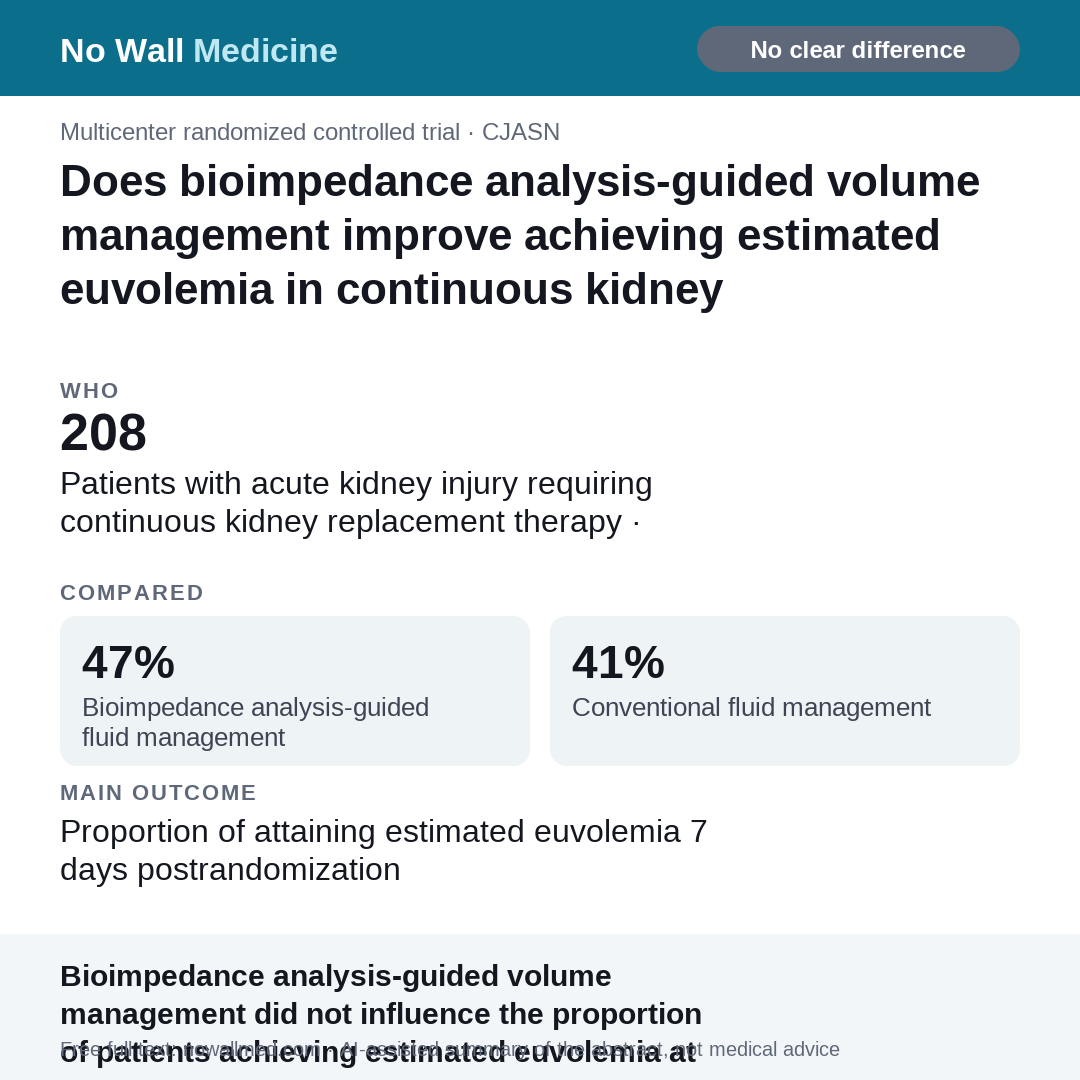
Clinical question: Does bioimpedance analysis-guided volume management improve achieving estimated euvolemia in continuous kidney replacement therapy patients?
Why it matters: It was unknown if using bioimpedance analysis to guide volume management is more effective than conventional methods for achieving estimated euvolemia in patients receiving continuous kidney replacement therapy.
Key points
- Researchers studied 208 patients with acute kidney injury requiring continuous kidney replacement therapy, comparing bioimpedance analysis-guided management to conventional fluid management.
- The proportion of patients achieving estimated euvolemia at 7 days was 47% in the bioimpedance group versus 41% in the control group.
- Bioimpedance guidance was associated with a higher proportion of patients reaching estimated euvolemia on day 1 compared to conventional management (13% versus 4%).
Headline and key points written with AI from the paper’s abstract, with every number checked against it. Read the paper before relying on them.
Was this summary helpful?
Cite this article
An JN, Oh HJ, Oh S, Rhee H, Seong EY, Baek SH. Bioimpedance-Guided Fluid Removal in Continuous KRT: The VENUS Randomized Clinical Trial. CJASN. 2024. doi:10.2215/CJN.0000000000000557
Spotted a mistake? Suggest a correction
Top studies every Monday
The week’s key trials and guidelines in your specialties, plus any topics you follow. By email, free.
Get the weekly digest