Biologic therapies targeting type 2 inflammation reduce exacerbations and improve lung function in COPD patients
Biologic therapies targeting type 2 inflammation in chronic obstructive pulmonary disease: a systematic review and meta-analysis of randomised controlled trials
Systematic review and meta-analysis of randomized controlled trialsBenefit found
Do biologic therapies targeting type 2 inflammation improve outcomes in COPD patients?
Who
Patients with chronic obstructive pulmonary disease and biomarker-defined type 2 inflammation
Compared
Biologic therapies
Placebo
Main outcome
Moderate or severe COPD exacerbations
Result: rate ratio 0.77 (95% CI 0.72 to 0.83)
Bottom line: Biologic therapies targeting type 2 inflammation reduce exacerbations and improve lung function and quality of life in certain COPD patients.
Limitation: Variations in patient selection and type 2 enrichment strategies make direct comparisons challenging.
BMJ Open Respir Res · 2026-07-14Download image
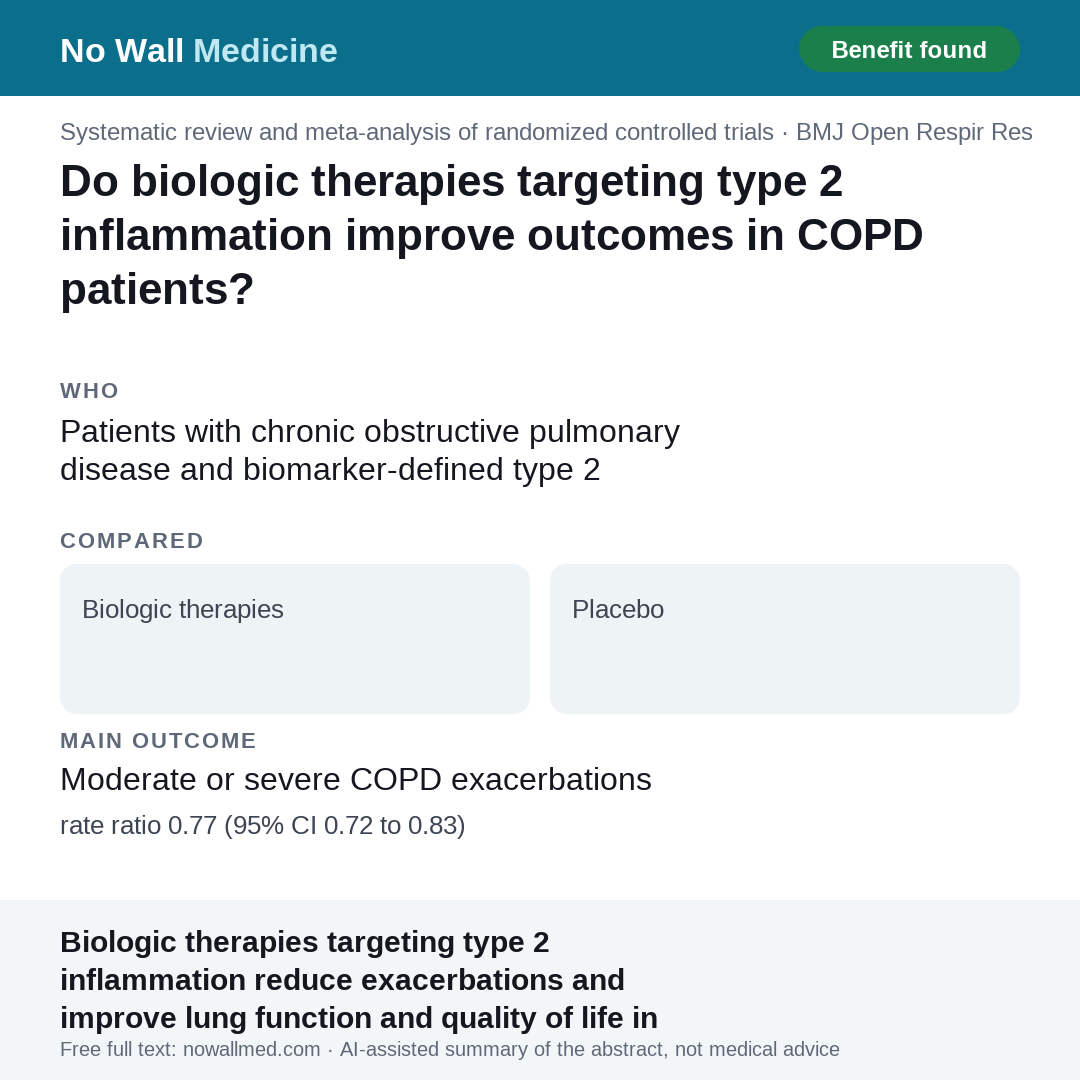
Clinical question: Do biologic therapies targeting type 2 inflammation improve outcomes in COPD patients?
Why it matters: The clinical efficacy of biologic therapies targeting type 2 inflammatory pathways in patients with chronic obstructive pulmonary disease remains variable.
Key points
- Researchers analyzed seven randomized controlled trials comparing biologic therapies targeting specific inflammatory pathways against a placebo in patients with chronic obstructive pulmonary disease and type 2 inflammation.
- Biologic therapies reduced the rate of moderate or severe exacerbations with a rate ratio of 0.77 and increased lung function, measured by forced expiratory volume in 1 second, by 43 mL.
- The greatest reduction in exacerbations occurred with interleukin-4/interleukin-13-targeting therapy in patients with blood eosinophil counts of 300 cells/µL or higher.
Limitation the authors note: Variations in patient selection and type 2 enrichment strategies across trials make direct comparisons challenging.
Headline and key points written with AI from the paper’s abstract, with every number checked against it. Read the paper before relying on them.
Abstract
Background
Chronic obstructive pulmonary disease (COPD) is a heterogeneous disease, and a subset of patients exhibits type 2 (T2) inflammation. Biologic therapies targeting T2 inflammatory pathways have been evaluated in COPD, but their clinical efficacy remains variable. We performed a systematic review and meta-analysis to assess the efficacy and safety of biologic therapies targeting T2 inflammation in COPD. Methods
Randomised controlled trials evaluating biologic therapies targeting interleukin (IL)-5, IL-5 receptor α, IL-4/IL-13 or thymic stromal lymphopoietin in patients with COPD and biomarker-defined T2 inflammation were systematically identified. Outcomes included moderate or severe COPD exacerbations, lung function (forced expiratory volume in 1 s (FEV₁)), health-related quality of life assessed by the St George's Respiratory Questionnaire (SGRQ) and serious adverse events. Random-effects meta-analyses were conducted when at least two comparable studies were available. Risk of bias was assessed using the Cochrane Risk-of-Bias 2 tool. Results
Seven randomised controlled trials were included in the quantitative synthesis. Biologic therapies targeting T2 inflammation significantly reduced the rate of moderate or severe COPD exacerbations compared with placebo (rate ratio 0.77, 95% CI 0.72 to 0.83; p<0.001; I²=0%). Lung function improved modestly with a pooled increase in FEV₁ of 43 mL (95% CI 12.5 to 73.6; p=0.006; I²=55.3%). SGRQ total scores improved by -2.46 units (95% CI -3.43 to -1.49; p<0.001; I²=0%). Subgroup analyses showed the greatest reduction in exacerbations with IL-4/IL-13-targeting therapy in patients with blood eosinophil counts ≥300 cells/µL. No significant increase in serious adverse events was observed. Conclusions
Biologic therapies targeting T2 inflammation improve clinical outcomes in certain patients with COPD. The most consistent improvements were observed in studies that focused on inhibiting the IL-4/IL-13 pathway. However, variations in patient selection and in T2 enrichment strategies across trials make direct comparisons challenging. These results favour a biomarker-based, personalised approach over the routine use of biologics in unselected populations with COPD.
Abstract reproduced under the article’s CC BY NC licence.
Topics
Spotted a mistake? Suggest a correction