Biological and clinical insights from a randomized phase 2 study of an anti-oncostatin M monoclonal antibody in systemic sclerosis
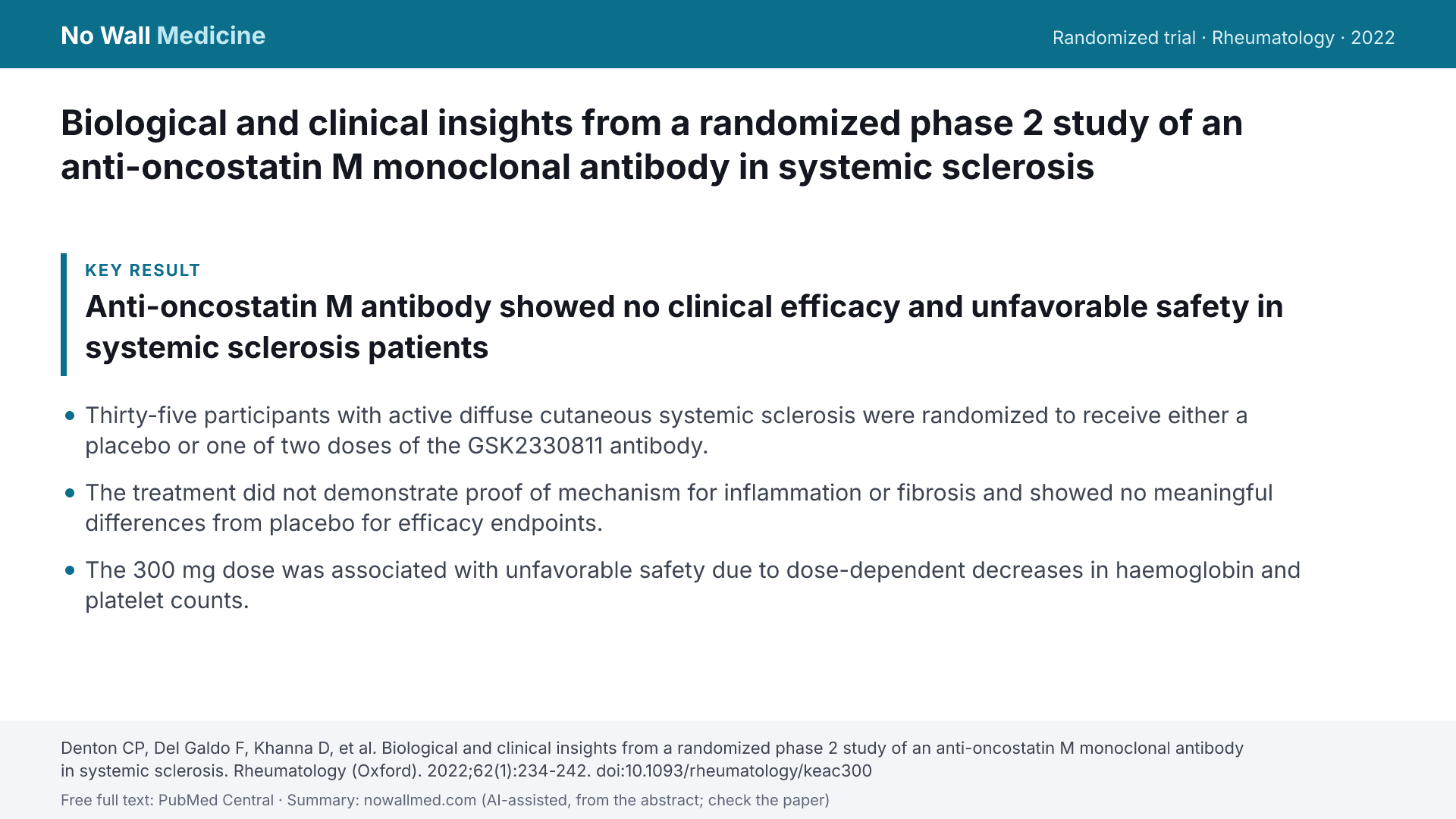
Key result: Anti-oncostatin M antibody showed no clinical efficacy and unfavorable safety in systemic sclerosis patients
Key points
- Thirty-five participants with active diffuse cutaneous systemic sclerosis were randomized to receive either a placebo or one of two doses of the GSK2330811 antibody.
- The treatment did not demonstrate proof of mechanism for inflammation or fibrosis and showed no meaningful differences from placebo for efficacy endpoints.
- The 300 mg dose was associated with unfavorable safety due to dose-dependent decreases in haemoglobin and platelet counts.
Discussion prompts
- Would these patients look like yours? Who was left out?
- Is the main outcome one that matters to patients?
- Is the difference large enough to change what you do?
Cite: Denton CP, Del Galdo F, Khanna D, et al. Biological and clinical insights from a randomized phase 2 study of an anti-oncostatin M monoclonal antibody in systemic sclerosis. Rheumatology. 2022. doi:10.1093/rheumatology/keac300
Free full text: PubMed Central · Summary and visual abstract: nowallmed.com/a/biological-and-clinical-insights-from-a-randomized-phase-2-study-of-h2epi8/ (AI-assisted from the abstract; check the paper before relying on it).