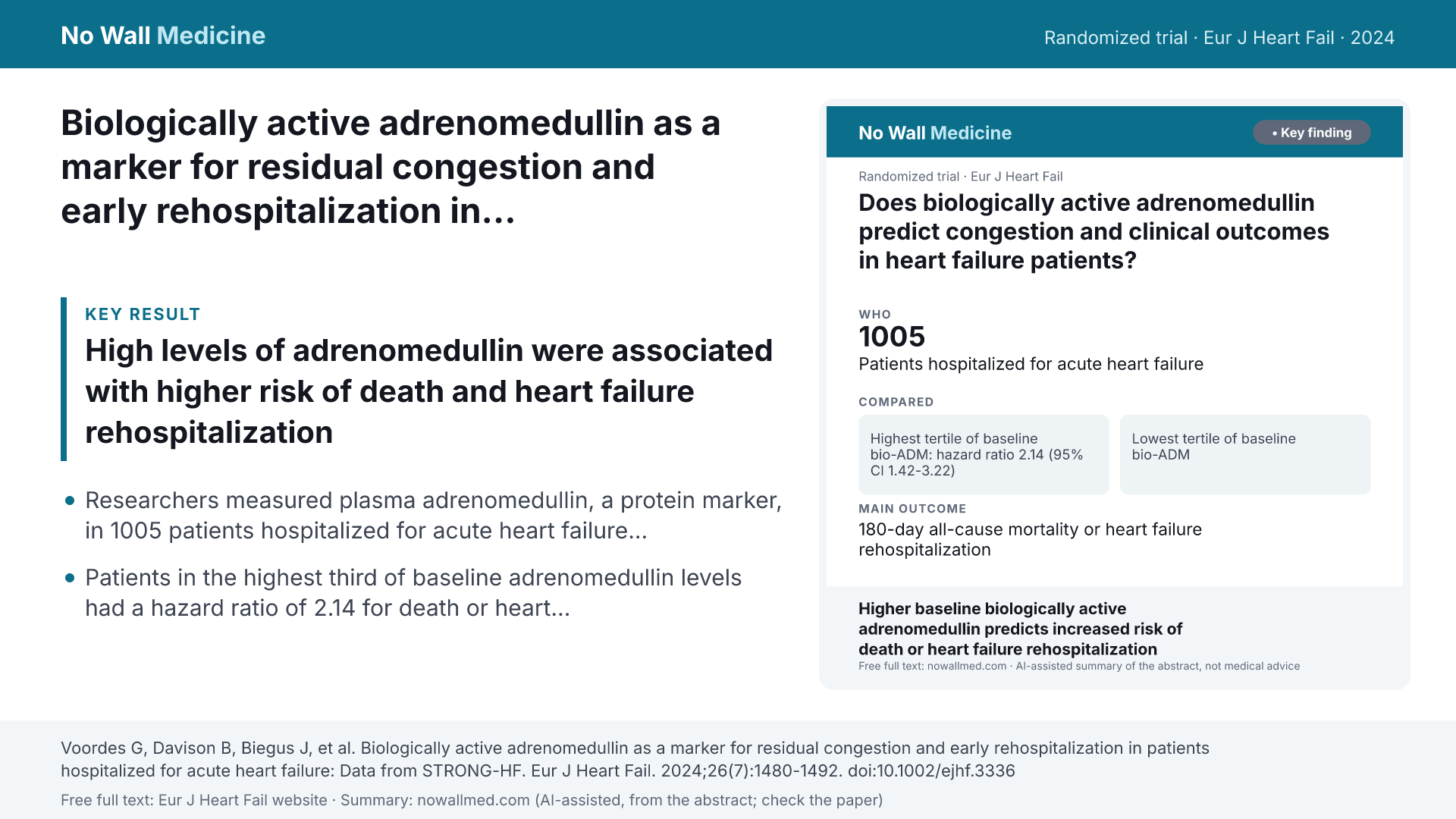
High levels of adrenomedullin were associated with higher risk of death and heart failure rehospitalization
Biologically active adrenomedullin as a marker for residual congestion and early rehospitalization in patients hospitalized for acute heart failure: Data from STRONG-HF
Randomized trialBenefit found
Does biologically active adrenomedullin predict congestion and clinical outcomes in heart failure patients?
Who
1005
Patients hospitalized for acute heart failure
Compared
Highest tertile of baseline bio-ADM: hazard ratio 2.14 (95% CI 1.42-3.22)
Lowest tertile of baseline bio-ADM
Main outcome
180-day all-cause mortality or heart failure rehospitalization
Result: hazard ratio 2.14 (95% CI 1.42-3.22)
Bottom line: Higher baseline biologically active adrenomedullin predicts increased risk of death or heart failure rehospitalization within 180 days.
Eur J Heart Fail · 2024-06-14Download image
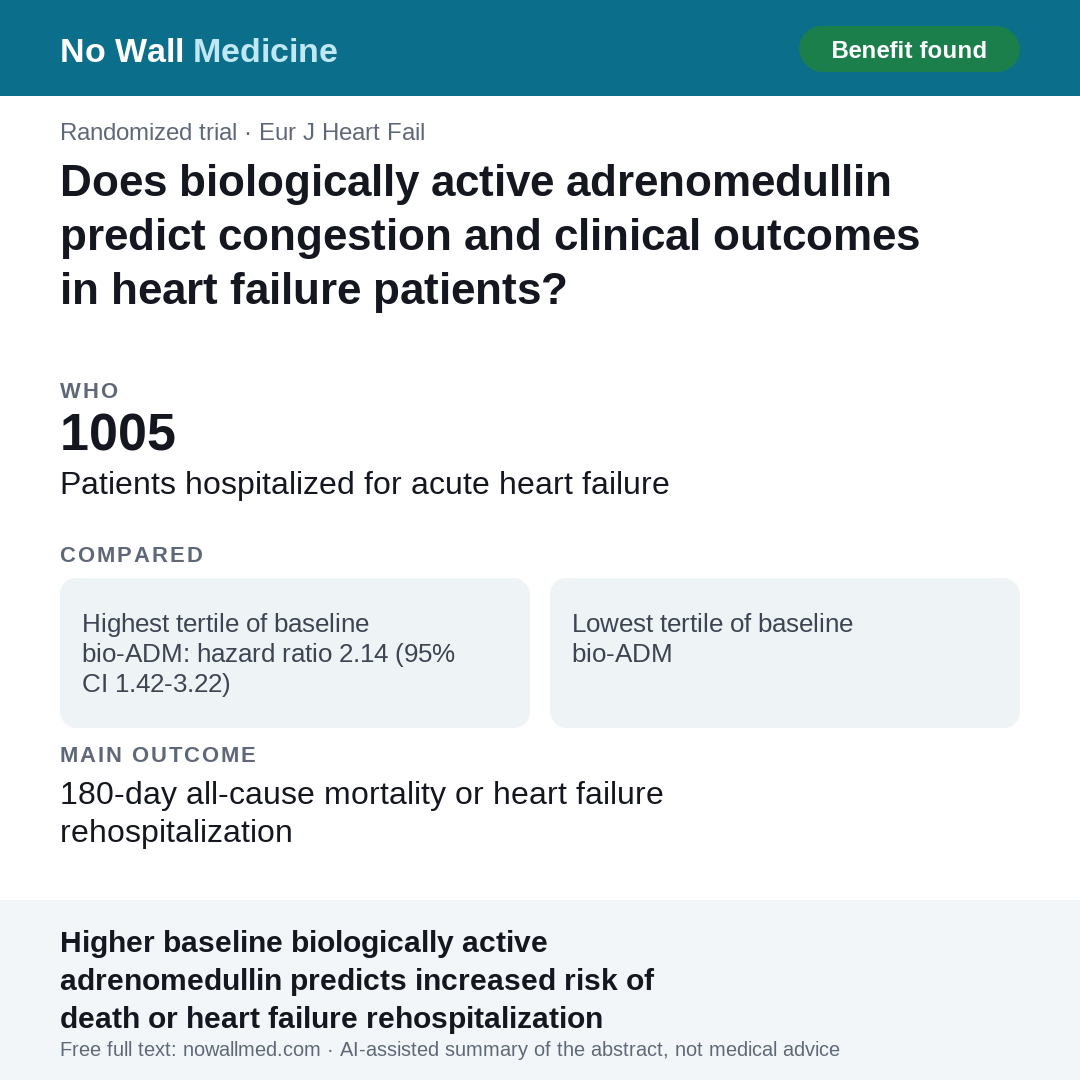
Clinical question: Does biologically active adrenomedullin predict congestion and clinical outcomes in heart failure patients?
Why it matters: It was unknown how adrenomedullin levels relate to residual congestion and clinical outcomes in patients receiving high-intensity medical therapy for heart failure.
Key points
- Researchers measured plasma adrenomedullin, a protein marker, in 1005 patients hospitalized for acute heart failure near discharge and 90 days later.
- Patients in the highest third of baseline adrenomedullin levels had a hazard ratio of 2.14 for death or heart failure rehospitalization at 180 days.
- The 90-day change in adrenomedullin levels did not differ significantly between patients receiving high-intensity care and those receiving usual care.
Headline and key points written with AI from the paper’s abstract, with every number checked against it. Read the paper before relying on them.
Was this summary helpful?
Subject terms
Cite this article
Voordes G, Davison B, Biegus J, Edwards C, Damman K, Ter Maaten J. Biologically active adrenomedullin as a marker for residual congestion and early rehospitalization in patients hospitalized for acute heart failure: Data from STRONG-HF. Eur J Heart Fail. 2024. doi:10.1002/ejhf.3336
Spotted a mistake? Suggest a correction