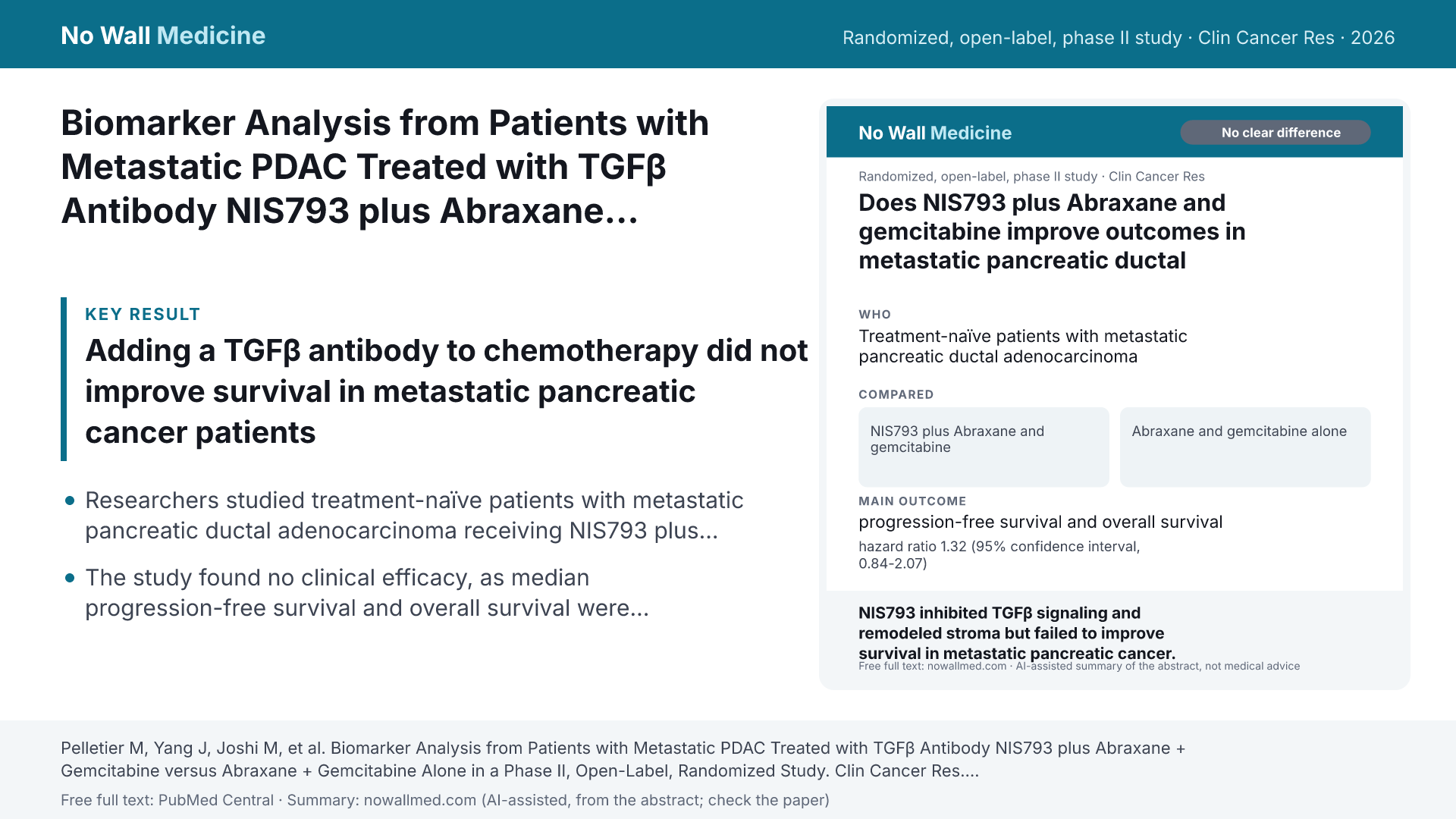
Biomarker Analysis from Patients with Metastatic PDAC Treated with TGFβ Antibody NIS793 plus Abraxane + Gemcitabine versus Abraxane + Gemcitabine Alone in a Phase II, Open-Label, Randomized Study
Key result: Adding a TGFβ antibody to chemotherapy did not improve survival in metastatic pancreatic cancer patients
Key points
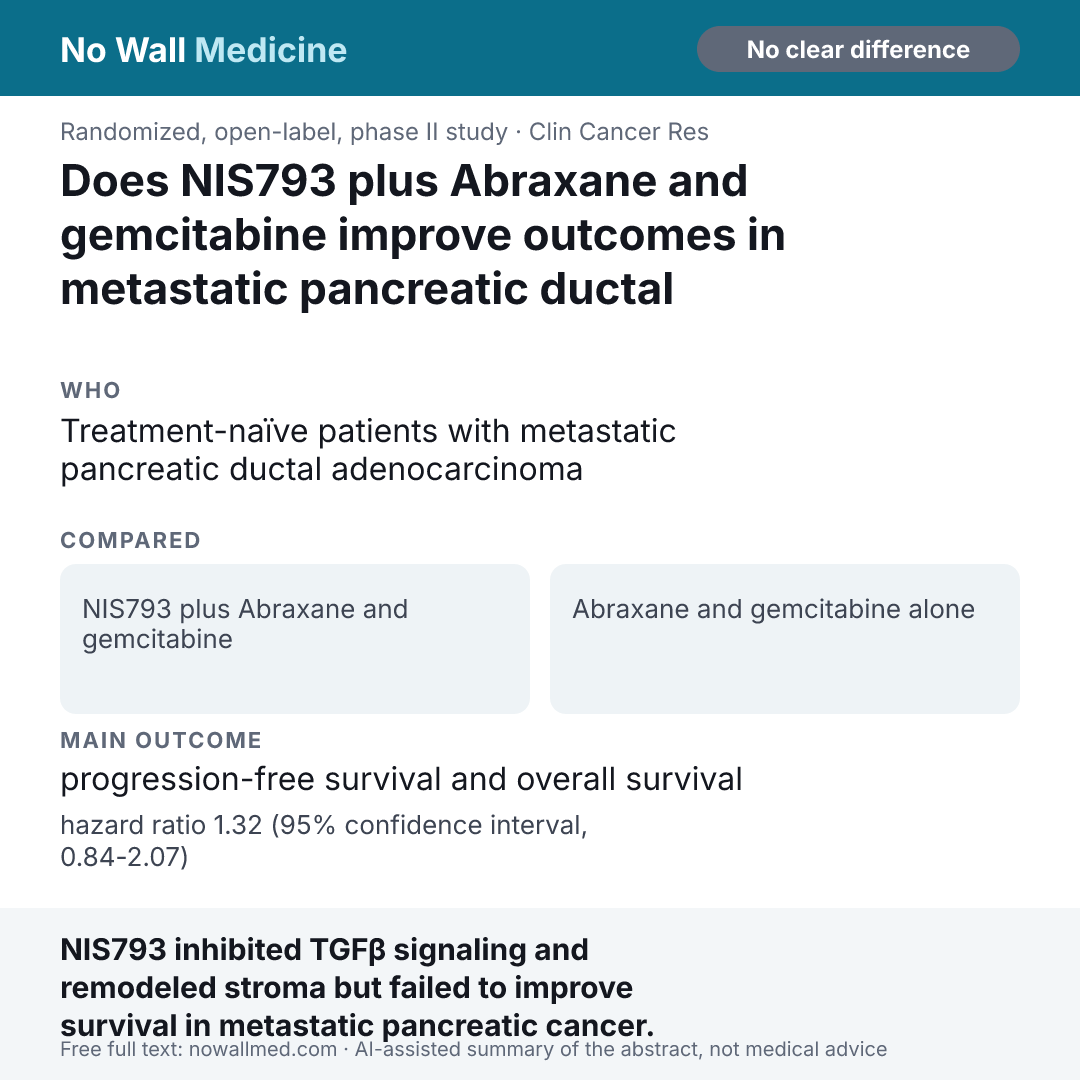
- Researchers studied treatment-naïve patients with metastatic pancreatic ductal adenocarcinoma receiving NIS793 plus Abraxane and gemcitabine compared to Abraxane and gemcitabine alone.
- The study found no clinical efficacy, as median progression-free survival and overall survival were comparable or numerically worse in the NIS793 group.
- The hazard ratio for overall survival in the NIS793 plus Abraxane/gemcitabine group versus the Abraxane/gemcitabine group was 1.32 (95% confidence interval, 0.84-2.07).
Why it matters: TGFβ-driven desmoplasia, which is the growth of dense connective tissue around a tumor, fosters chemoresistance and immunosuppression in pancreatic cancer.
Discussion prompts
- Would these patients look like yours? Who was left out?
- Is the main outcome one that matters to patients?
- Is the difference large enough to change what you do?
Cite: Pelletier M, Yang J, Joshi M, et al. Biomarker Analysis from Patients with Metastatic PDAC Treated with TGFβ Antibody NIS793 plus Abraxane + Gemcitabine versus Abraxane + Gemcitabine Alone in a Phase II, Open-Label, Randomized Study. Clin Cancer Res. 2026;32(18):4001-4015. doi:10.1158/1078-0432.CCR-26-0805
Free full text: PubMed Central · Summary and visual abstract: nowallmed.com/a/biomarker-analysis-from-patients-with-metastatic-pdac-treated-with-19ueekp/ (AI-assisted from the abstract; check the paper before relying on it).