Ocrelizumab depletes B cells in people with relapsing multiple sclerosis
Biomarker Synergy in Relapsing Multiple Sclerosis: Neurofilament Light Chain and B Cells in Relation to Disease Outcomes
Randomized trialsBenefit found
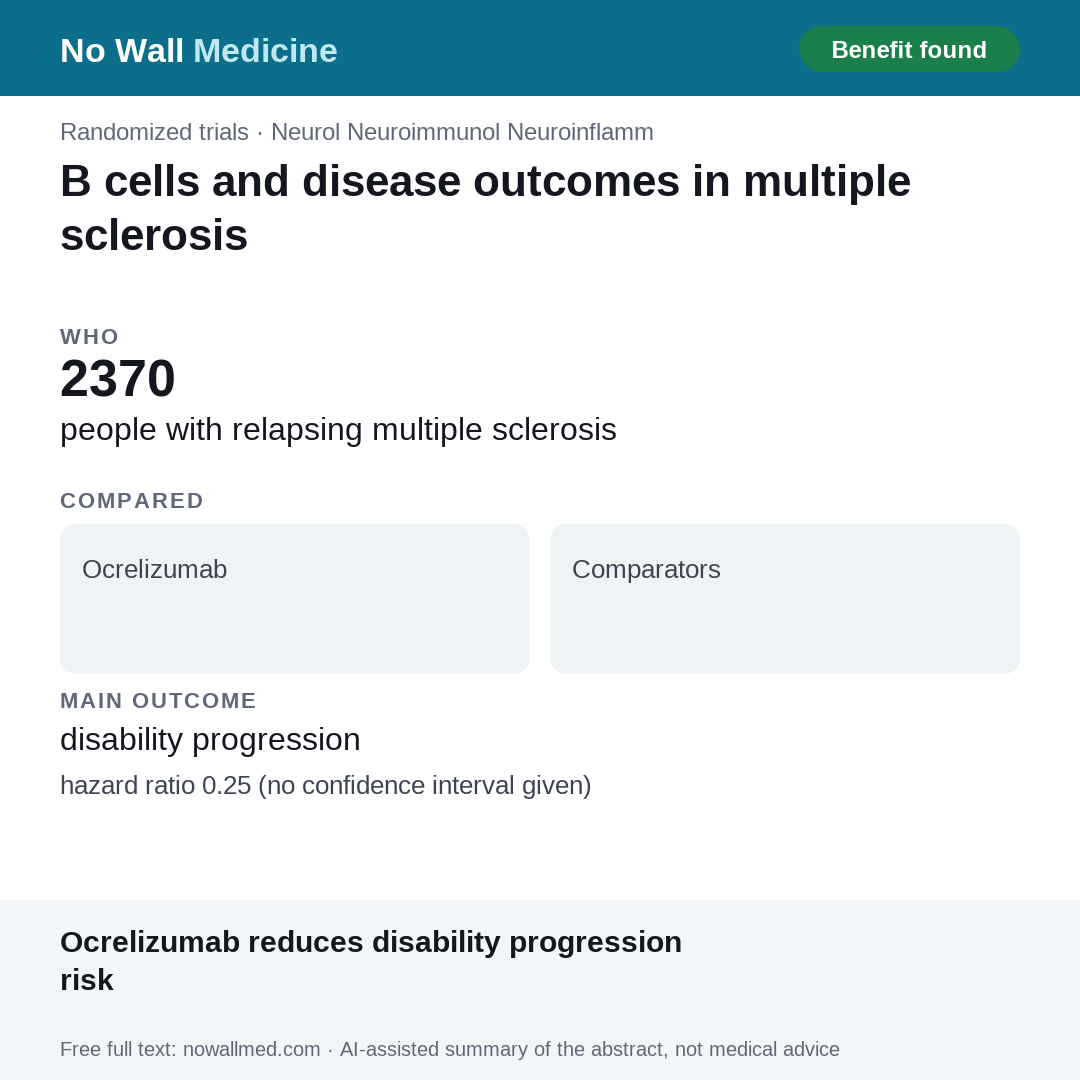
B cells and disease outcomes in multiple sclerosis
Who
2370
people with relapsing multiple sclerosis
Compared
Ocrelizumab
Comparators
Main outcome
disability progression
Result: hazard ratio 0.25 (no confidence interval given)
Bottom line: Ocrelizumab reduces disability progression risk
Neurol Neuroimmunol Neuroinflamm · 2026-11-12Download image
Why it matters: Doctors have had limited understanding of B-cell relationships to disease outcomes in multiple sclerosis
Key points
- Researchers studied 2,370 people with multiple sclerosis in 3 Phase 3 trials.
- People with detectable B cells after ocrelizumab treatment had greater risk of new lesions.
- High baseline B cells and neurofilament light levels predicted greater risk of disability progression.
Headline and key points written with AI from the paper’s abstract, with every number checked against it. Read the paper before relying on them.
Topics
Cite this article
Hauser SL, Strauli N, Shinoda K, Raievska A, Harp C, Koendgen H. Biomarker Synergy in Relapsing Multiple Sclerosis: Neurofilament Light Chain and B Cells in Relation to Disease Outcomes. Neurol Neuroimmunol Neuroinflamm. 2026. doi:10.1212/NXI.0000000000200665
Spotted a mistake? Suggest a correction