Ten biomarkers show potential for predicting and diagnosing weakness acquired in intensive care units
Biomarkers for intensive care unit-acquired weakness: a systematic review for prediction, diagnosis and prognosis
Systematic reviewMixed results
Can biomarkers predict, diagnose, and prognosticate intensive care unit-acquired weakness?
Who
1176
Critically ill patients
Compared
Six biomarkers: AUC values exceeding 0.80
Four biomarkers: AUC values ranging from 0.60 to 0.80
Main outcome
Diagnostic, predictive, and prognostic accuracy of biomarkers
Bottom line: Ten biomarkers show potential for intensive care unit-acquired weakness assessment, but clinical utility remains inconsistent.
Ann Intensive Care · 2025-07-02Download image
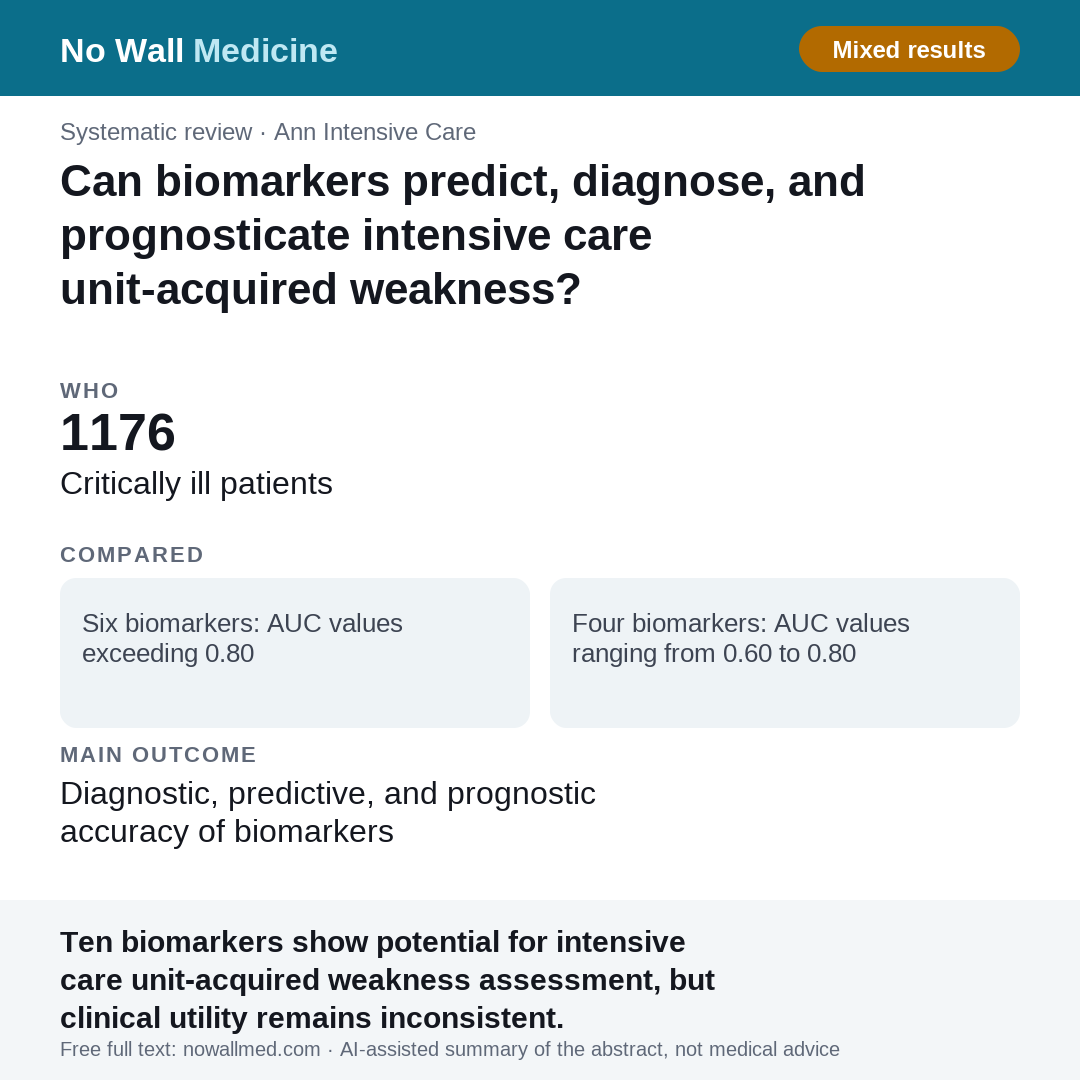
Clinical question: Can biomarkers predict, diagnose, and prognosticate intensive care unit-acquired weakness?
Why it matters: Current diagnostic methods for intensive care unit-acquired weakness are not widely accepted and have a narrow window for application.
Key points
- Researchers reviewed 11 studies involving 1,176 critically ill patients to evaluate biomarkers for intensive care unit-acquired weakness.
- Six biomarkers had strong diagnostic and predictive accuracy with area under the curve values exceeding 0.80.
- Growth differentiation factor-15 showed excellent utility for diagnosis, prediction, and prognosis with an area under the curve of 0.85 or higher.
Limitation the authors note: The clinical utility of the identified biomarkers remains inconsistent, requiring large-scale, prospective validation studies.
Headline and key points written with AI from the paper’s abstract, with every number checked against it. Read the paper before relying on them.
Cite this article
Song J, Deng T, Yu Q, Luo X, Miao Y, Xie L. Biomarkers for intensive care unit-acquired weakness: a systematic review for prediction, diagnosis and prognosis. Ann Intensive Care. 2025. doi:10.1186/s13613-025-01500-9
Spotted a mistake? Suggest a correction