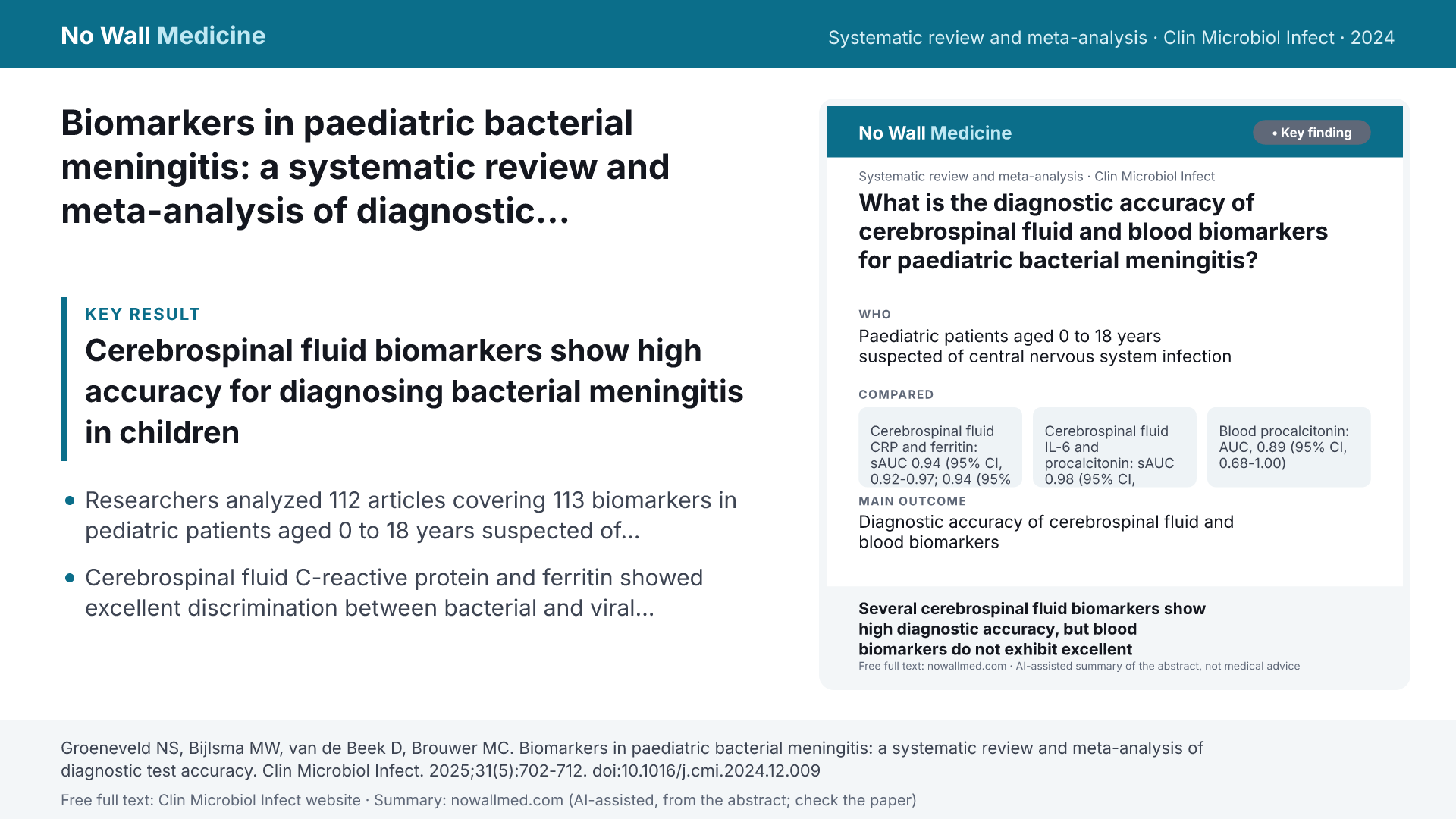
Cerebrospinal fluid biomarkers show high accuracy for diagnosing bacterial meningitis in children
Biomarkers in paediatric bacterial meningitis: a systematic review and meta-analysis of diagnostic test accuracy
Systematic review and meta-analysisKey finding
What is the diagnostic accuracy of cerebrospinal fluid and blood biomarkers for paediatric bacterial meningitis?
Who
Paediatric patients aged 0 to 18 years suspected of central nervous system infection
Compared
Cerebrospinal fluid CRP and ferritin: sAUC 0.94 (95% CI, 0.92-0.97; 0.94 (95% CI, 0.90-1.0))
Cerebrospinal fluid IL-6 and procalcitonin: sAUC 0.98 (95% CI, 0.96-1.00); sAUC 0.96 (95% CI, 0.94-0.99)
Blood procalcitonin: AUC, 0.89 (95% CI, 0.68-1.00)
Main outcome
Diagnostic accuracy of cerebrospinal fluid and blood biomarkers
Bottom line: Several cerebrospinal fluid biomarkers show high diagnostic accuracy, but blood biomarkers do not exhibit excellent discrimination.
Limitation: Validation in prospective, well-designed diagnostic accuracy studies in children is needed.
Clin Microbiol Infect · 2024-12-12 · Save PNG
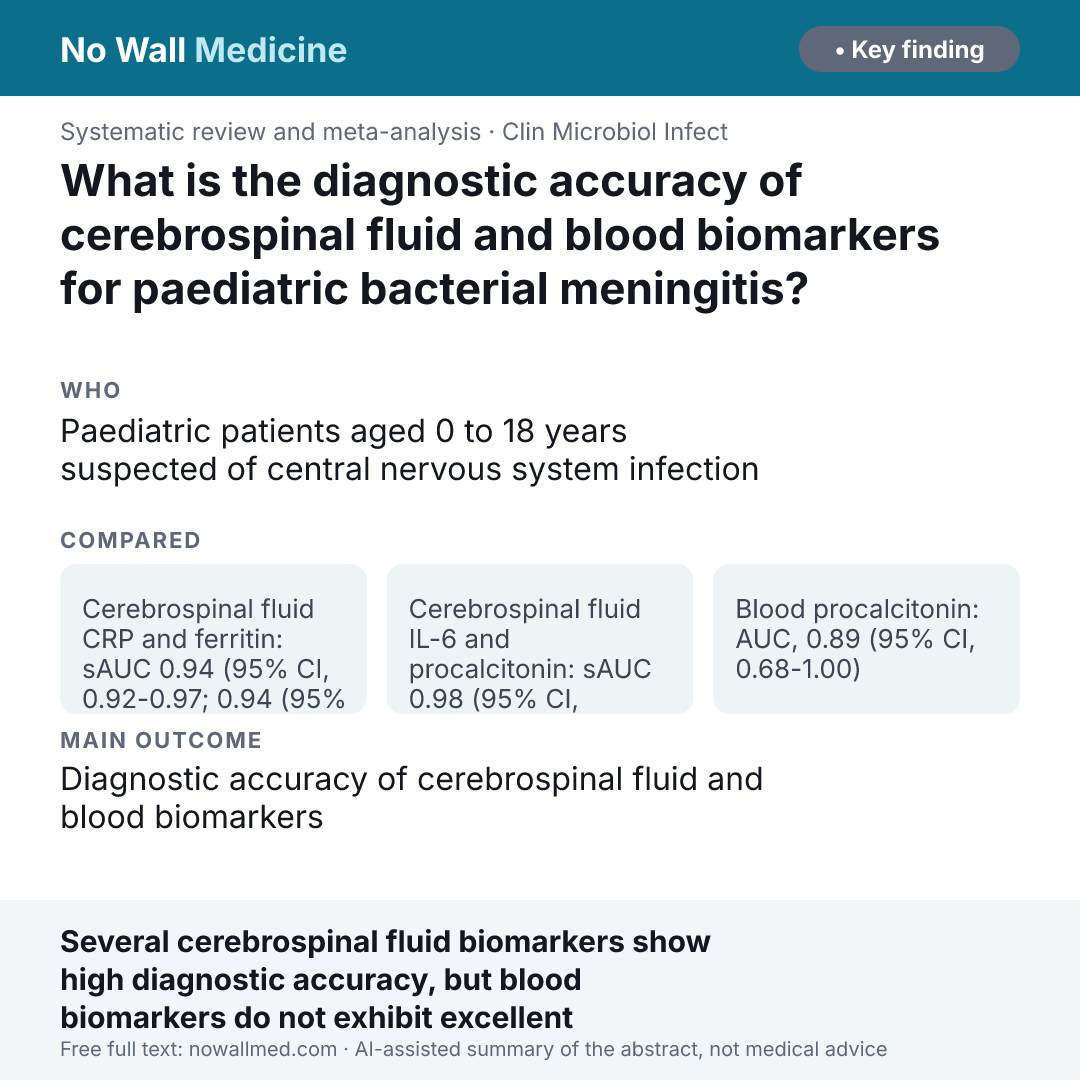
Clinical question: What is the diagnostic accuracy of cerebrospinal fluid and blood biomarkers for paediatric bacterial meningitis?
Why it matters: The diagnostic accuracy of various blood and cerebrospinal fluid biomarkers for identifying bacterial meningitis in children remains to be fully established.
Key points
- Researchers analyzed 112 articles covering 113 biomarkers in pediatric patients aged 0 to 18 years suspected of central nervous system infections.
- Cerebrospinal fluid C-reactive protein and ferritin showed excellent discrimination between bacterial and viral meningitis with a summary area under the curve of 0.94.
- Cerebrospinal fluid interleukin-6 and procalcitonin showed excellent discrimination for bacterial versus nonbacterial meningitis, while blood procalcitonin showed good discrimination with an area under the curve of 0.89.
Limitation the authors note: Validation of these biomarkers is needed in prospective, well-designed diagnostic accuracy studies performed in children with suspected meningitis.
Headline and key points written with AI from the paper’s abstract, with every number checked against it. Read the paper before relying on them.
Was this summary helpful?
Subject terms
Headline, design, result, key points, caveat and citation as plain text.
Cite this article
Groeneveld NS, Bijlsma MW, van de Beek D, Brouwer MC. Biomarkers in paediatric bacterial meningitis: a systematic review and meta-analysis of diagnostic test accuracy. Clin Microbiol Infect. 2025;31(5):702-712. doi:10.1016/j.cmi.2024.12.009
Spotted a mistake? Suggest a correction