Knot configuration, suture material, and number of throws determine surgical knot security
Biomechanics of surgical knot security: a systematic review
Systematic reviewMixed results
What physical factors determine surgical knot security and failure?
Who
In vitro surgical knot configurations
Compared
knot configuration
suture materials
suture sizes
number of throws
Main outcome
knot security and failure mechanisms
Bottom line: Knot configuration, suture materials, sizes, and number of throws are key factors determining knot security.
Int J Surg · 2023-03-01Download image
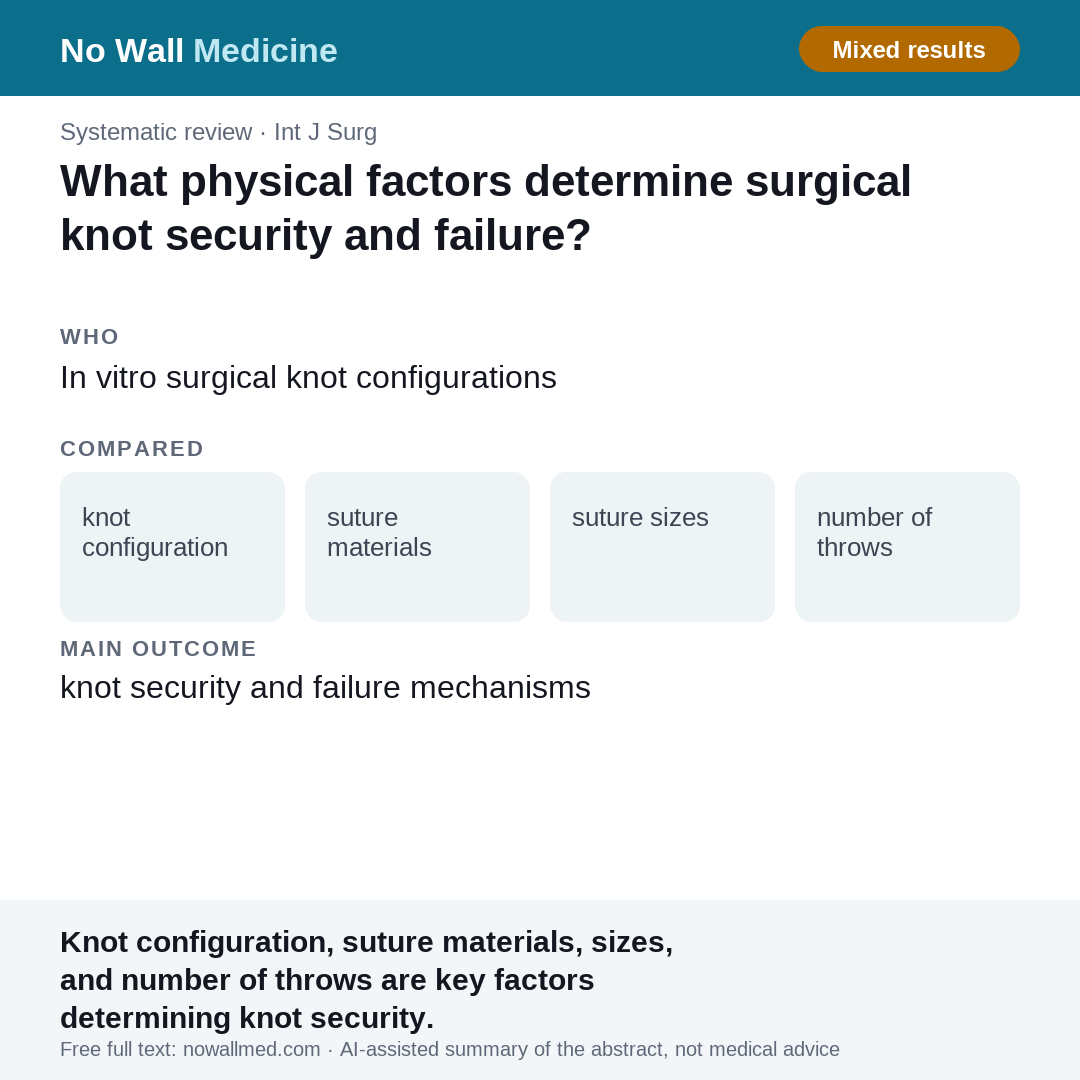
Clinical question: What physical factors determine surgical knot security and failure?
Why it matters: The physical behavior of knots and the factors determining resistance to slippage or rupture are not fully understood for stronger suture materials used in high-tension reconstructive procedures.
Key points
- Researchers reviewed 36 articles covering 24 different configurations of surface, laparoscopic, and arthroscopic knots.
- The review found that knot configuration, suture materials, suture sizes, and the number of throws are key factors in determining knot security.
- Laparoscopic and arthroscopic knots require simple configurations due to the confined space of the operating site.
Headline and key points written with AI from the paper’s abstract, with every number checked against it. Read the paper before relying on them.
Was this summary helpful?
Subject terms
Cite this article
Wong YR, McGrouther DA. Biomechanics of surgical knot security: a systematic review. Int J Surg. 2023. doi:10.1097/JS9.0000000000000298
Spotted a mistake? Suggest a correction
Top studies every Monday
The week’s key trials and guidelines in your specialties, plus any topics you follow. By email, free.
Get the weekly digest