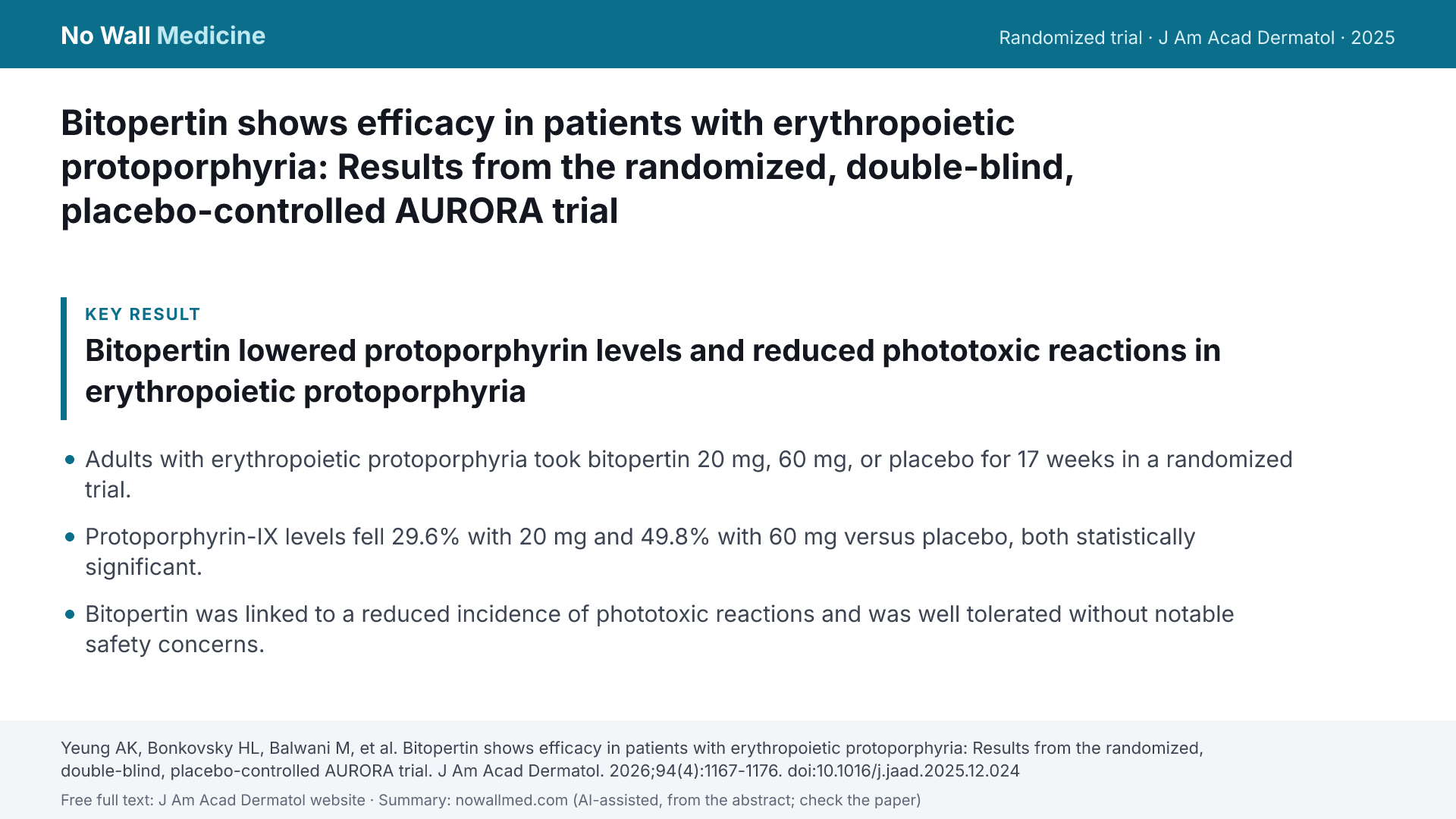
Bitopertin lowered protoporphyrin levels and reduced phototoxic reactions in erythropoietic protoporphyria
Bitopertin shows efficacy in patients with erythropoietic protoporphyria: Results from the randomized, double-blind, placebo-controlled AURORA trial
Why it matters: Applies to adults with erythropoietic protoporphyria; supports bitopertin as a treatment option to lower protoporphyrin levels and improve sunlight tolerance.
Key points
- Adults with erythropoietic protoporphyria took bitopertin 20 mg, 60 mg, or placebo for 17 weeks in a randomized trial.
- Protoporphyrin-IX levels fell 29.6% with 20 mg and 49.8% with 60 mg versus placebo, both statistically significant.
- Bitopertin was linked to a reduced incidence of phototoxic reactions and was well tolerated without notable safety concerns.
Limitation the authors note: The authors noted a small sample size, short follow-up period, and no formal adjustments for multiple comparisons.
Headline and key points written with AI from the paper’s abstract, with every number checked against it. Read the paper before relying on them.
Was this summary helpful?
Subject terms
Headline, design, result, key points, caveat and citation as plain text.
Cite this article
Yeung AK, Bonkovsky HL, Balwani M, et al. Bitopertin shows efficacy in patients with erythropoietic protoporphyria: Results from the randomized, double-blind, placebo-controlled AURORA trial. J Am Acad Dermatol. 2025. doi:10.1016/j.jaad.2025.12.024
Spotted a mistake? Suggest a correction