Blended learning for accredited life support courses - A systematic review
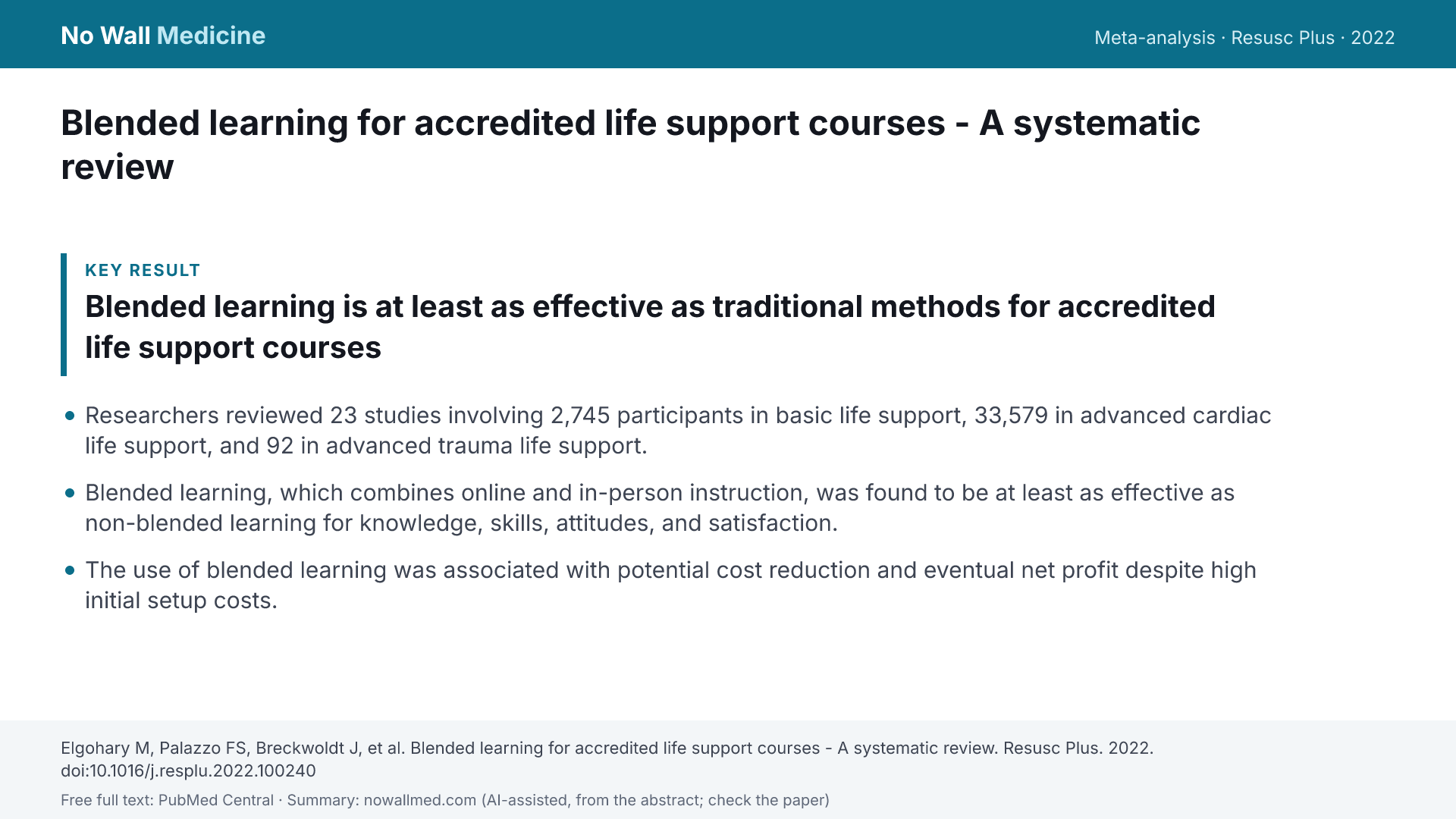
Key result: Blended learning is at least as effective as traditional methods for accredited life support courses
Key points
- Researchers reviewed 23 studies involving 2,745 participants in basic life support, 33,579 in advanced cardiac life support, and 92 in advanced trauma life support.
- Blended learning, which combines online and in-person instruction, was found to be at least as effective as non-blended learning for knowledge, skills, attitudes, and satisfaction.
- The use of blended learning was associated with potential cost reduction and eventual net profit despite high initial setup costs.
Limitation the authors note: The certainty of evidence was very low due to a high risk of bias and inconsistency across the included studies.
Discussion prompts
- Would these patients look like yours? Who was left out?
- Is the main outcome one that matters to patients?
- Is the difference large enough to change what you do?
Cite: Elgohary M, Palazzo FS, Breckwoldt J, et al. Blended learning for accredited life support courses - A systematic review. Resusc Plus. 2022. doi:10.1016/j.resplu.2022.100240
Free full text: PubMed Central · Summary and visual abstract: nowallmed.com/a/blended-learning-for-accredited-life-support-courses-a-systematic-15oxent/ (AI-assisted from the abstract; check the paper before relying on it).