Stopping empagliflozin for 30 days was associated with increased risk of heart failure events
Blinded Withdrawal of Long-Term Randomized Treatment With Empagliflozin or Placebo in Patients With Heart Failure
Randomized, double-blind trialBenefit found
Do the benefits of empagliflozin persist after withdrawal in heart failure patients?
Who
6799
Patients with heart failure with reduced or preserved ejection fraction
Compared
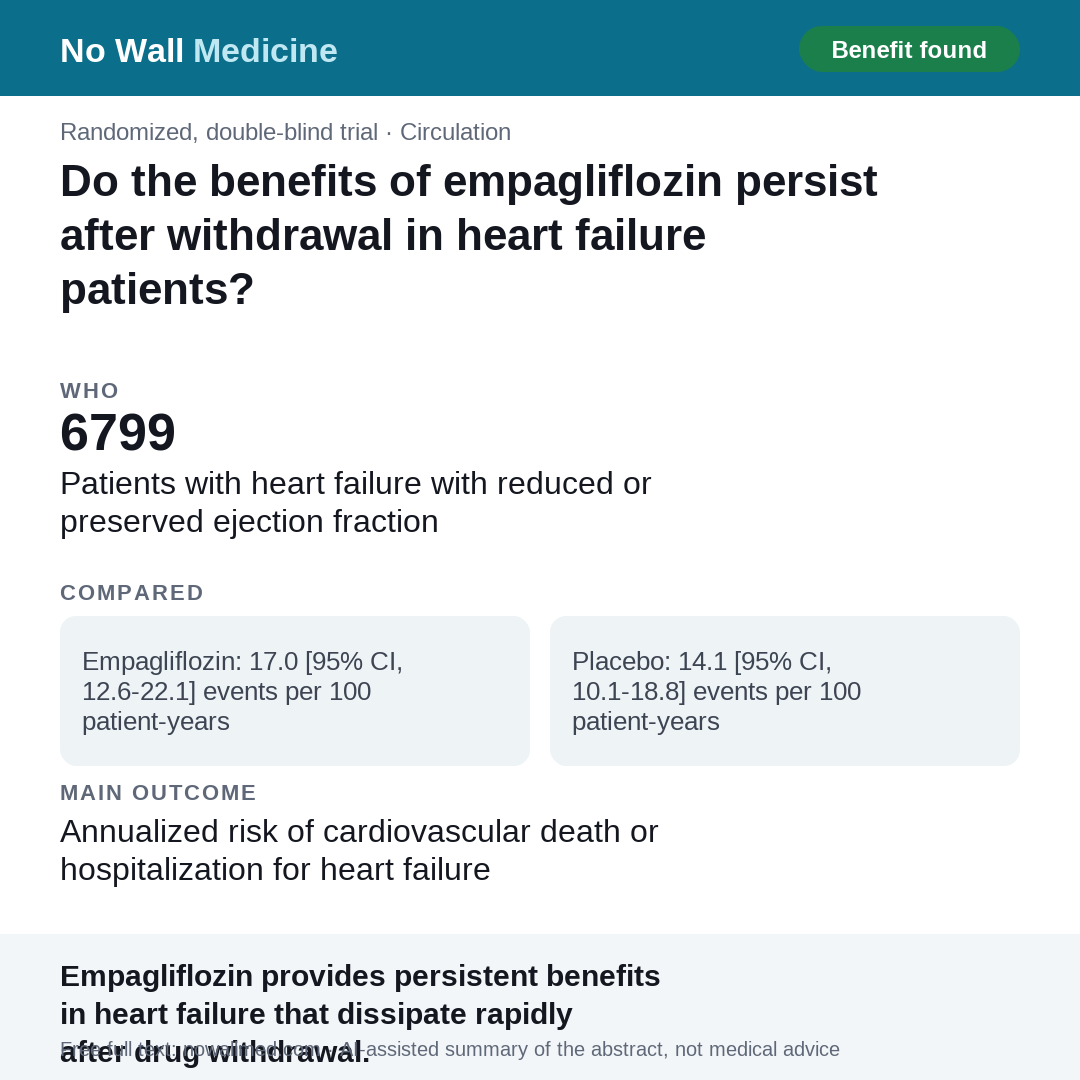
Empagliflozin: 17.0 [95% CI, 12.6-22.1] events per 100 patient-years
Placebo: 14.1 [95% CI, 10.1-18.8] events per 100 patient-years
Main outcome
Annualized risk of cardiovascular death or hospitalization for heart failure
Result: hazard ratio 1.75 (95% CI, 1.20-2.54)
Bottom line: Empagliflozin provides persistent benefits in heart failure that dissipate rapidly after drug withdrawal.
Circulation · 2023-08-24Download image
Clinical question: Do the benefits of empagliflozin persist after withdrawal in heart failure patients?
Why it matters: It is unknown whether the benefits of sodium-glucose cotransporter 2 inhibitors, a class of heart failure medications, persist after years of therapy.
Key points
- Researchers analyzed 6799 patients from the EMPEROR-Reduced and EMPEROR-Preserved trials who were blindedly withdrawn from either empagliflozin or a placebo.
- After 30 days without medication, the annualized risk of cardiovascular death or heart failure hospitalization was 17.0 events per 100 patient-years for those withdrawn from empagliflozin versus 14.1 for placebo.
- Withdrawal of empagliflozin was also associated with increased body weight, blood pressure, and uric acid, alongside a decline in the Kansas City Cardiomyopathy Questionnaire Clinical Summary Score.
Headline and key points written with AI from the paper’s abstract, with every number checked against it. Read the paper before relying on them.
Was this summary helpful?
Subject terms
Cite this article
Packer M, Butler J, Zeller C, Pocock SJ, Brueckmann M, Ferreira JP. Blinded Withdrawal of Long-Term Randomized Treatment With Empagliflozin or Placebo in Patients With Heart Failure. Circulation. 2023. doi:10.1161/CIRCULATIONAHA.123.065748
Spotted a mistake? Suggest a correction
Top studies every Monday
The week’s key trials and guidelines in your specialties, plus any topics you follow. By email, free.
Get the weekly digest