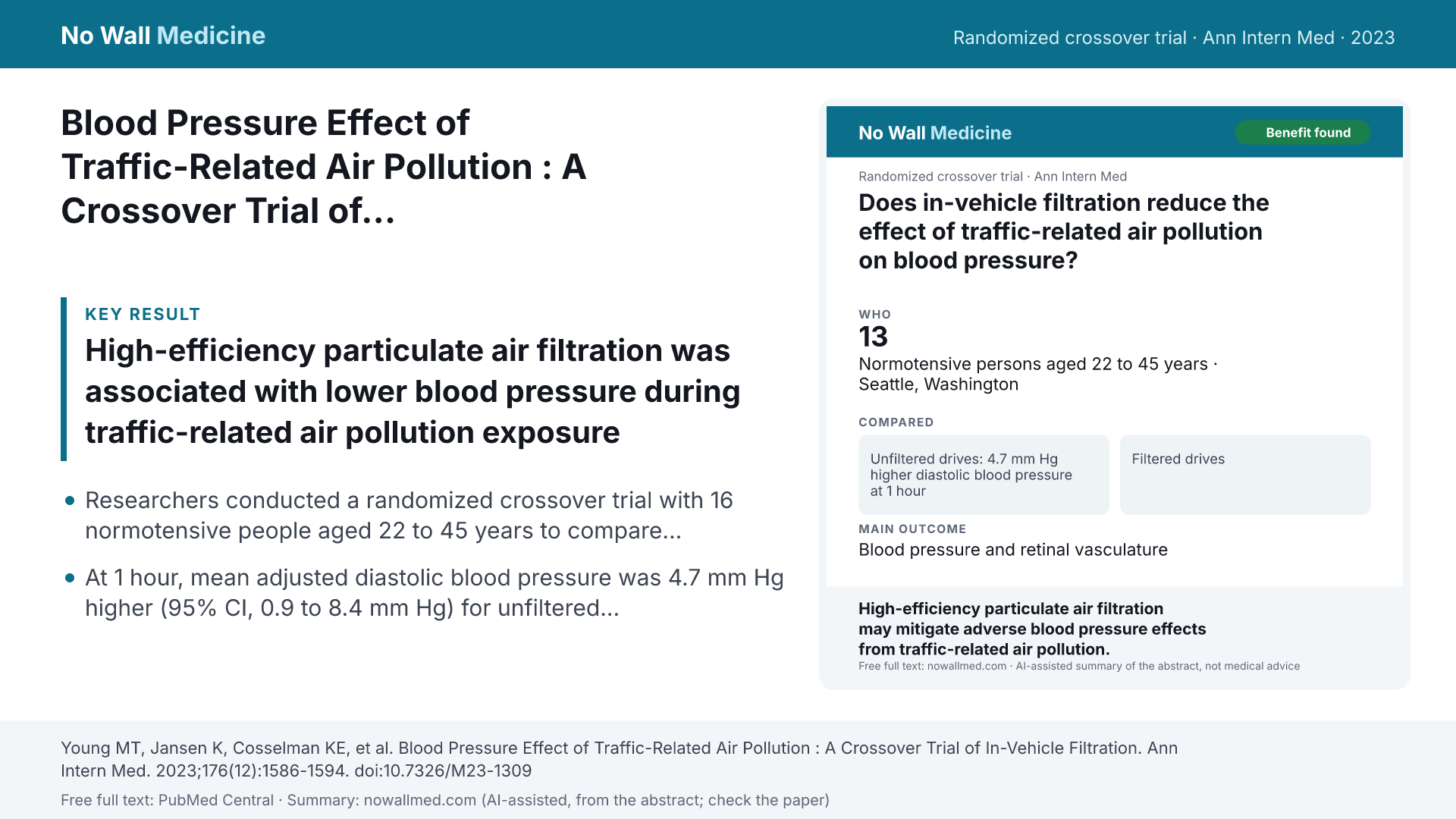
High-efficiency particulate air filtration was associated with lower blood pressure during traffic-related air pollution exposure
Blood Pressure Effect of Traffic-Related Air Pollution : A Crossover Trial of In-Vehicle Filtration
Randomized crossover trialBenefit found
Does in-vehicle filtration reduce the effect of traffic-related air pollution on blood pressure?
Who
13
Normotensive persons aged 22 to 45 years · Seattle, Washington
Compared
Unfiltered drives: 4.7 mm Hg higher diastolic blood pressure at 1 hour
Filtered drives
Main outcome
Blood pressure and retinal vasculature
Result: 4.7 mm Hg higher (95% CI, 0.9 to 8.4 mm Hg)
Bottom line: High-efficiency particulate air filtration may mitigate adverse blood pressure effects from traffic-related air pollution.
Limitation: Imprecise estimates due to small sample size; seasonal imbalance by exposure order.
Funded by: U.S. Environmental Protection Agency and National Institutes of Health
Ann Intern Med · 2023-11-28 · Save PNG
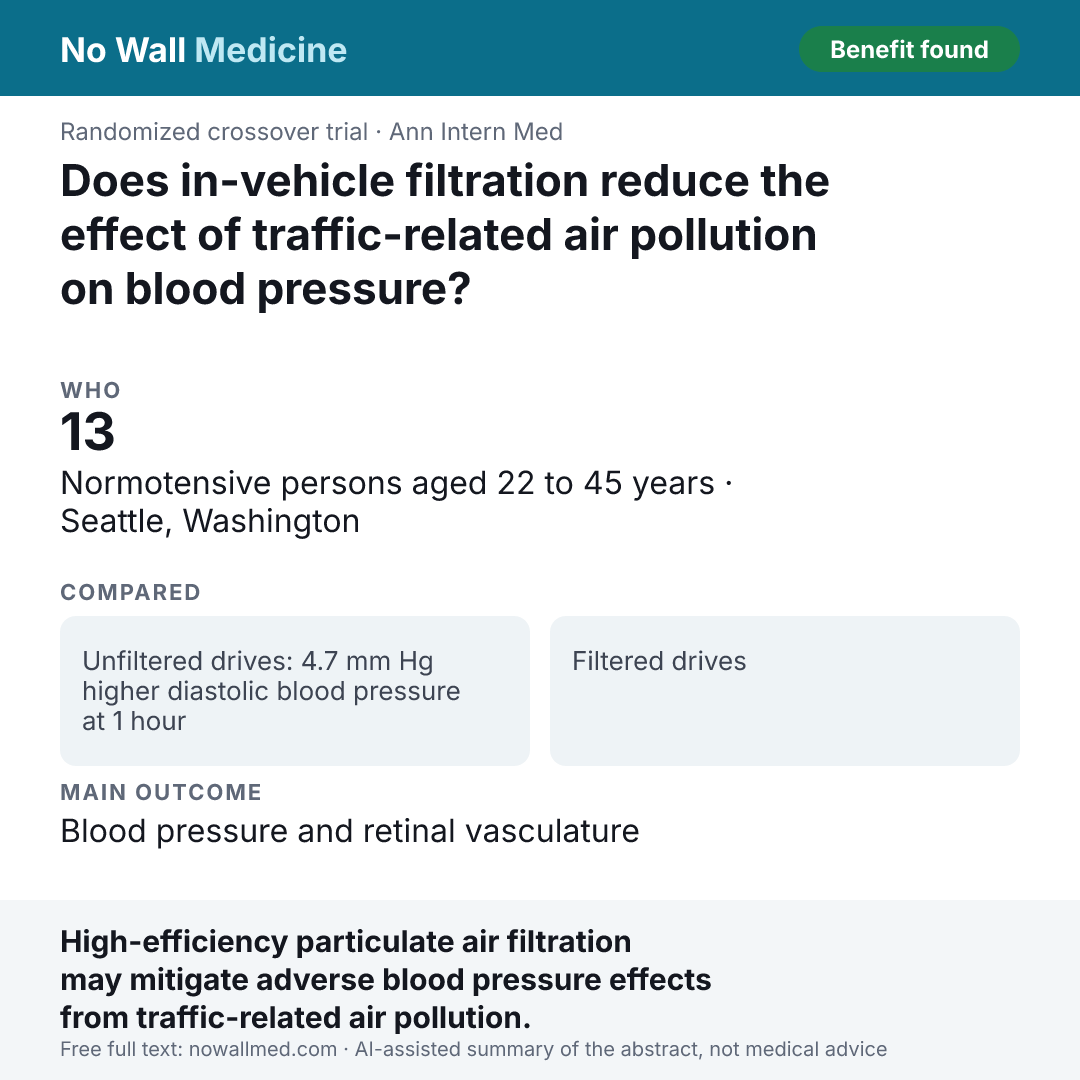
Clinical question: Does in-vehicle filtration reduce the effect of traffic-related air pollution on blood pressure?
Why it matters: Limited information exists regarding how traffic-related air pollution exposure inside vehicles affects blood pressure and retinal vasculature.
Key points
- Researchers conducted a randomized crossover trial with 16 normotensive people aged 22 to 45 years to compare unfiltered air with high-efficiency particulate air filtration during commutes.
- At 1 hour, mean adjusted diastolic blood pressure was 4.7 mm Hg higher (95% CI, 0.9 to 8.4 mm Hg) for unfiltered drives compared with filtered drives.
- At 24 hours, mean adjusted diastolic blood pressure for unfiltered drives was 3.8 mm Hg higher (CI, 0.02 to 7.5 mm Hg) than for filtered drives.
Limitation the authors note: The authors state that the study had imprecise estimates due to a small sample size and seasonal imbalance by exposure order.
Headline and key points written with AI from the paper’s abstract, with every number checked against it. Read the paper before relying on them.
Was this summary helpful?
Subject terms
Headline, design, result, key points, caveat and citation as plain text.
Cite this article
Young MT, Jansen K, Cosselman KE, et al. Blood Pressure Effect of Traffic-Related Air Pollution : A Crossover Trial of In-Vehicle Filtration. Ann Intern Med. 2023;176(12):1586-1594. doi:10.7326/M23-1309
Spotted a mistake? Suggest a correction