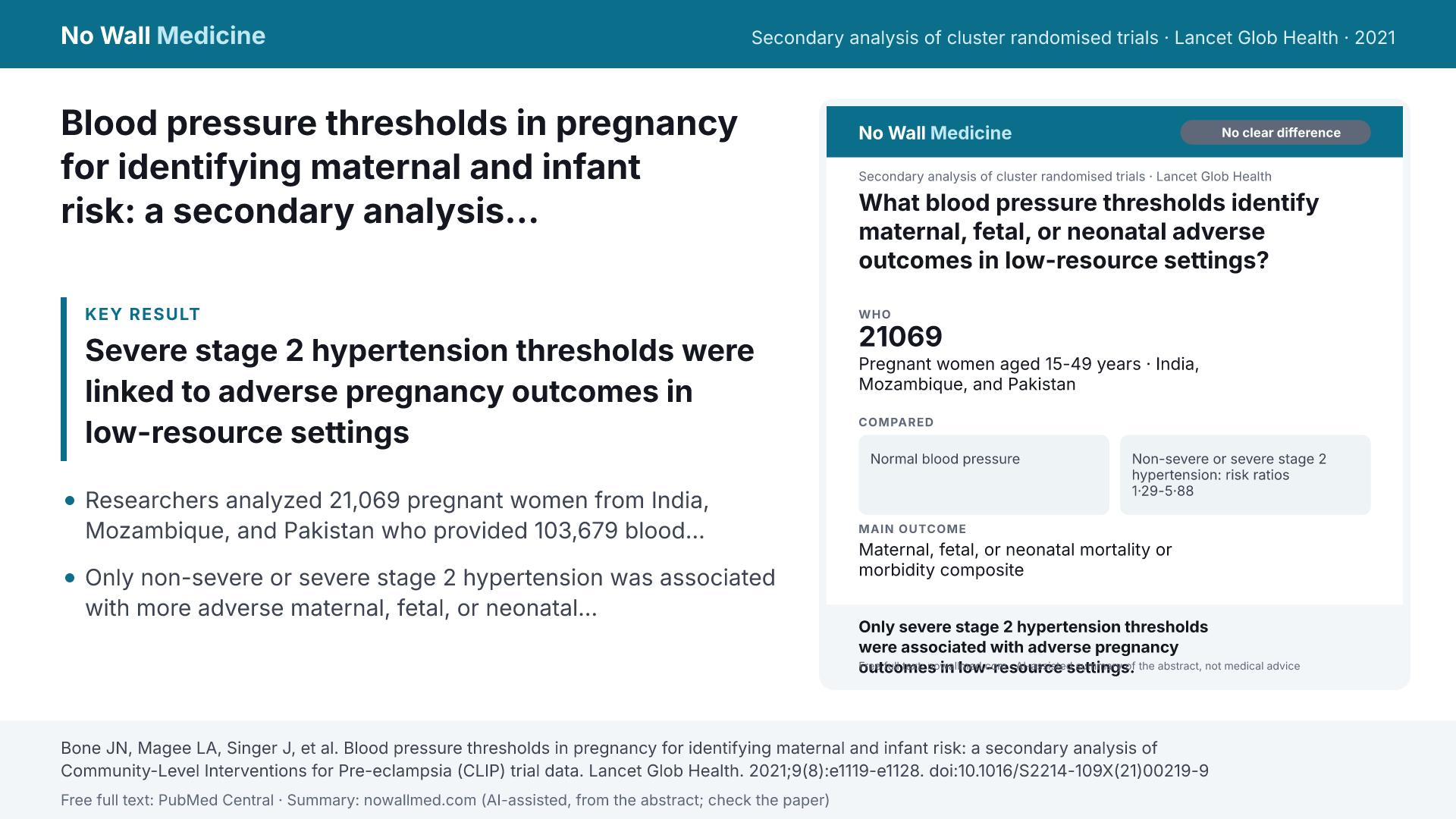
Severe stage 2 hypertension thresholds were linked to adverse pregnancy outcomes in low-resource settings
Blood pressure thresholds in pregnancy for identifying maternal and infant risk: a secondary analysis of Community-Level Interventions for Pre-eclampsia (CLIP) trial data
Secondary analysis of cluster randomised trialsNo clear difference
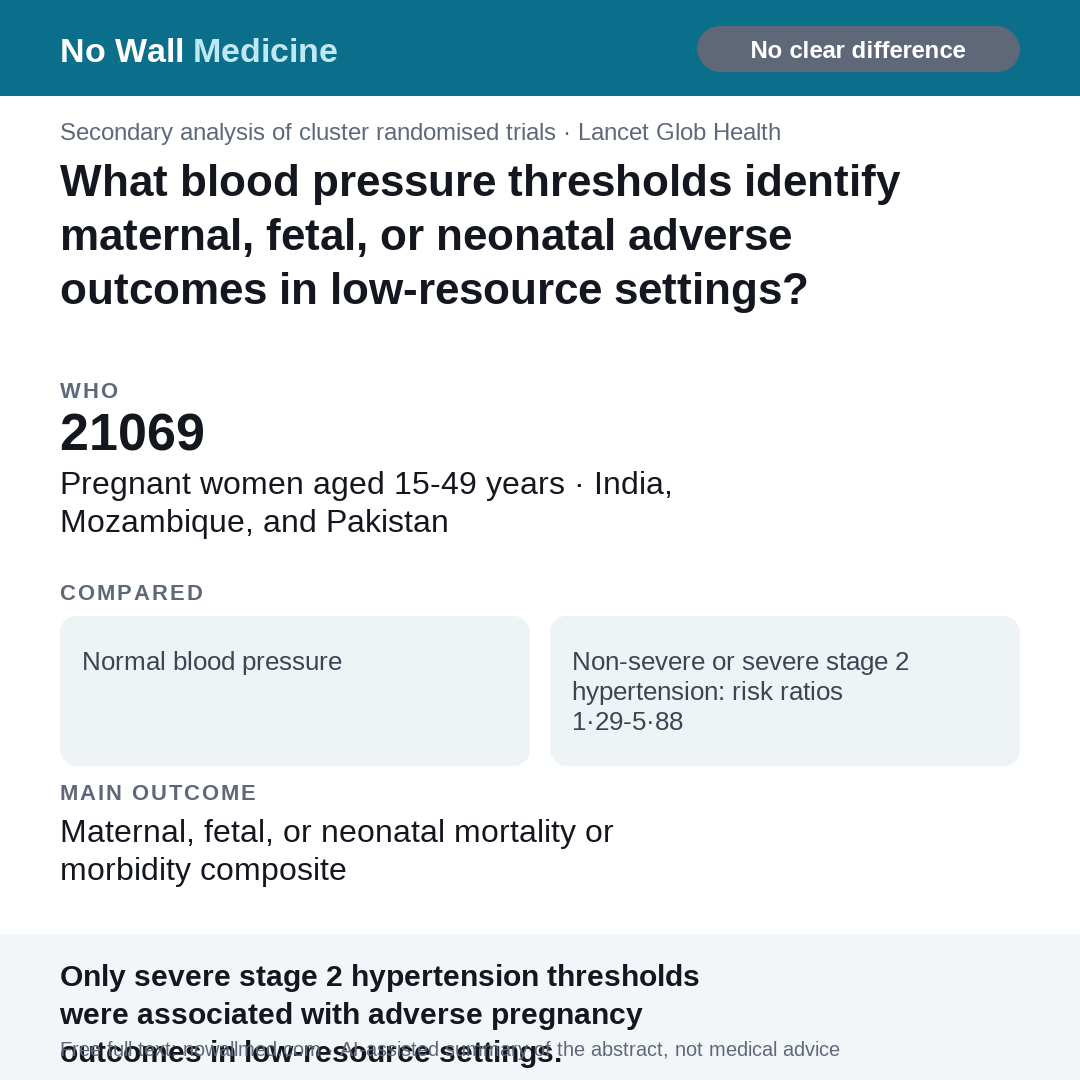
What blood pressure thresholds identify maternal, fetal, or neonatal adverse outcomes in low-resource settings?
Who
21069
Pregnant women aged 15-49 years · India, Mozambique, and Pakistan
Compared
Normal blood pressure
Non-severe or severe stage 2 hypertension: risk ratios 1·29-5·88
Main outcome
Maternal, fetal, or neonatal mortality or morbidity composite
Result: likelihood ratio 6·36 (95% CI 3·65 to 11·07) for maternal CNS events
Bottom line: Only severe stage 2 hypertension thresholds were associated with adverse pregnancy outcomes in low-resource settings.
Funded by: University of British Columbia, Bill & Melinda Gates Foundation
Lancet Glob Health · 2021-07-05Download image
Clinical question: What blood pressure thresholds identify maternal, fetal, or neonatal adverse outcomes in low-resource settings?
Why it matters: It is unknown if lower blood pressure cutoffs for hypertension are associated with adverse pregnancy outcomes in low-resource settings.
Key points
- Researchers analyzed 21,069 pregnant women from India, Mozambique, and Pakistan who provided 103,679 blood pressure measurements.
- Only non-severe or severe stage 2 hypertension was associated with more adverse maternal, fetal, or neonatal outcomes compared to normal blood pressure.
- Severe stage 2 hypertension was associated with maternal central nervous system events and a likelihood ratio of 5.07 for perinatal death.
Headline and key points written with AI from the paper’s abstract, with every number checked against it. Read the paper before relying on them.
Was this summary helpful?
Abstract
Background
Blood pressure measurement is a marker of antenatal care quality. In well resourced settings, lower blood pressure cutoffs for hypertension are associated with adverse pregnancy outcomes. We aimed to study the associations between blood pressure thresholds and adverse outcomes and the diagnostic test properties of these blood pressure cutoffs in low-resource settings. Methods
We did a secondary analysis of data from 22 intervention clusters in the Community-Level Interventions for Pre-eclampsia (CLIP) cluster randomised trials (NCT01911494) in India (n=6), Mozambique (n=6), and Pakistan (n=10). We included pregnant women aged 15-49 years (12-49 years in Mozambique), identified in their community by trained community health workers, who had data on blood pressure measurements and outcomes. The trial was unmasked. Maximum blood pressure was categorised as: normal blood pressure (systolic blood pressure [sBP] <120 mm Hg and diastolic blood pressure [dBP] <80 mm Hg), elevated blood pressure (sBP 120-129 mm Hg and dBP <80 mm Hg), stage 1 hypertension (sBP 130-139 mm Hg or dBP 80-89 mm Hg, or both), non-severe stage 2 hypertension (sBP 140-159 mm Hg or dBP 90-109 mm Hg, or both), or severe stage 2 hypertension (sBP ≥160 mm Hg or dBP ≥110 mm Hg, or both). We classified women according to the maximum blood pressure category reached across all visits for the primary analyses. The primary outcome was a maternal, fetal, or neonatal mortality or morbidity composite. We estimated dose-response relationships between blood pressure category and adverse outcomes, as well as diagnostic test properties. Findings
Between Nov 1, 2014, and Feb 28, 2017, 21 069 women (6067 in India, 4163 in Mozambique, and 10 839 in Pakistan) contributed 103 679 blood pressure measurements across the three CLIP trials. Only women with non-severe or severe stage 2 hypertension, as discrete diagnostic categories, experienced more adverse outcomes than women with normal blood pressure (risk ratios 1·29-5·88). Using blood pressure categories as diagnostic thresholds (women with blood pressure within the category or any higher category vs those with blood pressure in any lower category), dose-response relationships were observed between increasing thresholds and adverse outcomes, but likelihood ratios were informative only for severe stage 2 hypertension and maternal CNS events (likelihood ratio 6·36 [95% CI 3·65-11·07]) and perinatal death (5·07 [3·64-7·07]), particularly stillbirth (8·53 [5·63-12·92]). Interpretation
In low-resource settings, neither elevated blood pressure nor stage 1 hypertension were associated with maternal, fetal, or neonatal mortality or morbidity adverse composite outcomes. Only the threshold for severe stage 2 hypertension met diagnostic test performance standards. Current diagnostic thresholds for hypertension in pregnancy should be retained. Funding
University of British Columbia, the Bill & Melinda Gates Foundation.
Abstract reproduced under the article’s CC BY licence.
Subject terms
Cite this article
Bone JN, Magee LA, Singer J, et al. Blood pressure thresholds in pregnancy for identifying maternal and infant risk: a secondary analysis of Community-Level Interventions for Pre-eclampsia (CLIP) trial data. Lancet Glob Health. 2021. doi:10.1016/S2214-109X(21)00219-9
Spotted a mistake? Suggest a correction