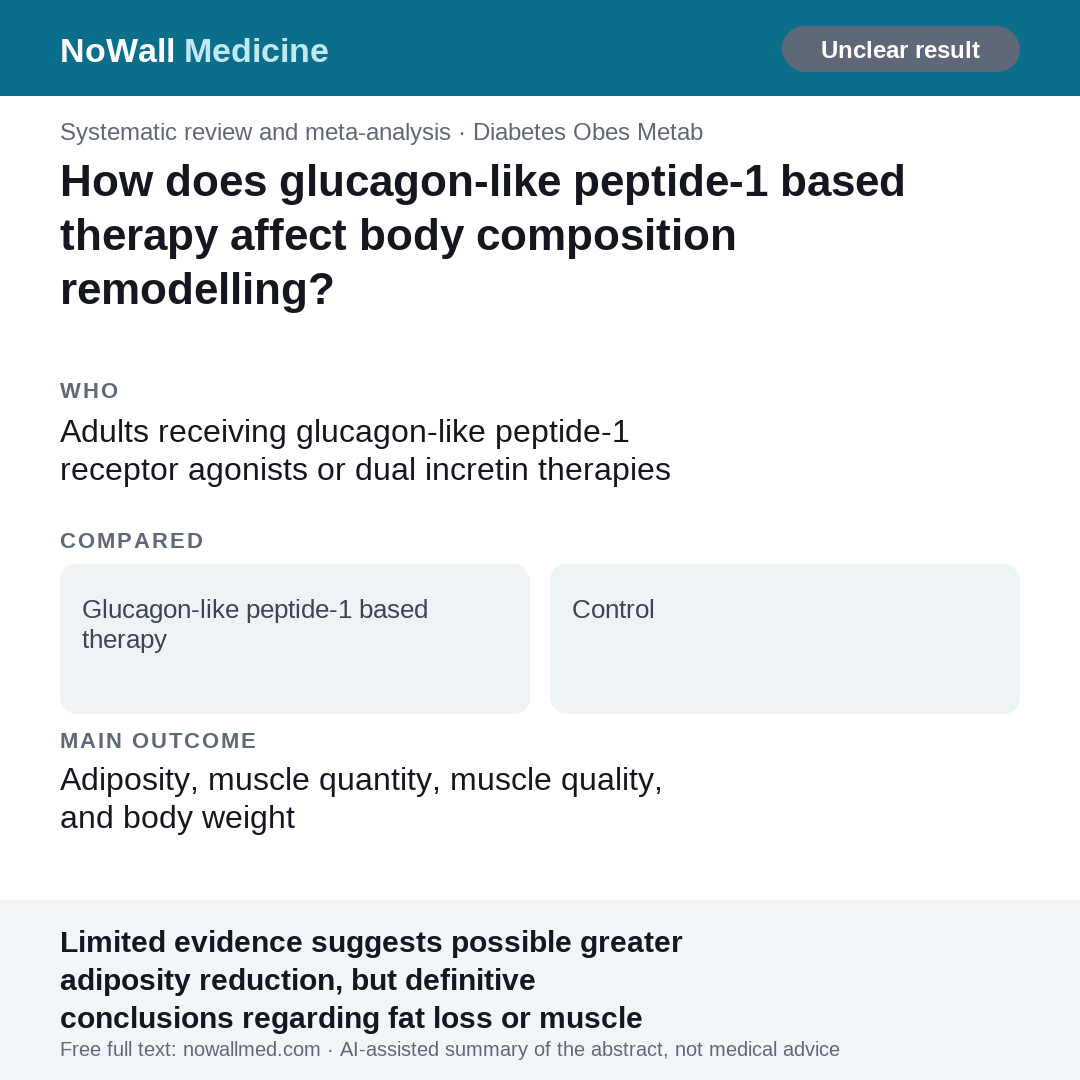
How does glucagon-like peptide-1 based therapy affect body composition remodelling?
Who
Adults receiving glucagon-like peptide-1 receptor agonists or dual incretin therapies
Compared
Glucagon-like peptide-1 based therapy
Control
Main outcome
Adiposity, muscle quantity, muscle quality, and body weight
Bottom line: Limited evidence suggests possible greater adiposity reduction, but definitive conclusions regarding fat loss or muscle preservation cannot be made.
Limitation: Limited number of comparative studies, substantial heterogeneity, and low certainty of evidence.
Clinical question: How does glucagon-like peptide-1 based therapy affect body composition remodelling?
Why it matters: Body composition changes during GLP-1-based therapy remain incompletely characterized
Key points
Nineteen studies with comparative and single-arm investigations were analyzed.
Three comparative studies suggested greater reductions in adiposity during GLP-1-based therapy, but with substantial heterogeneity.
Evidence on muscle quantity and quality was highly heterogeneous and imprecise, with variable changes across studies.
Limitation the authors note: The limited number of comparative studies, substantial between-study heterogeneity, and low to very low certainty of evidence preclude definitive conclusions
Headline and key points written with AI from the paper’s abstract, with every number checked against it. Read the paper before relying on them.